


California Closets Alternatives in the Bay Area
Franchise, modular, DIY, or a local design studio — how each option works and how to choose a custom closet builder.
There are four ways to get a better closet, and the right one depends less on your budget than on how irregular the space is. DIY components suit a standard reach-in you're willing to build. Modular track systems suit renters and changing needs. National franchises sell design plus installation under a national brand. A local design studio offers design under one local roof. Which of these suits your closet comes down to the room itself and the written scope each company will put in front of you.
If you are weighing a franchise quote against the alternatives, it helps to know how each of the four works, what you are actually paying for, and which questions separate a good plan from an expensive one. That is what this guide covers.
Your four real options
1. DIY with basic components. A rod, shelving, some paint. For a simple reach-in, if you're handy, this is legitimately fine.
2. Modular systems (Elfa, big-box custom programs). Adjustable track-and-shelf systems, usually the least expensive option after DIY. Well suited to closets whose needs change, and worth a look for renters. Limits: the look of exposed track and shelving, and the weight each shelf or rail is rated for. Whether anyone designs or installs it for you depends on the retailer's program, so ask what is included before you buy.
3. National franchise brands (California Closets, Closets by Design). Both brands operate through franchised locations; California Closets notes that each franchise is independently owned and operated and that it also has corporate-owned locations. The offer is typically a designer visit, design drawings, manufactured panels and installation; confirm what your location includes. As with any franchise, the experience depends on the local location — read reviews for the branch that would actually serve you.
4. A local design studio. Design happens under one local roof. Ask the same questions you would ask a franchise: who measures, who installs, and who handles a callback if something needs adjusting after the install.
If your question is narrower — specifically whether IKEA's Pax system can do what fitted work does — that comparison has its own product-versus-product breakdown.
How the price picture works
Cost generally follows the order of the list above: DIY components cost least, self-designed modular systems come next, and fitted closets and wardrobe walls sit at the top, driven by drawer count, door fronts, and finishes.
Headline numbers are hard to compare because two quotes rarely describe the same closet. One may include drawers, lighting and installation; another may quote panels only. Get written quotes for the same closet from more than one company, ask each to name the panel material, the drawer slides and hinges, and what installation covers, and compare them line by line.
What actually separates a good closet from an expensive one
Whatever you pay, the plan is a large part of what you're buying, and it's where projects succeed or fail:
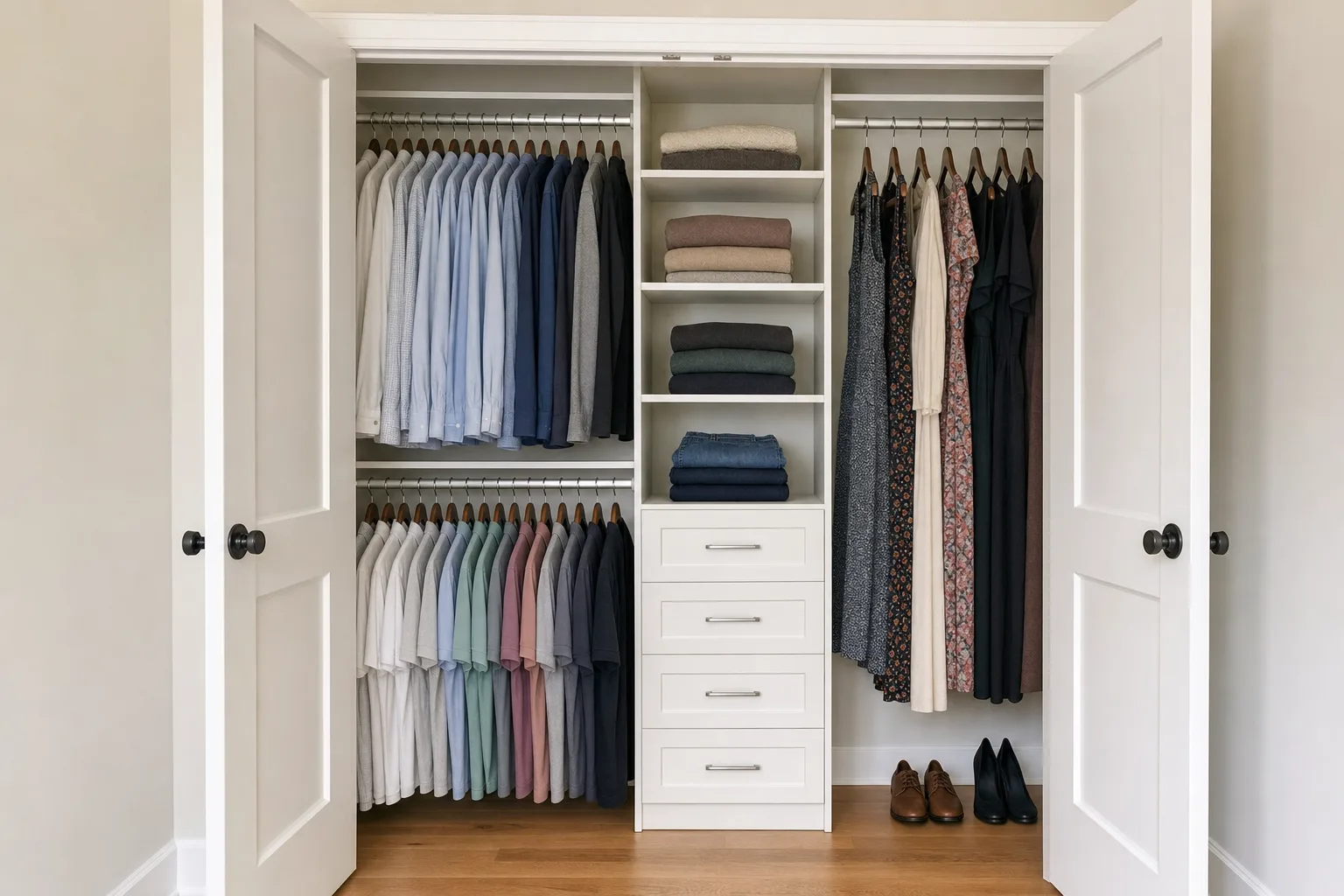
- An inventory-first design. Long-hang versus double-hang ratio, shoe count, drawer depth for what you fold versus hang. A designer who doesn't ask what you own is decorating, not designing. The method is spelled out in our walk-in design guide.
- Vertical space. Measure your ceiling height and decide what the space above the top rod is for. If you can reach it safely with a step stool, it can hold seasonal storage; if you can't, a shelf there may go unused.
- Drawers where drawers belong. Folded knits and small items are easier to find in drawers than on deep shelves. Ask to see the drawer slides and open a drawer fully — slide quality is easy to judge in person.
- Lighting and sight lines. A closet you can't see into is a closet you don't use. That's a design decision, not an accessory.
The design appointment, decoded
Whether it's a franchise visit or a local studio, a design consultation tends to cover the same ground. Knowing what to look for turns a sales meeting into a working session:
- The measure. Anyone can tape a wall. The useful version also counts hanging clothes by length, shoes, and folded stacks — if that inventory never happens, the design is generic.
- The render. 3D drawings are persuasive. Look past the render to the elevation: shelf depths, drawer counts, and what happens in the corners.
- The price reveal. If any company presents a price valid "today only," treat it as a sales tactic — a real quote survives a week of thinking.
- The revision. The most informative moment: ask for one change and watch how the design and the price respond. A designer who defends the plan with reasons is worth hiring; one who simply re-discounts is negotiating.
Take the drawings home. Comparing two designs for the same closet teaches you more about both companies than any review thread.
What to measure before any appointment
You will get more out of any consultation if you arrive with the basics. Measure wall-to-wall width at the back and at the door opening, depth from the back wall to the door frame, and floor-to-ceiling height. Note the door swing, any light switch or outlet, attic hatches, and anything that juts out, like a sloped ceiling or a window. Then count what you own: how many long items (dresses, coats), how many short items (shirts, jackets), how many pairs of shoes you want visible, and how many folded stacks. Photos of the empty closet and of your current overflow help a designer see what the numbers can't.
Questions that sort the field fast
- "Who does the design, and who installs?" You want both answerable by name, plus a clear answer on who is responsible if the install goes wrong.
- "What happens when a drawer sticks two years from now?" Ask who you call and whether the warranty is in writing.
- "Can I see the drawer hardware?" Slides and hinges are easy to compare in person.
- "What would you cut from my quote?" A designer who can name the low-value items in their own proposal is designing for you, not for commission.
When to skip the pros entirely
A standard reach-in with ordinary storage needs doesn't require a design studio. A modular kit or a weekend of DIY can serve it well, and we would rather you spend that budget where design changes daily life — a walk-in that has never worked, a bedroom wall that could become a wardrobe, a pantry drowning in overflow, or the kitchen, where storage planning gets used every single day.
Walk-in and reach-in closets, pantries, laundry and home-office storage are what our closet and storage studio designs: space planning first, then cabinetry specified around the inventory you actually own — the same discipline we bring to kitchens. For trades we do not provide, we connect you with partners we work with regularly. See what the custom closets service covers, or book a design consultation and bring your measurements and photos of your worst closet.
FAQ: Custom closets in the Bay Area
How do custom closet quotes compare with California Closets?
Only a written quote for your closet can answer that. Ask each company — franchise or local — to specify panel material, drawer slides, hinges, accessories and installation, then compare the quotes line by line rather than by the headline number.
Are custom closets worth it for a small reach-in?
Often not. A modular system or simple DIY can handle a standard reach-in well. Custom earns its cost where geometry is awkward, storage pressure is high, or the closet doubles as furniture — walk-ins, wardrobe walls, and odd corners.
Do custom closets add resale value in the Bay Area?
Treat resale as a possible bonus, not the business case. Buy the closet because you open it every day.
How long does a custom closet project take?
It varies by company, design and materials. Ask each company for a written schedule covering design, manufacturing and installation dates before you sign.
Can a closet system work in a rental?
It can, with care. Modular systems are designed to be adjustable, and some can be taken down and reused, but they still fasten to the wall. Get your landlord's permission, follow the system's installation instructions for your wall type, and plan for patching when you move out. Save the built-ins for a home you own.
Does the same approach work for pantries?
Yes. Pantries reward shallow shelving — deep shelves let food hide two rows back — plus drawer baskets and door storage. The design logic is identical to a closet: inventory first, vertical space used as far as you can safely reach, and drawers where you'd otherwise stack.
What's a common mistake in DIY closet projects?
Hanging everything at one height. A single rod leaves unused space below short items like shirts. Double-hang where your clothes allow it, keep one long-hang section for dresses and coats, and put shelving above.
About the author
Anthony
Design Lead, Excelle Kitchen & Bath
Leads cabinetry and storage design at Excelle Kitchen & Bath, a design studio with a San Jose showroom serving the Bay Area. Ten years of kitchen and custom storage projects, specialising in space planning, semi-custom cabinetry specification, and closet systems.