


Custom vs Premade Cabinets: An Honest Comparison
A San Jose design studio compares custom and premade cabinet lines honestly: cost, lead time, and when each makes sense for your kitchen.
Two Real Paths to a Finished Kitchen
Walk into any cabinet showroom and you'll hear two words tossed around like they mean the same thing: "custom" and "semi-custom" or "premade." They don't. At Excelle Kitchen & Bath in San Jose, we sell both, and we'd rather tell you honestly which one fits your project than upsell you into something you don't need.
Premade cabinet lines, sometimes called stock or semi-custom depending on how much modification the manufacturer allows, are built in standard width increments, usually 3-inch steps, with a set menu of door styles, finishes, and box configurations. Brands we carry like Shiloh, Eclipse, Bellmont, J&K, and Boxy all fall into this category, and most of them let you adjust depth, add a filler panel, or swap a drawer bank within their published options.
Fully custom cabinetry, which we build under our own Excelle line, is made to the exact dimensions of your space. No filler panels bridging awkward gaps, no compromise on a 34-inch-wide run when your wall measures 34.5. If your kitchen has an odd angle, a low soffit, or you want a specific storage insert nobody makes off the shelf, custom is how you get it built right the first time.
Neither option is "better" in the abstract. The right call depends on your walls, your timeline, and your budget, and we'll walk through all three below so you can make the call with your eyes open.
When Premade Cabinets Are the Smart Choice
Premade lines earn their reputation for a reason: they're fast, they're proven, and for most standard kitchens, they look every bit as good as custom once installed. If your kitchen has conventional wall dimensions and ceiling heights, a modification-friendly stock line can hit the same visual result as fully custom cabinetry for meaningfully less.
Lead time is the other big factor. Custom orders take longer to engineer and build because every box is drawn from scratch. Premade lines run on established production schedules, which typically means a shorter wait between placing your order and seeing cabinets show up for your project. If you're working around a tight timeline, that difference matters.
Premade also shines when you want proven consistency. These manufacturer lines have been refined over thousands of installs, so the finish quality, hinge tolerances, and drawer glide performance are well documented. You can see and touch the actual door samples and finish options in our San Jose showroom before committing, which takes a lot of guesswork out of the decision.
The tradeoff is flexibility. If your galley kitchen is 30.75 inches deep instead of a standard 30 or your island needs a nonstandard corner solution, you'll be working within the modification menu the manufacturer allows, not building whatever you can imagine. For the majority of straightforward kitchen layouts, though, that menu is wide enough that most homeowners never feel boxed in.
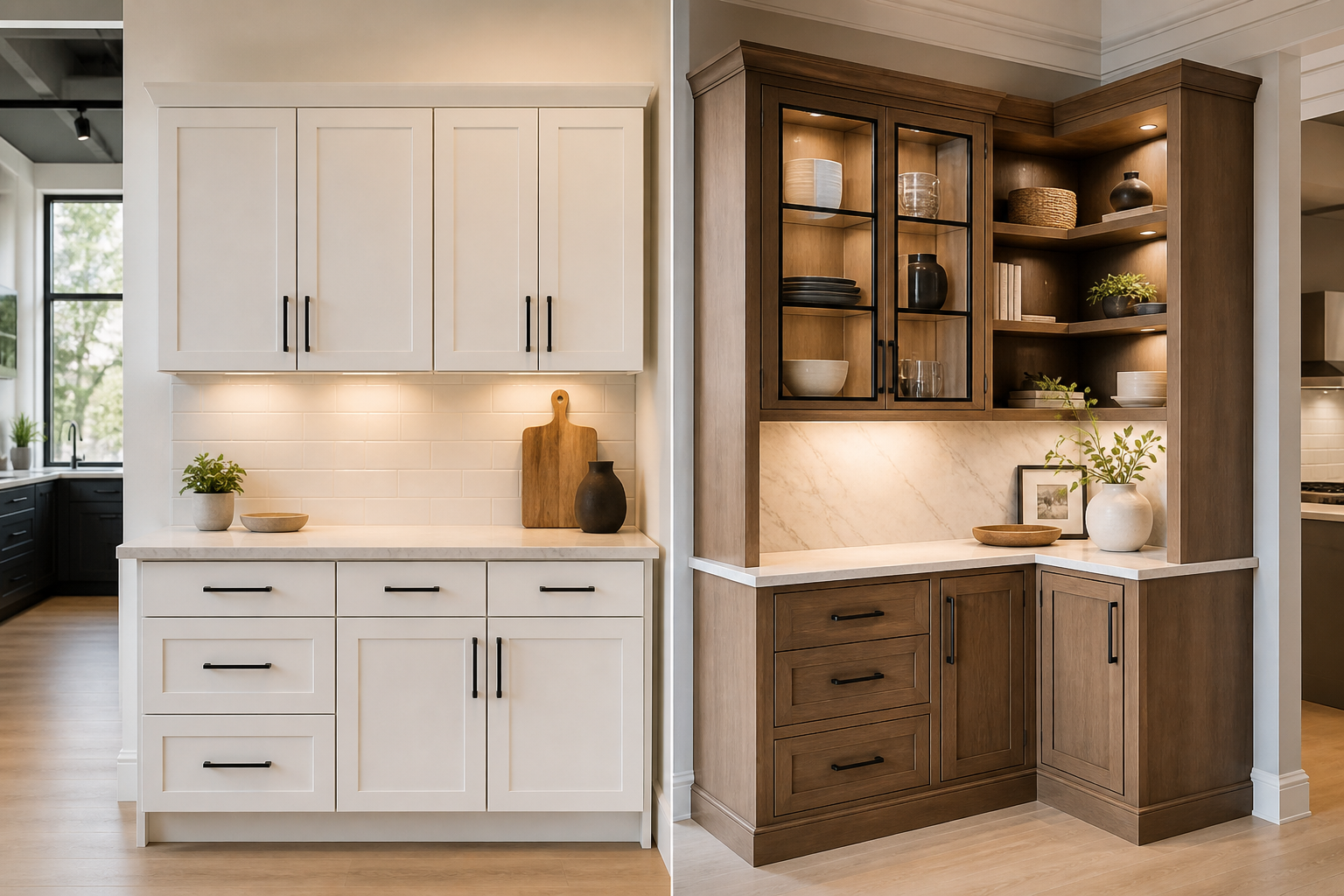
Seeing premade and custom options side by side in the showroom makes the tradeoffs concrete rather than theoretical.
When Fully Custom Wins
Custom cabinetry earns its keep in the situations premade lines can't handle gracefully. The most obvious case is an unusual space: a kitchen with a load-bearing column mid-run, a sloped ceiling over a breakfast nook, or a bathroom vanity that has to squeeze into a 22-inch alcove. When your dimensions fall outside standard increments, custom construction eliminates the filler strips and awkward gaps that come with forcing stock cabinets into a non-standard footprint.
It also wins when storage function matters more than catalog convenience. We've built pull-out spice drawers sized around a specific jar collection, appliance garages shaped around a particular mixer, and vertical tray dividers scaled to a client's baking sheets, none of which exist as a checkbox option on a manufacturer's order form. If you know exactly how you want to use a space and a standard configuration doesn't get you there, custom is the path.
Design continuity is a third reason people choose custom. When cabinetry needs to flow around an architectural feature or match an exact stain across a large kitchen and adjoining custom closet or pantry build, a single custom shop building everything from one set of drawings keeps the finish and proportions consistent in a way that mixing catalog runs sometimes can't.
The honest tradeoff is time and, in some cases, cost. Fully custom work takes longer to design and build, and for straightforward layouts it can carry a premium over an equivalent premade configuration. That premium buys precision, not prestige, so it's worth paying only when your space or your storage needs actually require it.
Cost and Timeline: What to Actually Expect
Every kitchen is different, so we won't hand you a single number and call it accurate. What we can say is that typical cabinetry investment runs in increments of roughly $10K depending on scope, sizes, and selections. A small galley kitchen refresh with a premade line sits toward the lower end of that range, while a larger kitchen with fully custom cabinetry, an island, and integrated pantry storage climbs several increments higher.
Lead time follows a similar pattern. Premade lines with modifications generally move faster through production because they're built on an established manufacturing schedule. Fully custom work requires more design time upfront, more drawing revisions, and a build process that starts from a blank sheet, so plan for a longer runway between your final design sign-off and delivery.
The way to get an accurate answer for your specific project is a real conversation, not a guess based on square footage. Our design consultation process starts with measuring your space and understanding how you actually use it, then we recommend premade, custom, or a mix based on what your kitchen needs, not what's easiest for us to sell.
It's common for a single kitchen to mix both approaches. We'll often spec premade boxes for standard runs of cabinetry and reserve custom construction for the one or two problem areas, like a corner cabinet or an appliance nook, where standard sizing simply doesn't work. That blended approach frequently delivers the best balance of cost, timeline, and fit.

A design consultation, not a catalog page, is where you find out whether your kitchen actually needs custom work.
How to Decide for Your Kitchen
Start with your walls, not your Pinterest board. Measure your space, note any angles, columns, soffits, or nonstandard dimensions, and be honest about whether your layout is conventional or unusual. A rectangular kitchen with standard 8-foot ceilings and no structural obstacles is a strong candidate for premade cabinetry. A kitchen with an angled peninsula, a low bulkhead, or a tight galley footprint tilts toward custom.
Next, get clear on your must-have storage. If you have a specific organizational need, like a dedicated spice pull-out, a mixer lift, or a charging drawer for devices, check whether your preferred premade line offers it before assuming you need full custom. Many manufacturer lines have expanded their accessory options significantly, and you might get exactly what you want without the custom premium.
- Standard kitchen dimensions, flexible timeline, budget-conscious: premade with modifications
- Unusual angles, columns, or ceiling heights: custom for the affected sections
- Highly specific storage needs not in a manufacturer's catalog: custom
- Large kitchen needing exact finish continuity across a big run: custom or a high-end premade line
- Tight renovation timeline: premade, which typically moves faster through production
Finally, bring your measurements and your wish list to a showroom conversation before you decide anything. We'll tell you plainly which parts of your project need custom work and which don't, because a kitchen that mixes both intelligently almost always beats one built entirely from either extreme.
Frequently Asked Questions
Is custom cabinetry always more expensive than premade?
Not always, but it's often higher for equivalent scope because each box is engineered and built individually rather than pulled from a standard production run. Typical cabinetry investment runs in increments of roughly $10K depending on scope, sizes, and selections, and where your project lands in that range depends more on size and finish level than on custom versus premade alone.
Can I mix custom and premade cabinets in the same kitchen?
Yes, and it's more common than people expect. Many of our San Jose clients use a modification-friendly premade line, such as Shiloh or Eclipse, for standard runs and reserve custom construction for one problem area like a corner unit or an appliance nook. It keeps cost down while still solving the tricky spots correctly.
How long does a custom cabinet order take compared to premade?
Custom orders generally require more time upfront for design and drawing revisions, then a longer production run since nothing is pulled from existing stock. Premade lines with modifications move through an established manufacturing schedule, which is typically faster. Ask for a project-specific timeline during your design consultation since it varies by scope.
Do premade cabinets look cheaper than custom?
Not necessarily. Once installed, a well-specified premade line from a quality manufacturer can be visually indistinguishable from custom work to most homeowners and guests. The differences that matter most, exact-fit dimensions and specialized storage inserts, are functional rather than visual.
Where can I see both custom and premade options in person?
Visit our San Jose showroom at 1350 Ridder Park Dr Suite B, open Monday through Saturday from 9am to 5pm. You can see door samples, finishes, and full displays from Shiloh, Eclipse, Bellmont, J&K, Boxy, and our own custom line side by side, and talk through which fits your project. You can also review our full custom kitchen cabinets service page for more detail.
A Quick Reference: Custom vs Premade at a Glance
Manufacturer lines like Shiloh and Eclipse build cabinets in standard width increments, most commonly 3-inch steps, with modification options for depth, height, and drawer configuration published in their order guides. Our Excelle custom line builds to the exact measurement of your space, down to a fraction of an inch, with no standard increment constraint at all. That single difference explains most of the cost and timeline gap between the two approaches.
- Sizing: Premade moves in fixed increments (commonly 3 inches); custom is built to your exact measurements
- Design flexibility: Premade offers a published menu of modifications; custom has no catalog limit
- Typical use case: Premade fits standard rectangular kitchens; custom fits angled walls, columns, low soffits, or specialty storage
- Investment range: Both scale with the same roughly $10K increments depending on kitchen size and finish selections, with custom generally landing higher for equivalent square footage
- Where to compare them: Door samples and finish swatches for both are on display at our San Jose showroom, five brands plus our custom line under one roof
For most San Jose kitchens we design, the decision isn't all-or-nothing. A kitchen with three standard walls and one angled peninsula might use a premade line for 80% of the cabinetry and reserve custom construction for the peninsula alone, keeping the overall project closer to the lower end of the investment range while still solving the one spot that actually needs it.