


Where to Buy Kitchen Cabinets on the Peninsula
The five channels cabinets actually come from, what each does well, the white oak question, and how to shop with a floor plan.
Cabinets on the Peninsula come from five kinds of seller, and they are not interchangeable: big-box and flat-pack retail, import RTA warehouses, manufacturer showrooms, design studios and dealers, and local millwork shops. Each is the correct answer for a different project, and the reason cabinet shopping here feels exhausting is that they all present themselves as the same category — a store with kitchens in it.
Match your project to the channel first and the showroom Saturdays get much shorter. Often there's a specific wish attached to the search, too — white oak, often rift-cut, which is worth understanding before you price it.
The five places cabinets actually come from
1. Big-box and flat-pack retail. Fixed catalog sizes, stock you can often take home, and usually the lowest prices of the five. By default you (or your contractor) handle layout and assembly, but many big-box sellers offer optional help: IKEA, for example, lets you book a measuring service or a full consultation, planning and installation, and credits the measuring fee toward installation if you choose it (IKEA). What those services cover differs from store to store, so ask. A sensible fit for rentals, flips, standard layouts, and tight budgets.
2. Import RTA warehouses. Warehouses selling ready-to-assemble plywood cabinets in popular door styles, often at striking prices with stock on hand. Quality varies more by warehouse than the showroom suggests: box construction, drawer hardware, and finish durability are where the differences hide. Good fit for investor projects and straightforward kitchens where speed and price lead. Bring a skeptical eye and open every drawer.
3. Manufacturer showrooms and kitchen dealers. Order-to-spec cabinetry from factory lines — the semi-custom tier — sold with design help of widely varying depth. This is where sizing in small increments, finish choice, and interior fittings enter the picture, with lead times that vary by line. The depth of design help is the thing to test: ask who measures, who draws the plan, and whether anyone will question your layout rather than just price it. The brand on the door is only part of the decision; who measures your space matters too.
4. Design studios. Design-first businesses that carry cabinet lines rather than cabinet stores that offer design. The distinction shows early: a studio starts with your floor plan, storage habits, and the house's quirks, then specifies product — space planning before boxes. Lines like Bellmont and the other manufacturer lines a studio carries get chosen to fit the plan, not the other way around. This is our corner of the landscape, so weigh the description accordingly — but the structural point stands regardless of whose studio you visit.
5. Local millwork shops. Fully custom, built from scratch, any dimension or species. The right answer for period homes needing matched details, genuinely odd geometry, and furniture-grade wishes. Expect lead times and prices at the upper end, and judge each shop individually: ask to see finished work, a written schedule and what the quote includes.
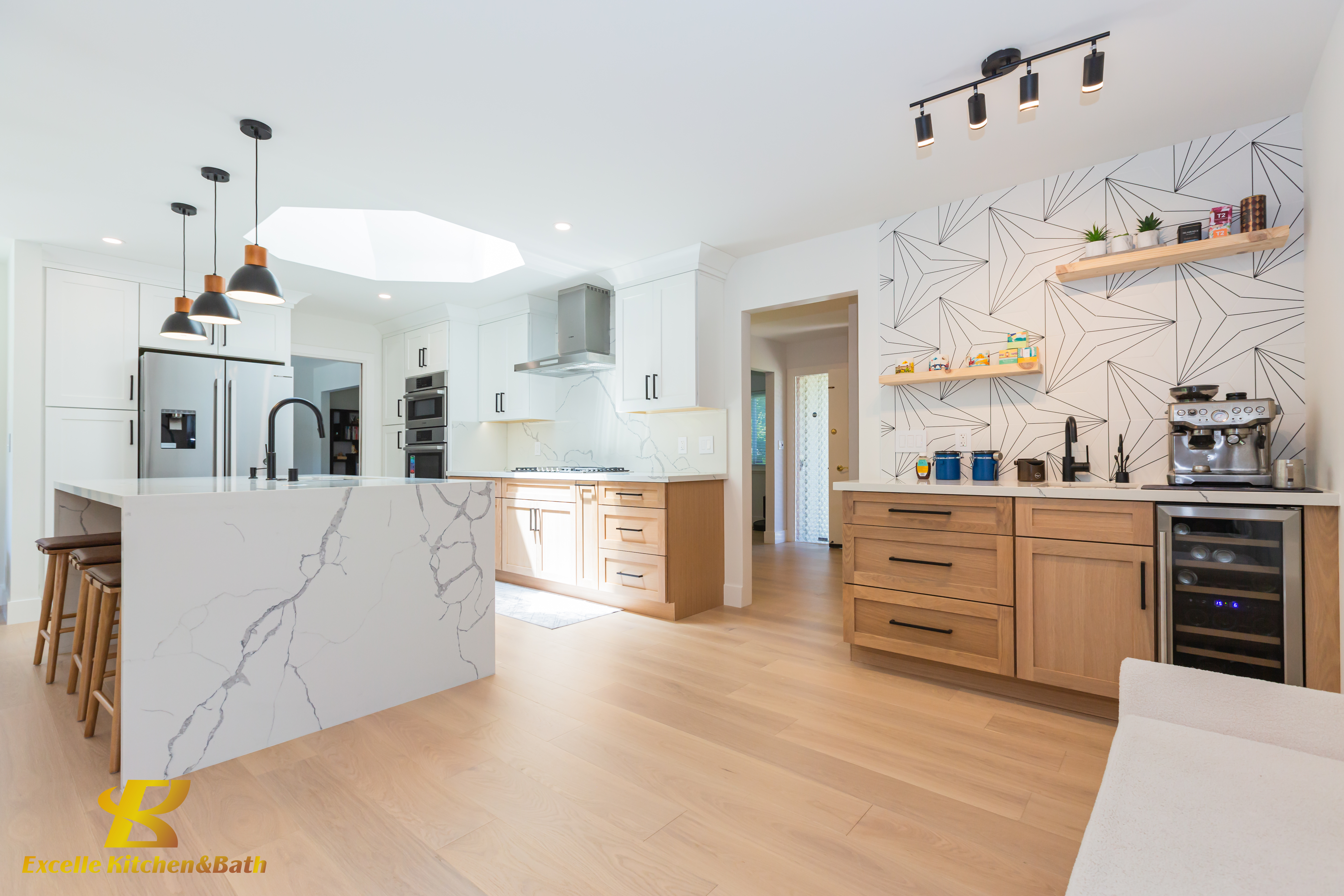
About that white oak kitchen
If your search started with a picture of a warm, straight-grained oak kitchen, some translation helps:
- Why it's everywhere: rift-sawn white oak gives a straight, linear grain without the cathedral patterns flat-sawn oak often shows, and many people find it reads both modern and warm.
- Rift vs. plain sawn: the same species, cut differently. Rift- and quarter-sawn boards show straight grain and tend to cost more because the cut produces more waste; flat-sawn (plain-sawn) is the least expensive cut, and in oak it often shows the "cathedral window" grain (Wikipedia: Quarter sawing).
- Veneer vs. solid: veneer is a thin slice of wood glued onto a core panel such as plywood, particleboard or MDF, and it is a standard way to make flat panels such as cabinet doors, tops and panels (Wikipedia: Wood veneer). Which parts of a given line are veneer and which are solid differs by manufacturer and door style, so ask for the spec rather than judging by the word.
- Cost reality: rift-cut oak tends to cost more because the cut produces more waste; ask for the oak and painted prices in the same line so you see the actual gap. Oak-look doors are another option; compare their material, edge treatment and finish spec against real wood veneer before you decide.
Shop with a floor plan, not a wish list
The single change that upgrades every showroom visit: arrive with your kitchen on paper. Not a contractor's drawing — a tape measure and thirty minutes produce everything needed:
- Wall lengths, ceiling height, and the exact positions of windows, doors, and openings (with trim).
- Locations of the sink, range, and refrigerator — and whether you're open to moving them.
- Photos of every wall, corner to corner.
- The three storage problems that bother you most in the current kitchen.
With that in hand, a good seller in any channel can talk specifics — and the ones who keep steering back to door styles without engaging the plan have told you what kind of business they are. It's also the fastest way to compare channels honestly: the same floor plan, quoted as flat-pack, semi-custom, and custom, turns abstract tiers into three real numbers.
Questions that work in every showroom
- "Who measures, and who's accountable if the measurement is wrong?" The answer separates sellers from partners faster than any brochure.
- "What's the box construction and drawer hardware — and can I see it?" Open drawers, press on shelves, look at the back panel. Two minutes of touching beats an hour of talking.
- "What's the real lead time, in writing, and what happened on your last delayed order?" Everyone quotes best case; the second half of the question gets the truth.
- "What does my quote include — delivery, install, haul-away, filler and panel stock?" Channel-to-channel comparisons fail on exactly these lines.
- "What would you change about my plan?" The most revealing question on the list. A thoughtful answer means someone actually looked; silence means you're buying boxes.
However far you are in the arc — first IKEA trip or third unsatisfying showroom — the fix is usually not another store but a better match between project and channel. If your project is the design-heavy kind, that's what our studio does all day: plan first, then product, from premade manufacturer lines through the Excelle custom line, with storage design beyond the kitchen when the house needs it. Browse design inspiration, bring us your floor plan — sketch, photos, and all — or see the lines in person at the San Jose showroom, open Monday to Saturday, 9:00 AM to 5:00 PM.
FAQ: Buying cabinets on the Peninsula
Where should I start if I don't know what tier I need?
Measure your kitchen, then get the same plan priced in two channels — one flat-pack or RTA quote, one semi-custom quote. The gap between the numbers, held against your budget and how long you'll stay, usually makes the decision for you.
Are import RTA warehouse cabinets good quality?
Quality varies from one warehouse to the next, and two products that look alike in a showroom can differ in box material, hardware and finish. Judge the specific warehouse, not the category: inspect drawer slides, box joinery, and finish edges in person, and ask what warranty support looks like after the sale.
Why do white oak cabinets cost so much more than painted ones?
Rift- and quarter-sawn boards tend to cost more because those cuts produce more waste, and a clear finish shows the wood itself rather than covering it with paint. The premium over painted equivalents in the same line varies by manufacturer; price both.
Is veneer white oak worse than solid?
Not by definition. Veneer glued onto a core panel is a standard way to make flat cabinet doors and panels. What to ask about is the core material and the edge treatment, which vary by manufacturer, rather than the word "veneer" itself.
How long do semi-custom cabinets take on the Peninsula?
Lead times vary by manufacturer and line, so get the date from finalized order to delivery in writing, and add design time before and installation after. In-stock flat-pack and RTA product can be much quicker if what you need is on the shelf; a fully custom build is usually slower. Place the order only once the plan is final, so a late change does not restart the clock.
Do I need a designer if my contractor says he can order cabinets?
Many contractors can order cabinets; whether they also plan storage in detail varies, so ask what design work is included. If your layout is staying identical and works fine, contractor-ordered boxes are a reasonable path. If the kitchen has ever annoyed you, that annoyance is a design problem — solve it before anyone orders anything.
About the author
Anthony
Design Lead, Excelle Kitchen & Bath
Leads cabinetry and storage design at Excelle Kitchen & Bath, a design studio with a San Jose showroom serving the Bay Area. Ten years of kitchen and custom storage projects, specialising in space planning, semi-custom cabinetry specification, and closet systems.