


Frameless vs. Framed Cabinets: What Actually Changes
Construction, storage capacity, door styles, and durability — what the two box types really mean for your kitchen.
A frameless cabinet gives you roughly an inch and a half more usable width per opening than a framed one of the same exterior size. That single number is the whole practical difference: framed cabinets carry a 1–1.5” face frame around the box opening, frameless cabinets don't, and everything else — drawer widths, what fits on a shelf, how the doors sit — follows from it. Across twenty cabinets it is the difference between a kitchen that swallows your things and one that doesn't.
Both are legitimate construction methods with real advantages, and price is not reliably one of them. What follows is what changes in the box, the install, and daily use.
What the two constructions actually are
Framed (the American tradition): a hardwood face frame — typically 1.5” wide rails and stiles — is attached to the front of the box, like a picture frame around every opening. Doors and hinges mount to the frame. The frame adds rigidity, covers the raw box edges, and defines the look American kitchens carried for most of a century.
Frameless (the European or "full-access" method): no face frame at all. The box is built from thicker panels — commonly 5/8” to 3/4” — with edges banded, and doors mount directly to the cabinet sides with cup hinges. The door covers essentially the entire box front, which is why the style is also called full-overlay by default.
Neither is a quality tier. A cheap framed cabinet and a cheap frameless cabinet are both cheap; a well-built version of either outlasts its owner's tastes. What differs is geometry, and geometry has consequences.
The storage math: where the inches go
The face frame is the storage story. Every framed opening is narrower than its box, because the frame overhangs the interior on all four sides:
- Drawers: in a framed cabinet, the drawer box must clear the frame opening, surrendering roughly 1.5–2” of width per drawer versus a frameless box of the same exterior size. Across a 36” three-drawer base, that's a stack of lost sock-drawer.
- Roll-outs and pull-outs: same penalty, plus the frame lip becomes a threshold that interior fittings must be sized around. Frameless interiors accept wider fittings off the shelf.
- Access: the frame's center stile — the vertical bar many framed double-door cabinets carry — splits the opening, so a big stockpot enters diagonally or not at all. Frameless doubles open to one clear void.
In a large kitchen the difference is a convenience. In the compact kitchens common to older San Francisco and Peninsula housing stock, an inch and a half per cabinet is the difference between the mixer fitting in a base cabinet or living on the counter — the same per-inch honesty we push in space planning generally.
What each construction does to the look
Door mounting drives style range:
- Inset doors — the door sits flush inside the frame opening, shadow line all around — are a framed-cabinet exclusive. If you want that furniture-grade, Shaker-house look, you want a face frame, and you'll pay for the precision it demands.
- Partial overlay — doors covering part of the frame, frame visible between them — is the classic (and now dated-reading) framed look, and the budget end of framed lines.
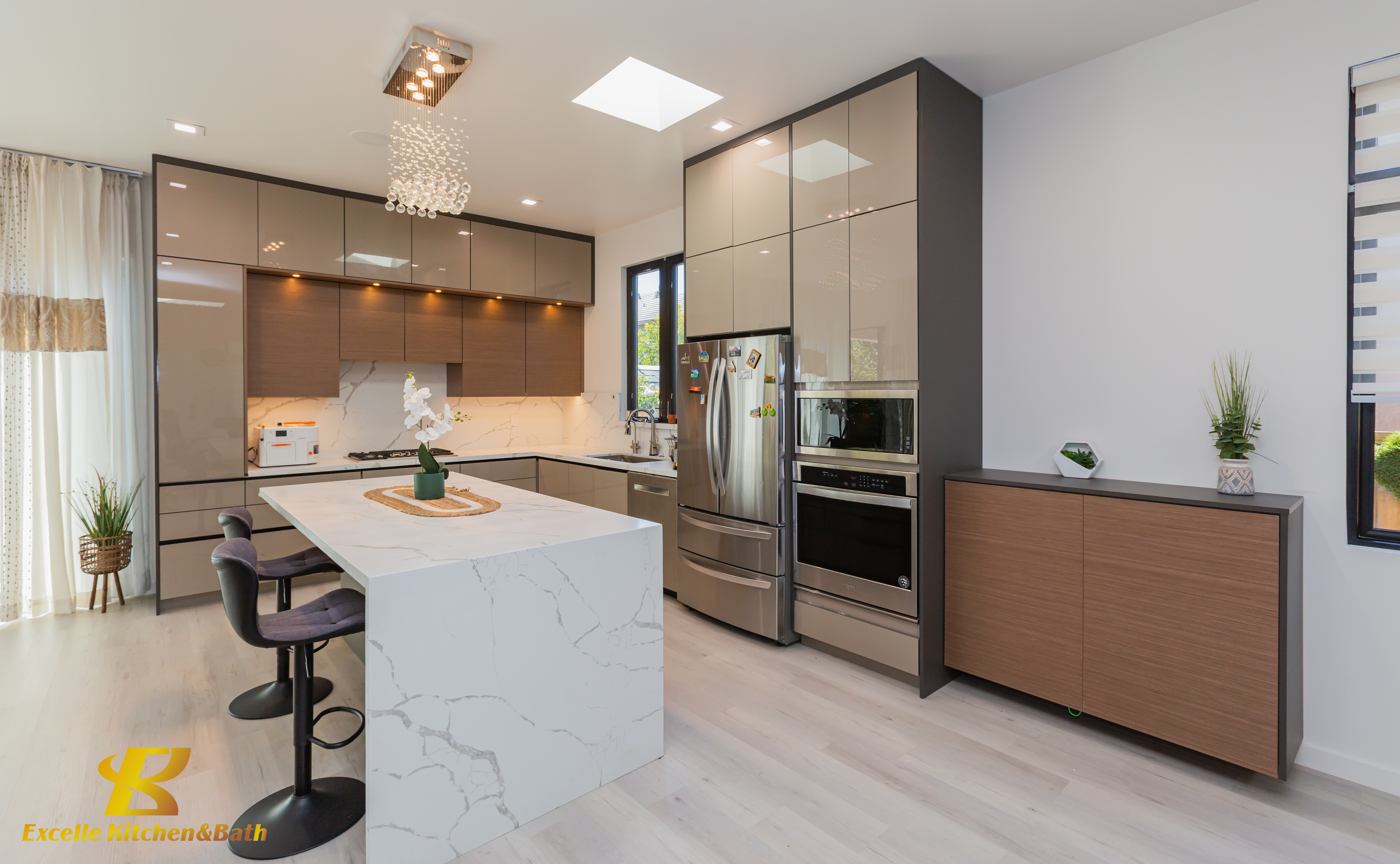
- Full overlay — doors covering nearly everything, minimal gaps — is where the two constructions converge visually. Framed lines achieve it with wider doors; frameless delivers it by default, usually with tighter, more consistent reveals.
The modern flat-slab and minimal-Shaker looks that dominate current remodels are native territory for frameless boxes. That's a big part of why most European manufacturers never used frames and why the majority of semi-custom lines — including the ones we carry among our brands — now build frameless as standard or offer both.
Durability, hinges, and the install day
Rigidity: the face frame stiffens a box, which mattered when boxes were thin particleboard. Modern frameless construction compensates with thicker panels and full backs — a well-specified frameless box gives up nothing structurally. Where framed retains an edge is abuse tolerance at the opening: the hardwood frame shrugs off impacts that can chip a banded edge.
Hinges: both use concealed cup hinges today, but frameless hinges mount to the box side on standardized 32mm system holes — replacement and adjustment decades later is trivially standard. Framed hinges mount to the frame and vary more by line.
Installation is the honest trade-off. Framed cabinets forgive: the frame bridges small wall waves, and reveals hide minor misalignment. Frameless full-overlay forgives nothing — with 1/8” gaps between door faces, a box set 2mm out of plane telegraphs across the whole run. In hundred-year-old Berkeley and Oakland walls, that means frameless installs demand more shimming, more scribing, and a more patient installer. Budget the labor accordingly; a bargain install crew is a worse idea on frameless than anywhere else.
Cost: closer than the internet claims
Community remodel threads report the two constructions landing within 5–15% of each other at the same quality tier, and which one costs more flips by manufacturer: framed lines spend money on hardwood frames, frameless lines on thicker panels and edge processing. Inset framed sits above both — market-reported figures put inset 15–30% over comparable overlay work because of the fitting precision. The honest summary: choose on function and look, not price; at any given budget both exist. (For what cabinets cost overall in this market, see our Bay Area cabinet cost guide.)
How to choose in one paragraph
Want inset doors, a traditional or period-correct look, or maximum tolerance for a rough install environment? Framed. Want maximum interior capacity, wide clean drawer stacks, modern full-overlay faces, and standardized hardware for the long run? Frameless. Own a small kitchen in an older Bay Area house? Frameless storage math usually wins — paired with an installer who treats out-of-square walls as a craft problem, not a surprise. If you're not sure which your project wants, bring us the floor plan; the answer usually falls out of the wardrobe of pots you own and the walls you're working with, not the marketing.
FAQ: Frameless vs. framed cabinets
Are frameless cabinets less durable than framed?
Not at equal build quality. The face frame's stiffening role is covered in frameless construction by thicker box panels and full backs. The genuine framed advantage is impact resistance at the opening edge — hardwood frame versus banded panel edge — which matters most in hard-use households.
How much more storage do frameless cabinets really give?
Roughly 1.5–2” of usable width per drawer or pull-out opening, plus unobstructed double-door openings with no center stile. Estimates around 10–15% more usable interior in the same footprint are commonly cited, and the gain concentrates exactly where small kitchens hurt: drawers and base storage.
Can I get a Shaker look with frameless cabinets?
Yes — full-overlay Shaker doors on frameless boxes are one of the most common current combinations. What frameless cannot do is inset: the flush-in-frame look requires an actual face frame to be flush with.
Why did European cabinets develop frameless?
Post-war rebuilding pushed European makers toward efficient flat-pack manufacturing on the 32mm system — standardized holes for hinges, shelves, and slides — which has no use for a face frame. The efficiency and interior capacity kept it dominant, and American semi-custom lines have steadily adopted it.
Do frameless cabinets work in old houses with crooked walls?
Yes, but installation quality decides the result. Full-overlay reveals expose misalignment that framed construction hides, so out-of-square older homes need careful shimming and scribing. The cabinets aren't the risk — the install crew is.
Is one construction better for resale?
Buyers respond to the look and condition, not the box construction. Full-overlay frameless reads current; tidy inset framed reads high-end traditional. Either presents well — a worn partial-overlay kitchen is what dates a listing.
About the author
Anthony
Design Lead, Excelle Kitchen & Bath
Leads cabinetry and storage design at Excelle Kitchen & Bath, a design studio with a San Jose showroom serving the Bay Area. Ten years of kitchen and custom storage projects, specialising in space planning, semi-custom cabinetry specification, and closet systems.