


What Kitchen Cabinets Really Cost in the Bay Area (2026)
Sourced cost ranges by tier, what moves a price inside them, how to read a cabinet quote, and the red flags worth walking away from.
Short answer: This page has no Bay Area price per linear foot, so it uses national figures from HomeAdvisor's June 2026 guide as reference points. Semi-custom cabinets run about $150 to $650 per linear foot installed ($75 to $400 for cabinets only), and custom cabinets about $500 to $1,200 installed ($300 to $750 cabinets only). Whole-remodel costs in the San Francisco market run higher than the national average, so treat these ranges as a floor for comparison and get a written quote for your own plan.
Nationally, kitchen cabinets run about $100 to $1,200 per linear foot installed, and HomeAdvisor's June 2026 cost guide puts a typical 10-by-10-foot kitchen at $2,000 to $24,000, with most landing between $4,000 and $13,000. Where you land depends on tier: stock, semi-custom or custom. For local context, Remodeling magazine's 2025 Cost vs Value report prices a midrange major kitchen remodel in the San Francisco market at $97,667, against a national average of $82,793.
Those figures are a starting point, not a quote. Cabinet pricing is not random, but it is often under-specified: two quotes that look far apart are usually describing different construction, different interiors and different definitions of "installed." This guide sets out the sourced ranges, what moves a price inside them, and how to compare quotes line by line.
The ranges, by tier
| Tier | Installed, per linear foot | Cabinets only, per linear foot |
|---|---|---|
| Stock | $100 to $300 | $50 to $100 |
| Semi-custom | $150 to $650 | $75 to $400 |
| Custom | $500 to $1,200 | $300 to $750 |
Source: HomeAdvisor, "2026 Average Cost of Kitchen Cabinets," updated June 17, 2026. National figures.
HomeAdvisor notes that a 10-by-10 kitchen usually has 20 to 25 linear feet of cabinetry. Multiplying its installed ranges by that footage gives a rough national picture for such a kitchen: about $2,000 to $7,500 for stock, $3,000 to about $16,000 for semi-custom, and $10,000 to $30,000 for custom. For a larger 12-by-12 kitchen, HomeAdvisor's range is $2,500 to $29,000, and it puts most high-end custom kitchens at $13,000 to $30,000.
For local context, the Cost vs Value comparison above covers a whole remodel rather than cabinets alone, and in each kitchen project it tracks the San Francisco figure is higher than the national one: the midrange minor kitchen remodel ($31,804 versus $28,458 nationally) and the upscale major remodel ($192,231 versus $164,104) as well as the midrange major remodel above. Use the national cabinet ranges as reference points only; neither they nor the whole-remodel averages tell you what cabinets for your kitchen will cost, which takes a quote for your own plan and selections.
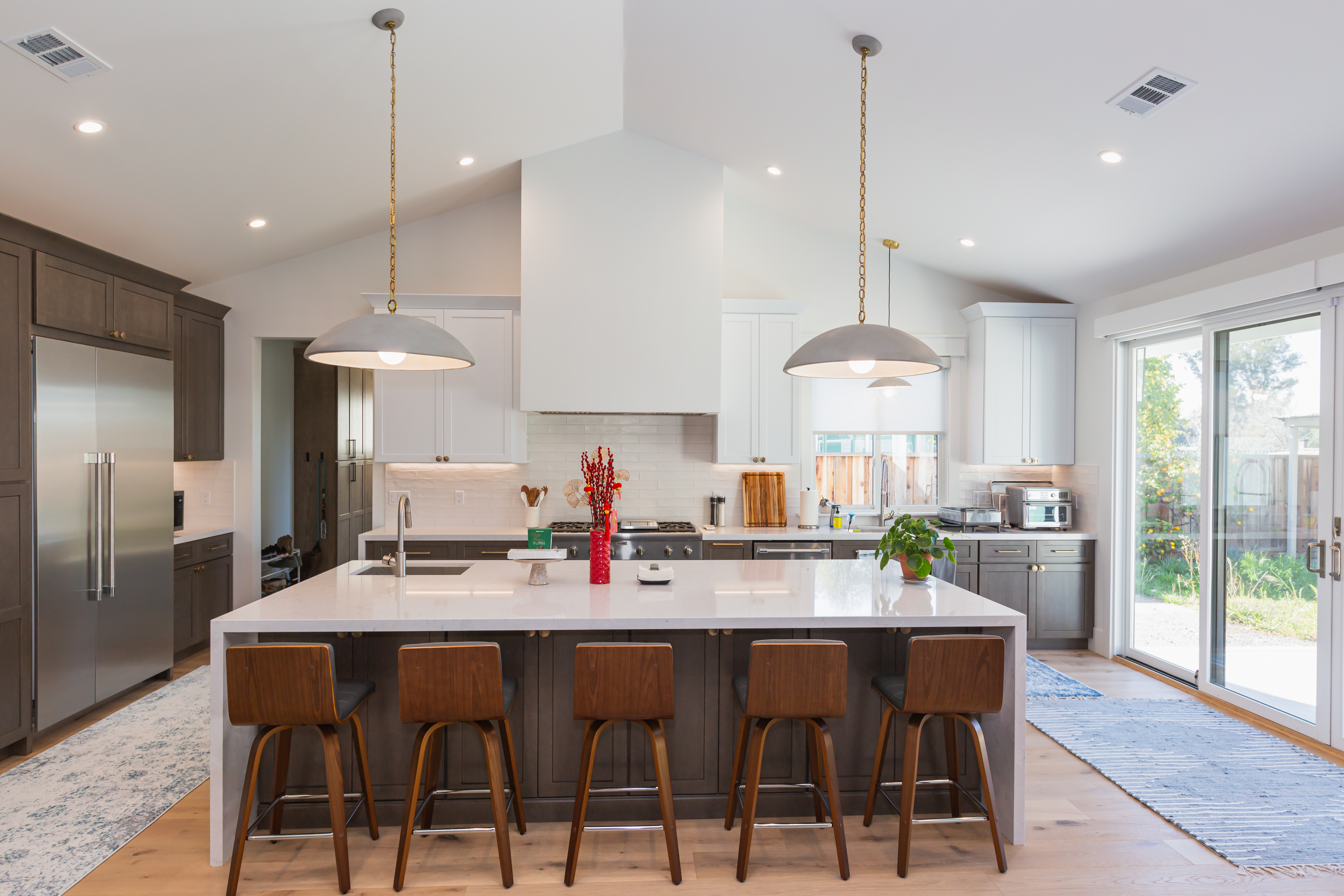
What moves the price inside a tier
Premade versus custom. This is the biggest fork. Manufacturer lines are built in standard sizes with a catalog of modifications, so they generally cost less per linear foot and come with a more accessible lead time. Custom cabinets are built to your exact dimensions, which costs more but can reduce the filler strips and gaps needed in rooms that do not fit standard sizes; some fillers and scribes may still be needed for clearances, door operation and uneven walls, which the installation design determines. Some kitchens mix the two: a manufacturer line for the regular runs, custom pieces for the awkward corner, the tall pantry or the island.
Framed versus frameless. HomeAdvisor reports that frameless cabinets cost about 15% more on average than framed ones. Frameless gives full-access openings and a cleaner face; framed gives the traditional look and more overlay options. Our framed versus frameless guide covers the trade-off.
Door overlay. Inset doors, which sit flush inside the face frame, typically cost about 20% more than a comparable overlay design with the same materials, according to HomeAdvisor. Shaker doors, by contrast, cost the same as other styles according to HomeAdvisor, since Shaker is a style rather than a material; your own quotes can still differ by maker and door.
Box and door materials. HomeAdvisor notes that most stock and some lower-end semi-custom cabinets use MDF with a veneer, while most high-end semi-custom and many custom cabinets combine plywood boxes with solid wood or veneered doors. Our plywood versus MDF guide explains where each belongs.
Scope and specialty pieces. Each added linear foot costs more, and tall pantry cabinets, corner solutions and appliance garages cost more per unit than a standard base or wall cabinet. Define the scope before you compare: base cabinets only, a full tear-out, an added island, or an extended run on another wall. If the existing boxes are sound and the layout works, refacing is another route; see refacing versus full replacement.
Interior fittings and hardware. Pull-outs, drawer stacks, corner mechanisms and soft-close, full-extension slides across twenty or more cabinets are where quotes that look alike quietly diverge.
How to read a cabinet quote
Before comparing bottom lines, make every quote answer these:
- What construction? Box material, framed or frameless, door material and finish. Ask for it cabinet by cabinet if the quote only says "cabinets."
- What is inside? Drawer boxes, slides, pull-outs, corner solutions and interior fittings.
- Is installation included, and by whom? A cabinets-only number and an installed number are different things. Delivery, assembly (for ready-to-assemble lines), fillers, panels, mouldings and haul-away can all sit inside or outside the price.
- What is the lead time, in writing? Ask for the manufacturer's current schedule for your exact selections.
- What does the warranty cover, and how are claims made? Terms differ widely. For example, Shiloh publishes a 10-year limited warranty, Bellmont a limited lifetime warranty on three of its four series, and J&K and Boxy five years. Ask who handles a claim before you buy.
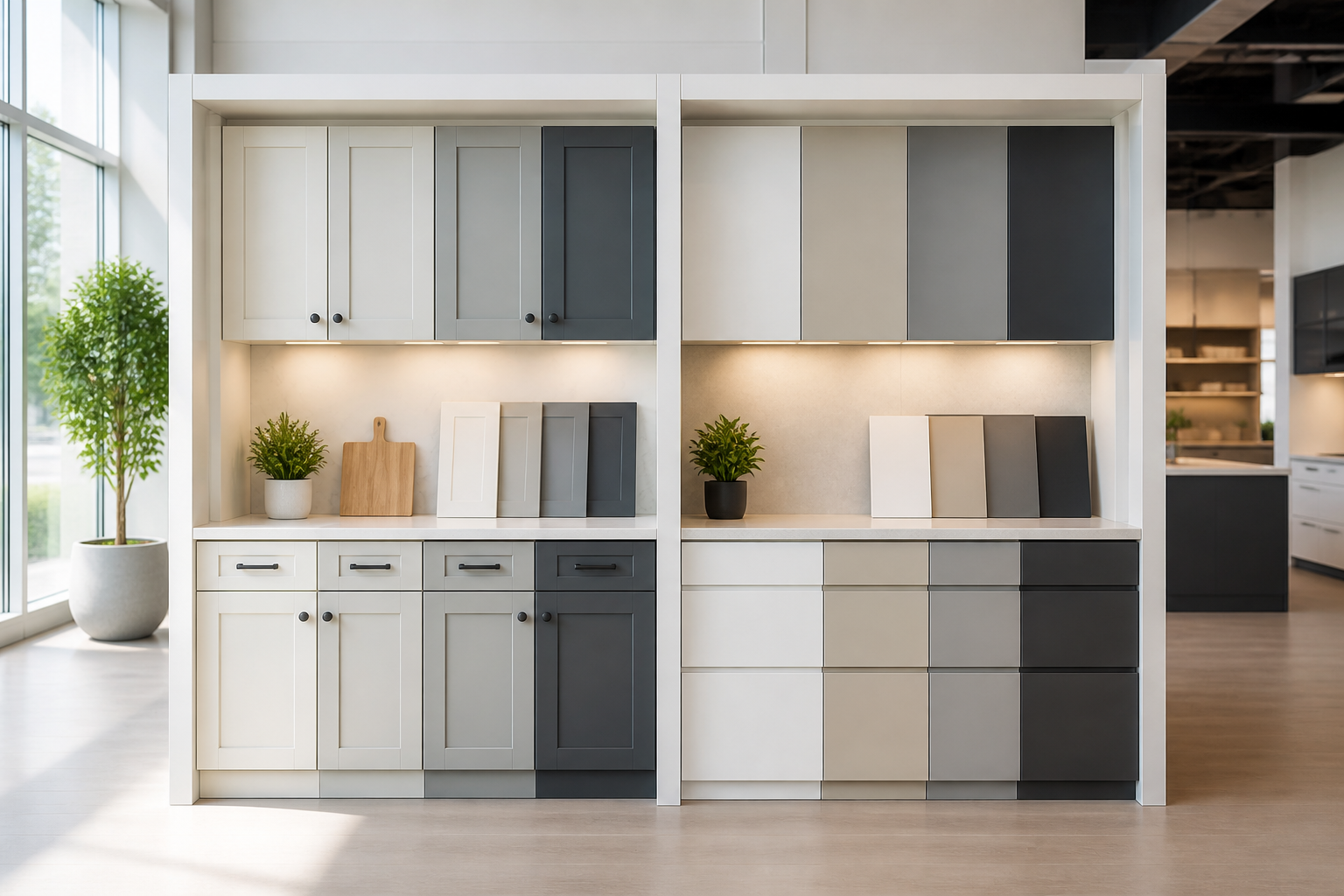
Red flags worth walking away from
- A quote that will not itemize construction, interior fittings or installation scope.
- "Custom" pricing on what is plainly a standard catalog line.
- A large deposit requested before drawings or a specification exist.
- A seller who will not put a lead time in writing, or whose dates keep sliding without explanation.
- Cabinets bought outside the manufacturer's authorized dealer network. J&K, for one, says warranty claims on products from unauthorized sellers may not be honored.
Where the money is best spent
If the budget forces choices, spend down this list in order:
- Layout and space planning. Premium boxes cannot fix a layout that does not work, so plan the layout before choosing the tier. See how to plan a kitchen layout.
- Drawers and slides. They are the parts you use many times a day. Our cabinet hardware guide covers what to look for.
- Box construction where water lives: the sink base and the cabinets beside the dishwasher.
- Finish quality on the doors you see most.
- Everything else, including upgrades that photograph well but store nothing.
Which tier a room actually needs is a separate question, covered in custom versus semi-custom versus IKEA.
Getting a number for your own kitchen
Excelle Kitchen & Bath has no fixed project price or menu quote, because the number depends on your layout, sizes and selections. Its brand comparison shows the relative price tier of each line it carries (Shiloh, Eclipse, Bellmont, J&K, Boxy and its own custom line) with an approximate guide, and notes that actual pricing depends on scope, sizes and selections. Excelle designs the cabinetry, guides product selection and coordinates the order; for installation it connects you with partners it works with regularly, or you can use your own contractor. If the cabinets are part of a larger project, the kitchen remodel design page explains how the design work and the contractor's work divide. Either way, confirm what installation covers, who does it and how it is priced before you compare totals.
Bring measurements, photos and any quote you are already holding to the San Jose showroom at 1350 Ridder Park Dr, Suite B, open Monday to Saturday, 9:00 AM to 5:00 PM, or book a design consultation.
FAQ: Kitchen cabinet costs
How much do custom made cabinets cost?
HomeAdvisor's June 2026 guide puts custom cabinets at about $500 to $1,200 per linear foot installed, or $300 to $750 for cabinets only. For a 10-by-10 kitchen with 20 to 25 linear feet of cabinetry, that works out to roughly $10,000 to $30,000 nationally. These are not Bay Area quotes. What a custom kitchen costs in San Jose depends on your layout, sizes and selections, so it takes a written quote for your plan.
What is the cabinet price per linear foot?
By HomeAdvisor's national figures, installed prices run about $100 to $300 per linear foot for stock, $150 to $650 for semi-custom and $500 to $1,200 for custom. Cabinets-only prices run $50 to $100, $75 to $400 and $300 to $750 respectively. Check whether a quote is installed or cabinets only before comparing per-foot numbers, because the two differ by a wide margin.
How much do kitchen cabinets cost for a 10-by-10 kitchen?
HomeAdvisor's June 2026 guide puts a 10-by-10 kitchen at $2,000 to $24,000 nationally, with most between $4,000 and $13,000. Stock, semi-custom and custom tiers run about $100 to $300, $150 to $650 and $500 to $1,200 per linear foot installed.
Are cabinets more expensive in the Bay Area?
Whole-remodel costs in the San Francisco market are higher than the national average in Remodeling's 2025 Cost vs Value report, which puts a midrange major kitchen remodel there at $97,667 versus $82,793 nationally. That covers the whole remodel, not cabinets alone, so get a cabinet quote for your own project.
Why do two cabinet quotes for the same kitchen differ so much?
Because "cabinets" is not a single specification. Box material, framed or frameless construction, door overlay, interior fittings, hardware, and whether installation, assembly and trim are included can all differ between quotes that look alike.
Do frameless or inset cabinets cost more?
HomeAdvisor reports frameless cabinets cost about 15% more than framed on average, and inset doors about 20% more than a comparable overlay design with the same materials.
When is refacing worth considering instead of new cabinets?
Refacing keeps the existing cabinet boxes and replaces doors, drawer fronts and hardware, so it only makes sense when those boxes are sound and the layout does not need to change. Our refacing versus replacement guide compares the two.
Can I mix custom and premade cabinets to save money?
Yes. One approach is a manufacturer line for the standard runs and custom pieces only where the room demands them, such as an awkward corner, a tall pantry or the island.
About the author
Anthony
Design Lead, Excelle Kitchen & Bath
Leads cabinetry and storage design at Excelle Kitchen & Bath, a design studio with a San Jose showroom serving the Bay Area. Ten years of kitchen and custom storage projects, specialising in space planning, semi-custom cabinetry specification, and closet systems.