


How Much Do Kitchen Cabinets Cost? An Honest Guide
A straightforward breakdown of what actually drives kitchen cabinet cost: premade vs custom, construction type, door style, and scope.
Why "It Depends" Is the Honest Answer
Ask five different homeowners what their kitchen cabinets cost and you'll get five wildly different numbers, and none of them are wrong. Cabinet cost isn't a single line item, it's the sum of several decisions stacked on top of each other: whether you go premade or fully custom, what construction method the boxes use, which door style and overlay you pick, and how much of your kitchen actually needs new cabinetry versus a partial refresh.
We'd rather walk you through what actually moves the number than hand you a figure that falls apart the moment your project doesn't match the assumptions behind it. At Excelle Kitchen & Bath, the honest starting point we give most homeowners is that a typical cabinetry investment runs in increments of roughly $10K depending on scope, sizes, and selections. A single-wall galley kitchen refresh sits at the low end of that range. A full L-shaped or U-shaped kitchen with an island, custom storage inserts, and premium finishes climbs several increments higher. The variables below explain why.
This isn't a sales pitch dressed up as an article. It's the same conversation we have in every design consultation at our San Jose studio, because a homeowner who understands what drives cost makes better decisions faster, and ends up happier with where their budget went.
Premade vs Custom: The Biggest Cost Fork in the Road
The single largest factor in your final number is whether you choose a semi-custom manufacturer line or a fully custom build. We carry five manufacturer lines, Shiloh, Eclipse, Bellmont, J&K, and Boxy, each built in engineered size increments (typically 3-inch width steps) with a wide range of modifications available. Because these lines are produced on an established manufacturing system, they cost less per linear foot than fully custom work and ship faster.
Fully custom cabinetry, our Excelle line, is built to your exact dimensions with no size increments to compromise around. This matters when a kitchen has an odd angle, a low soffit, a narrow galley run, or a specific storage need a standard line can't solve gracefully. Custom costs more because every piece is a one-off build rather than a configuration of a standard system, but for the right kitchen it eliminates filler panels and wasted inches that a semi-custom line would otherwise leave behind.
Most of our clients land somewhere in between; using a manufacturer line for the bulk of the kitchen and custom-building just the awkward corner, the tall pantry cabinet, or the island. That hybrid approach keeps cost down while still solving the problems a catalog can't. We cover this trade-off in more depth in our full comparison of custom vs premade cabinets.
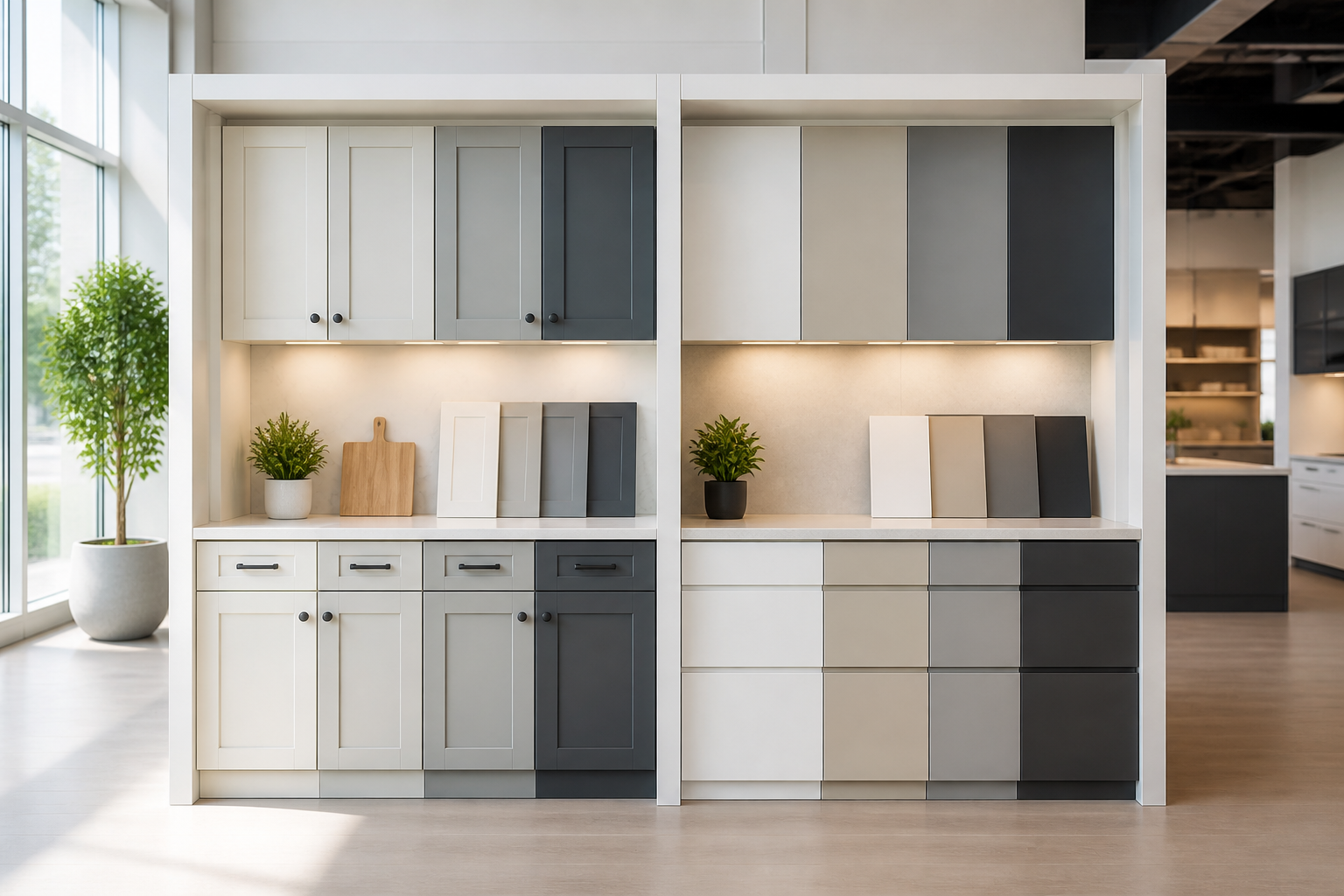
Comparing finish and construction samples side by side is the fastest way to understand where your budget is going.
Construction Method: Framed vs Frameless
The second cost driver is how the cabinet box itself is built. Framed (face-frame) construction adds a solid wood frame across the front of the cabinet box, a traditional approach that's been the American standard for decades. Frameless (full-access, sometimes called European-style) construction skips the frame, using thicker box materials and precision-engineered edges instead. Frameless typically costs a bit more per box because it demands tighter manufacturing tolerances, but it also opens up slightly more usable interior storage space since there's no frame lip blocking drawer glides and pull-out shelving.
Neither method is objectively better, they suit different kitchen styles and different homeowner priorities. Framed construction pairs naturally with traditional and transitional kitchens and shaker doors. Frameless leans toward the clean, modern look that handle-less and slab-door kitchens are built around. If storage capacity and drawer access matter more to you than a particular aesthetic, frameless often wins out even at the slightly higher price. We walk through this decision in detail in our guide to framed vs frameless cabinet construction, since it's one of the first choices we help clients make.
Door Style and Overlay: Small Choice, Real Cost Swing
Door style and overlay type are where a lot of homeowners get surprised, because these choices look like aesthetic preferences but carry real cost differences. Full overlay doors, where the doors nearly cover the entire cabinet box front with minimal gaps, require more precise manufacturing and typically cost more than partial overlay doors, which show more of the face frame and forgive small manufacturing variances. Inset doors, which sit flush inside the frame rather than overlaying it, are the most labor-intensive to build and fit, and cost the most of the three.
Shaker-style doors, the recessed-panel look that's remained popular for decades, sit in the middle of the price range regardless of overlay type, since the design itself is straightforward to manufacture even at high quality. Handle-less, flat-panel doors used in frameless kitchens require integrated pulls or push-to-open mechanisms, which adds hardware cost but often simplifies the door manufacturing itself. None of these differences are dramatic on their own, but across 20-30 doors and drawer fronts in a full kitchen, they add up to a meaningful percentage of the total project cost.
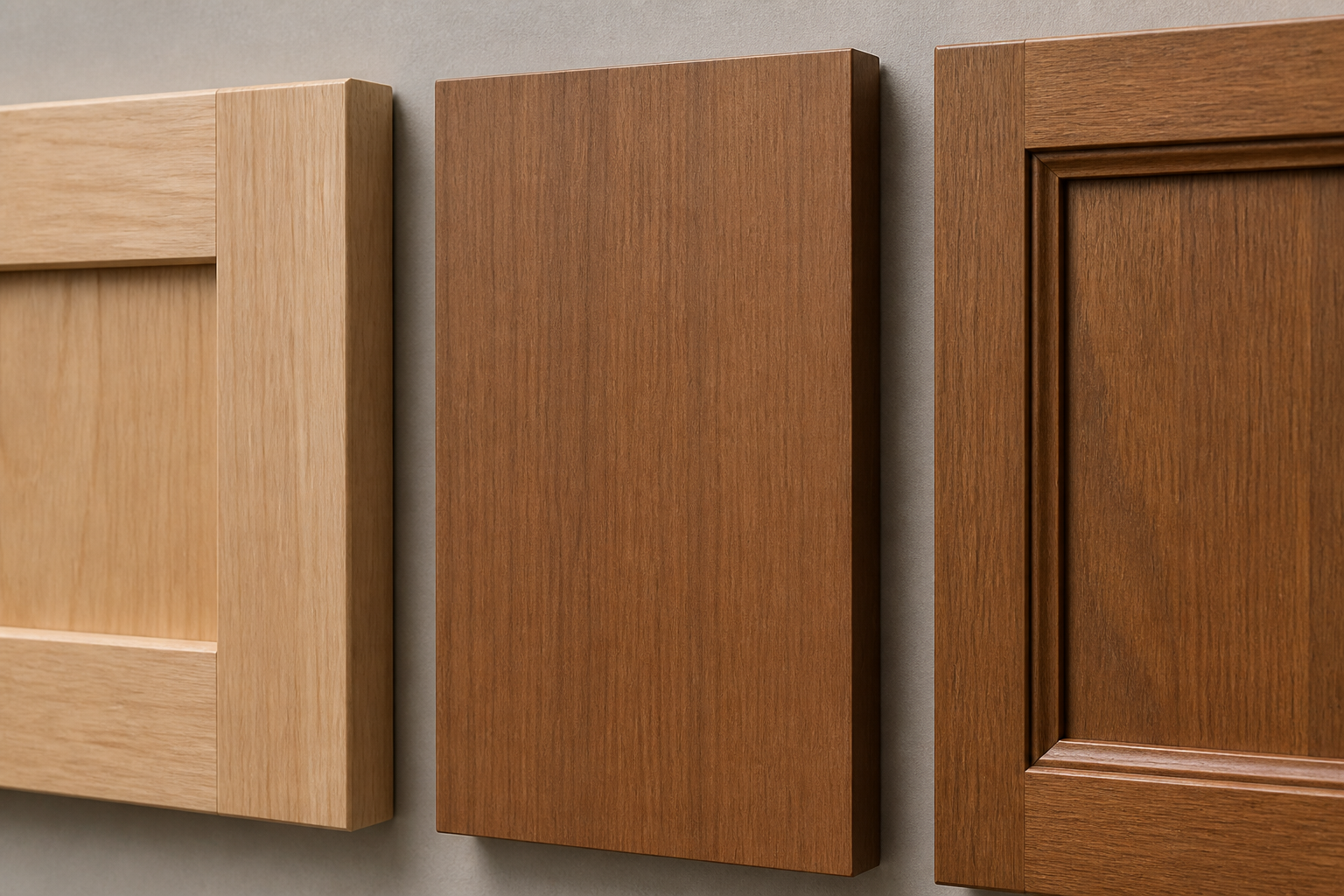
Door overlay and construction detail, seen up close, explains a lot of the price gap between two kitchens that otherwise look similar.
Scope: How Much of the Kitchen Are You Actually Replacing?
This sounds obvious, but it's the variable homeowners most often forget to nail down before they start comparing numbers. A cabinet cost estimate for "the whole kitchen" is meaningless until you define what that includes. Are you replacing base cabinets only and keeping your existing uppers? Adding an island where there wasn't one before? Extending storage into an adjacent wall? Each additional linear foot of cabinetry is additional cost, and specialty pieces, tall pantry cabinets, corner storage solutions, appliance garages, add more per unit than a standard base or wall cabinet.
This is also where a lot of the difference between a "kitchen refresh" and a "full kitchen remodel" budget comes from. Refacing or replacing cabinet fronts while keeping the existing boxes is far less expensive than a full tear-out and rebuild, but it only works if the existing layout and box condition support it. During a design consultation, we measure the actual space, talk through your storage needs and how you use the kitchen day to day, and give you a scope-specific range rather than a generic per-kitchen average that doesn't reflect your walls.
Where to See the Numbers for Yourself
Every homeowner deserves to see and touch the materials before committing a budget to them. That's the entire premise behind our San Jose showroom at 1350 Ridder Park Dr Suite B: full door samples across all five manufacturer lines, finish swatches, hardware displays, and cutaway construction models so you can feel the difference between framed and frameless, or full overlay and inset, before a single number gets attached to your project. We're open Monday through Saturday, 9 to 5, and walk-ins are welcome, though booking a design consultation ahead of time means we can have relevant samples pulled and ready when you arrive.
We'll say it plainly: we're a design studio, not a general contractor. We handle space planning, cabinet selection, and the full design process, and we coordinate with the installation professionals on your project, but we don't hold contracting licenses or manage construction crews ourselves. That distinction matters for your budget too, since your total project cost includes both the cabinetry investment we've discussed here and separate installation costs that depend on your contractor and site conditions.
Frequently Asked Questions
What's the average cost of new kitchen cabinets?
There's no single average that means much, because premade vs custom, framed vs frameless, and door style all swing the number independently. As a starting point, a typical cabinetry investment runs in increments of roughly $10K depending on scope, sizes, and selections. The best way to get a real number is a design consultation where we measure your space and talk through your priorities.
Is it cheaper to reface cabinets or replace them?
Refacing, keeping the existing cabinet boxes and replacing just the doors, drawer fronts, and hardware, is generally less expensive than a full replacement. It only works well if the existing boxes are structurally sound and the layout doesn't need to change.
Do custom cabinets always cost more than premade lines?
Almost always, yes, because custom work is built one-off rather than in standard size increments. That said, a hybrid approach, premade for most of the kitchen with custom pieces for awkward corners or specialty storage, often costs less than an all-custom kitchen while still solving the problems a catalog line can't.
Does door style really affect the price that much?
Individually, no. Across a full kitchen's worth of doors and drawer fronts, the difference between partial overlay, full overlay, and inset construction adds up to a meaningful percentage of total cost, since inset in particular demands much tighter manufacturing tolerances.
Can I get an accurate quote without visiting the showroom?
Rough ranges are possible over the phone, but an accurate number needs real measurements and a look at your actual space. We recommend visiting our San Jose showroom or booking a design consultation so we can give you a scope-specific figure rather than a generic estimate.
Quick Reference: What Moves the Number
Here's a condensed breakdown of the five factors covered above, ranked roughly by how much impact each one has on your final cabinet cost:
- Custom vs premade: Fully custom cabinetry (our Excelle line) generally costs more per linear foot than our five manufacturer lines (Shiloh, Eclipse, Bellmont, J&K, Boxy), since custom pieces are built one-off rather than in standard 3-inch size increments.
- Construction method: Frameless (full-access) boxes typically run a bit higher per unit than framed, face-frame boxes, due to tighter manufacturing tolerances.
- Door overlay: Inset doors cost the most of the three overlay types, followed by full overlay, then partial overlay, across a full set of 20-30 doors and drawer fronts.
- Project scope: Base-cabinets-only or refacing projects cost meaningfully less than a full tear-out covering base, wall, island, and specialty storage pieces.
- Specialty pieces: Tall pantry cabinets, corner storage solutions, and appliance garages each add more per unit than a standard base or wall cabinet.
As a rule of thumb, a typical cabinetry investment runs in increments of roughly $10K depending on where your project lands across these five factors. A single-wall refresh with a manufacturer line and partial overlay doors sits near the low end. A full kitchen with custom pieces, frameless construction, and inset doors sits several increments higher.