


Plywood vs. MDF Cabinets: Where Each One Belongs
What plywood, MDF and particleboard are, where each is commonly used in a kitchen, how each handles moisture, and how to read the spec on a quote.
Short answer: For most kitchens, the better choice is both, each in its own job. Plywood is the stronger pick for cabinet boxes, shelves and the sink base, because its cross-laminated layers give strength and stiffness in both panel directions. MDF is the better pick for painted doors, because its smooth, grain-free face takes paint cleanly and has no rail-and-stile joints to show through. For stained doors, use wood or veneer, since MDF has no grain. Neither one is waterproof, so how the edges are sealed matters more than the label.
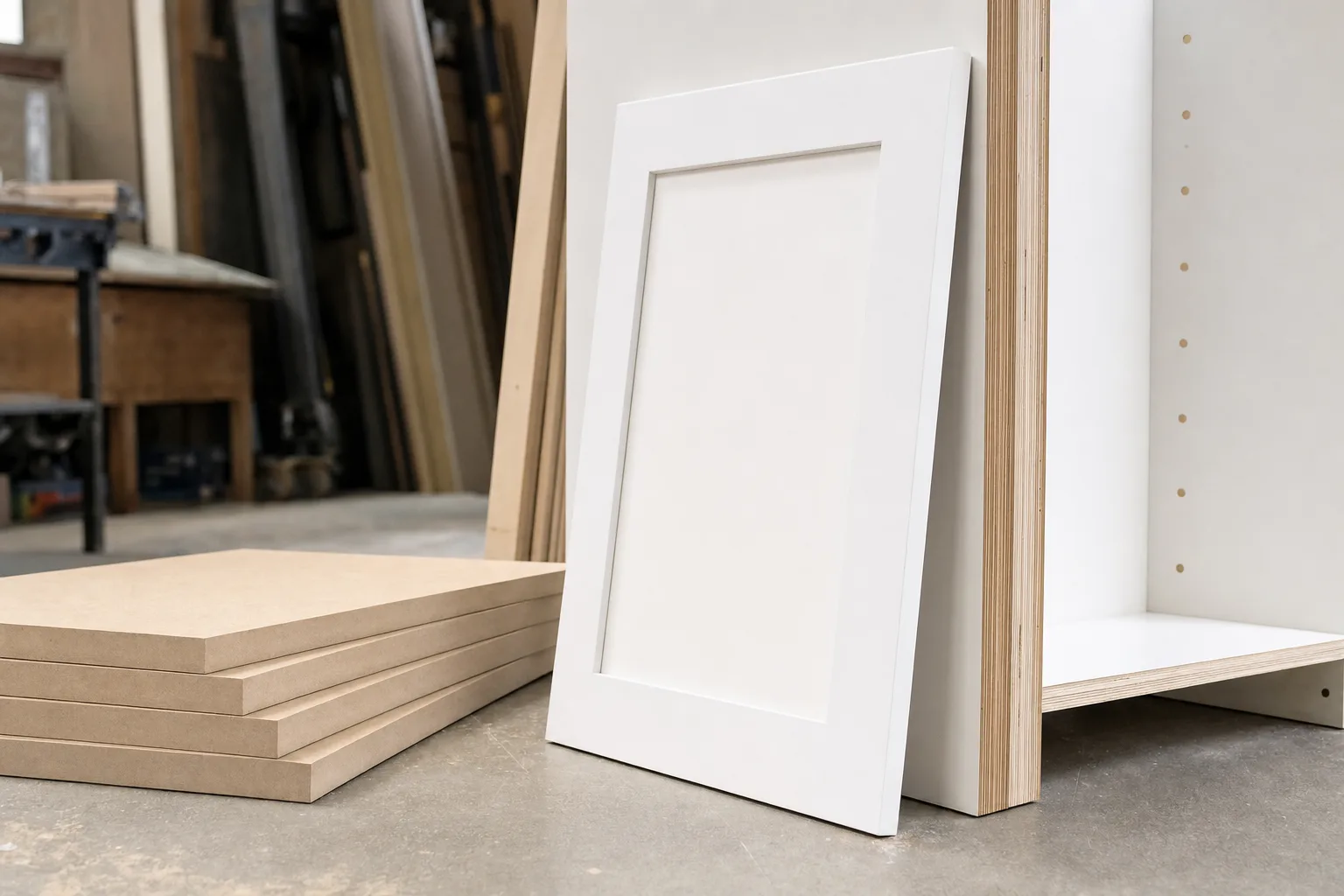
Plywood and MDF are both legitimate cabinet materials; they just suit different jobs. Plywood is a cross-laminated structural panel, often used for cabinet boxes and shelves. MDF is a smooth, grain-free fiberboard that machines cleanly, which makes it a common base for painted doors and panels. Neither label on its own tells you whether a kitchen is well built.
What matters on a quote is which material is used where, what grade and thickness it is, and how its edges are sealed. A quote rarely spells that out, so this guide covers what each material is, where each tends to be used, how each responds to moisture, and the questions that get a straight answer from a dealer.
The three materials people mix up
Plywood is made from "thin layers of cross-laminated wood veneer bonded under heat and pressure," with the veneers "assembled in cross-laminated layers with alternating grain directions," according to APA, the Engineered Wood Association (APA, plywood). APA says that cross-lamination "distributes strength and stiffness in both panel directions" and "reduces shrinkage and swelling compared to solid wood." Cabinet plywood typically has a face veneer chosen for appearance, and the species and grade vary by manufacturer.
MDF, medium-density fiberboard, is made of "cellulosic fibers combined with a synthetic resin or other suitable bonding system and joined together under heat and pressure," according to the Composite Panel Association (CPA, MDF). The CPA describes its surface as "flat, smooth, uniform, dense, and free of knots and grain patterns," with a density profile that "allows intricate and precise machining," and lists kitchen cabinets and doors among its common uses. That smooth, grain-free face and clean routed profile are why it is popular under paint.
Particleboard is the material MDF often gets confused with. The CPA describes it as "cellulosic particles of various sizes" bonded with resin under heat and pressure, made from residual wood such as chips and shavings, and notes it is often paired with laminates and melamine overlays for kitchens and furniture (CPA, particleboard). Particles versus fibers is the key difference: MDF and particleboard are different products, so it helps to know which one a quote actually lists before deciding what you are paying to avoid.
The three panels side by side:
| Plywood | MDF | Particleboard | |
|---|---|---|---|
| What it is | Thin layers of cross-laminated wood veneer bonded under heat and pressure (APA) | Cellulosic fibers bonded with resin under heat and pressure (CPA) | Cellulosic particles of various sizes bonded with resin, made from residual wood such as chips and shavings (CPA) |
| Key property | Strength and stiffness in both panel directions; less shrinkage and swelling than solid wood (APA) | Flat, smooth, grain-free surface that machines precisely (CPA) | Often paired with laminates and melamine overlays (CPA) |
| Where it is common in cabinets | Boxes and shelves | Painted doors and panels | Kitchens and furniture, under laminate or melamine |
| Water | Not waterproof; APA distinguishes bond classifications by exposure | Swelling from water or high humidity is not fully recovered on drying (CPA) | Swelling from water or high humidity is not fully recovered on drying (CPA) |
Where plywood is common: the boxes
The cabinet box (sides, back, floor, shelves) does the structural work. It carries dishes, anchors hinges and drawer slides, and hangs on the wall. Plywood's cross-laminated construction, which APA says gives it strength and stiffness in both panel directions and resistance to warping, is the main reason many buyers want it here.
Box construction varies widely by cabinet line, so look at the actual specification rather than assuming. Two lines Excelle carries show the range. Boxy's published catalogs list a 1/2" eucalyptus plywood box for its framed 1000 Series and a 3/4" eucalyptus plywood box for its frameless series, with 3/4" plywood shelves (Boxy 1000 Series catalog). Bellmont describes its 1300 Series as "all-white melamine construction" (Bellmont 1300 Series). Neither fact on its own makes one kitchen better than the other; what matters is that you know what you're getting and where.
Things worth checking for any box material:
- Thickness. A spec that names the material but not the thickness is incomplete. Ask for both, for the sides, back, floor and shelves.
- Shelf spans. Ask what the shelves are made of, how thick they are, and what span and load they are intended for, especially for long shelves that will hold plates.
- Hardware mounting. Hinges and drawer slides are screwed into the box. Ask how they are fastened and how the manufacturer recommends re-fastening if a screw loosens.
- Moisture exposure. Ask what the box panels are and how exposed edges are finished, particularly at the sink base (more on this below).
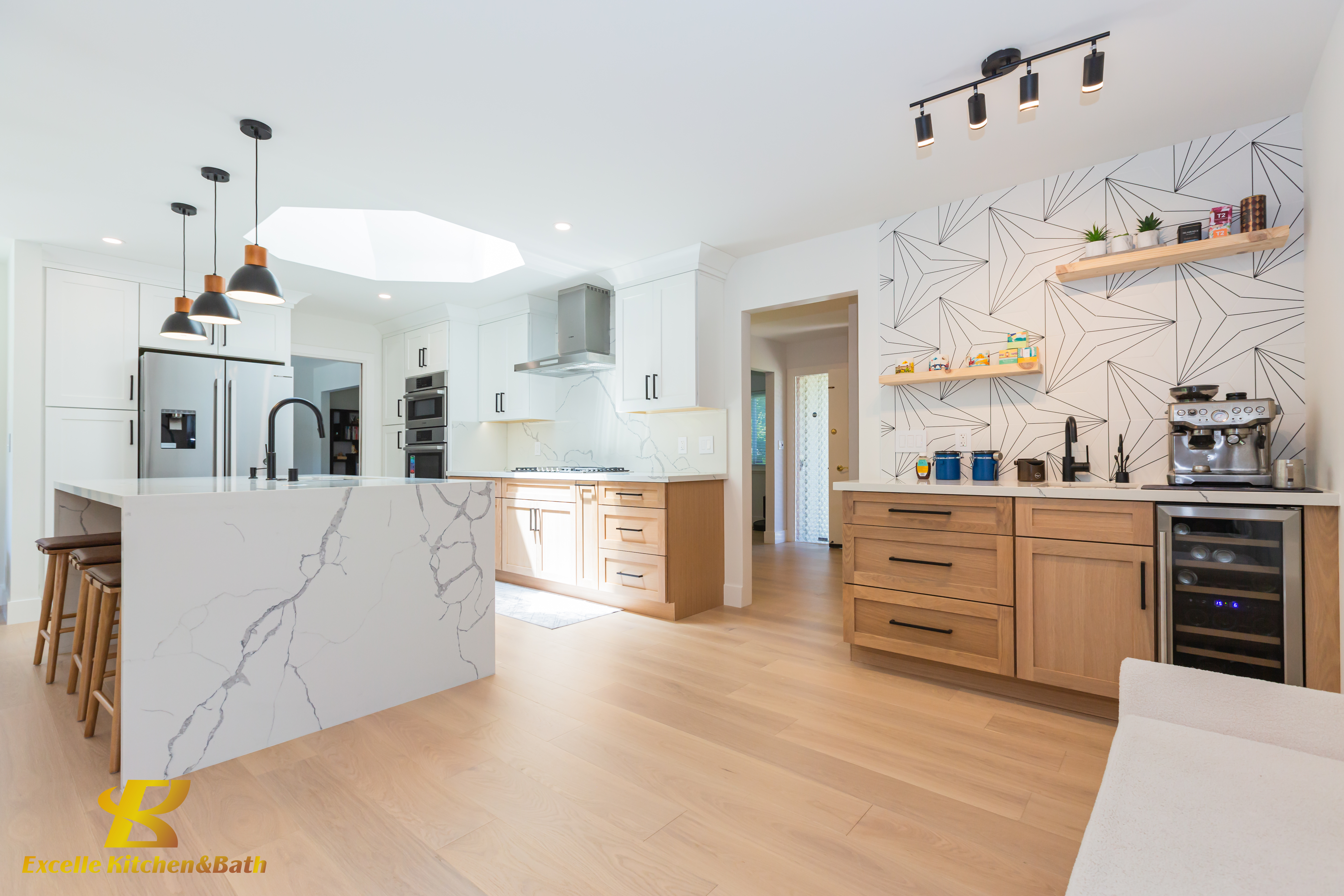
Where MDF is common: painted doors
On a painted kitchen, MDF doors are a common choice, and not only for cost. The reason is how solid wood behaves under paint.
Solid wood responds to humidity. The CPA's technical bulletin on dimensional stability explains that as moisture enters and leaves wood, its volume changes, and that for solid wood "swelling and shrinking is quite different in longitudinal vs. tangential or radial directions" (CPA dimensional stability bulletin). A five-piece shaker door made from solid wood is a frame of rails and stiles around a panel, and seasonal movement at those joints can show through a paint film as fine lines. Manufacturers treat this as normal: Boxy's limited warranty, for example, says visible cracking around the joint areas of painted face frames and doors "is considered a natural characteristic of wood" and is not covered (Boxy limited warranty).
A one-piece MDF door, machined from a single blank, has no rail-and-stile joints to open and no grain to show through the paint, which removes that particular cause of joint lines. MDF is not motionless, though. The same CPA bulletin says MDF and particleboard also swell and expand with high humidity or water, and that swelling beyond the original dimensions "is not reversible." So an MDF door still needs a sound finish and a reasonable indoor environment; Boxy's warranty, for instance, asks for 60–80°F and 35–50% relative humidity indoors. If you are offered solid-wood painted doors, ask how the manufacturer handles joint lines and what its warranty says about them.
The moisture question
Neither material is waterproof. The CPA's bulletin says that when MDF or particleboard swells beyond its original dimensions from high humidity or water, it is "not fully recovered upon re-drying." APA says its structural panels are not waterproof either, and it distinguishes bond classifications for different levels of moisture exposure (APA moisture exposure recommendations). How any cabinet panel holds up depends on its grade and adhesive, how its edges are sealed, and how long it stays wet. Practically:
- Sink base: this is where leaks happen. Ask exactly what the sink base floor and sides are made of and how their edges are finished; many buyers prefer plywood here, and a waterproof liner or mat on the cabinet floor adds protection whatever the material.
- Next to the dishwasher: ask the same questions for the panels beside it, and fix any leak promptly.
- Doors: ask whether doors are finished on all faces and edges at the factory. Any edge that is cut or drilled on site should be sealed according to the manufacturer's instructions.
A common combination, not a rule
One combination you will often see on spec sheets is plywood boxes with MDF used for painted doors and wood or veneer for stained doors. The logic is to assign each material to a job it suits: a cross-laminated panel for the structure, a smooth grain-free substrate under paint, and real grain where the finish is meant to show it. It is not the only sound approach, and lines differ, so treat it as one pattern to compare against rather than a definition of quality. This is the same way we look at framed vs. frameless cabinets: construction choices are systems, not status symbols.
Reading the material spec on a quote
Quotes can hide material decisions behind comfortable phrases. Two deserve a follow-up question:
- "All-wood construction." Particleboard and MDF are made from wood fiber or particles, so the phrase does not tell you which panel is used. If plywood is what you want, ask for the quote to say plywood, with a thickness, and where it is used.
- "Furniture board" and other trade names. Ask which panel it is (particleboard, MDF or plywood) and what surface it has. Any of them can be a reasonable choice in the right place at the right price; it should be a choice you made, not one you discover later.
Five questions that settle the spec with any dealer:
- What are the box sides, back and floor made of, and how thick?
- What are the shelves made of, and what span are they intended for?
- What is the painted door construction: one-piece MDF, an MDF panel in a wood frame, or solid wood?
- What is the sink base made of, and how are its edges finished?
- If plywood boxes aren't standard on this line, what does the upgrade cost?
What to insist on, what to let go
Insist on: a written material spec for boxes, shelves and doors instead of a slogan; a clear answer on the sink base; sealed edges on every MDF component; and a door construction for painted shaker doors that you have asked about and understood.
Let go: the idea that MDF anywhere means a cheap kitchen, or that plywood everywhere guarantees a good one. Material choice is one decision inside a bigger one: which cabinet tier fits your project at all. Our tier comparison and Bay Area cost guide cover that layer, and our design team reads material specs with clients. If you're holding a quote full of comfortable phrases, bring it in and we'll go through which panels are used where.
FAQ: Plywood vs. MDF cabinets
Is MDF worse than plywood for kitchen cabinets?
Not as a rule; they suit different jobs. Plywood's cross-laminated construction gives strength and stiffness in both directions, which is why many buyers want it for boxes and shelves. MDF's smooth, grain-free surface machines cleanly and takes paint well, which is why it is common for painted doors. Both swell if they get wet, so grade, edge sealing and where each is used matter more than the label.
How does the cost of MDF compare with plywood?
This page doesn't publish a per-sheet or per-cabinet price for either, and a fair comparison depends on the cabinet line, the grade and thickness, and the finish. MDF is not automatically the cheaper choice in a finished kitchen, because painted doors carry finishing cost either way. The reliable way to compare is to ask for the plywood box upgrade price in writing on the line you are considering. Our Bay Area cost guide covers the sourced price ranges by cabinet tier.
How do MDF cabinets compare with solid wood cabinets?
Solid wood moves with humidity, and on a painted five-piece door that seasonal movement can show as fine lines at the rail-and-stile joints. A one-piece MDF door has no joints and no grain, so it avoids that, but it swells if it gets wet and does not fully recover. Solid wood or veneer is the better choice where you want visible grain under a stain, since MDF has none. Neither is better in every case: pick by finish, since paint favors MDF and stain favors wood.
How do plywood cabinets compare with furniture board cabinets?
"Furniture board" is a trade name, not a single material, so ask which panel it is: particleboard, MDF or plywood. Plywood's cross-laminated layers give strength and stiffness in both directions. Particleboard is made of wood particles and is often paired with laminates and melamine; the CPA says it, like MDF, does not fully recover from swelling caused by water or high humidity. Any can suit the right place at the right price, so ask for the panel and thickness to be named on the quote.
Do MDF cabinet doors hold up in a real kitchen?
They are widely used in kitchens. A one-piece MDF door avoids the joint lines that seasonal movement can cause on painted solid-wood frame-and-panel doors. Their weakness is water: the CPA says MDF that swells from water or high humidity does not fully recover when it dries, so a sound factory finish on all faces and sealed edges matter.
What should I choose for a sink base cabinet?
Many buyers prefer plywood at the sink base because that is where leaks happen, but no cabinet panel is waterproof. Ask what the sink base is made of and how its edges are finished, add a waterproof liner or mat on the cabinet floor, and fix leaks promptly.
Can MDF cabinet doors be repainted later?
Painted cabinet doors can generally be repainted with proper cleaning, sanding and priming; follow the paint manufacturer's instructions (Sherwin-Williams publishes a cabinet repainting guide). Take care not to sand through routed profiles. MDF has no wood grain, which is why stain-grade doors use wood or veneer instead.
Is "all-wood construction" the same as plywood?
No. Particleboard and MDF are made from wood particles or fibers, so the phrase can describe many cabinets. If plywood is what you want, the quote should say plywood, name the thickness, and say where it's used: boxes, shelves, drawer bottoms, or all three.
How much more does a plywood box upgrade cost?
It depends on the line. Some lines, like Boxy, list plywood boxes in their standard specification; others use melamine or particleboard boxes and may offer plywood as an option. Ask for the upgrade price in writing, and confirm it isn't already included before paying for it.
About the author
Anthony
Design Lead, Excelle Kitchen & Bath
Leads cabinetry and storage design at Excelle Kitchen & Bath, a design studio with a San Jose showroom serving the Bay Area. Ten years of kitchen and custom storage projects, specialising in space planning, semi-custom cabinetry specification, and closet systems.