


What a Full Kitchen Remodel Costs in the East Bay
Where a full kitchen remodel budget goes, what each scope tier buys, and how to sanity-check an East Bay quote line by line.
Scope sets the cost of a full kitchen remodel more than finishes do: a cosmetic refresh that keeps the layout, a full remodel in the existing footprint, and a reconfiguration that moves walls and mechanicals are three different projects. Bob Vila's kitchen remodel cost guide, using Angi and HomeAdvisor data, puts small-scale remodels at $10,000–$20,000, mid-scale at $20,000–$65,000 and large-scale at $65,000–$130,000 nationally. Those are national figures; an East Bay quote should be read against its scope, not against the national number.
Knowing which tier a quote describes matters, because two "kitchen remodels" in Lafayette can differ by tens of thousands of dollars and both be priced fairly for what they include. What separates them is scope, and a quote does not always spell it out.
What follows is a general checklist for reading a remodel quote yourself. It covers the full project budget — cabinets are one line item here; for a deep look at that line specifically, see our Bay Area cabinet cost guide.
Where the money actually goes
A full kitchen remodel budget can be sorted into a handful of buckets. The same Bob Vila guide reports that cabinets and hardware typically take about 40 percent of the budget and installation and labor about 25 percent, and gives national ranges for several other lines:
- Cabinets and hardware: about 40% nationally. The single biggest line, and the one with the widest quality range.
- Installation and labor: about 25% nationally. Demo, framing, drywall, tile, paint, finish carpentry. This is the line most sensitive to local trade rates, so it's where a local quote is most likely to differ from national averages.
- Countertops: $1,870–$4,400 nationally. Material choice moves this line most; exotic slabs and waterfall edges push higher.
- Appliances: $1,200–$2,100 for a basic package, $13,000 or more for high-end or custom built-in packages, nationally. A bucket where your own choices move the number a great deal.
- Electrical and plumbing. Usually smaller if everything stays put and larger if circuits, panels, or drain lines move. Ask each bidder whether the existing electrical panel was assessed and whether any upgrade is included.
- Flooring and lighting: $1,000–$4,000 and $500–$2,000 nationally.
- Design, permits, and fees. Permit fees are set by your city's building department.
If a quote can't be sorted into these buckets, ask the bidder to break it down before you compare totals.
What each scope tier actually buys
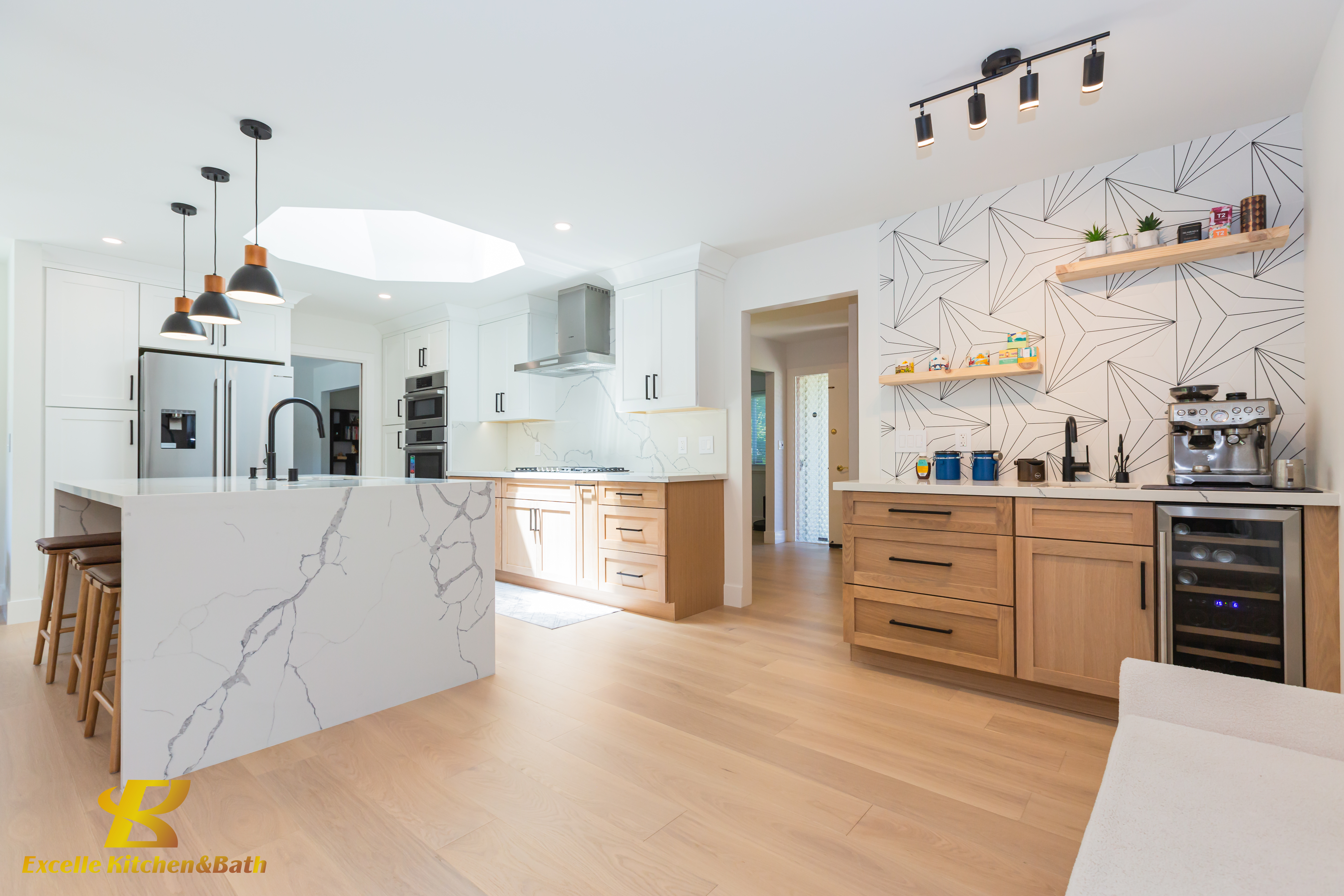
For comparing quotes, it helps to think of full remodels in three illustrative scope tiers:
The refresh. Layout stays exactly where it is. Cabinets are flat-pack or entry semi-custom, counters are mid-range quartz, appliances are replaced like-for-like, and the electrical work is limited to code-required updates. This is a real remodel and can look excellent — but it only holds if nothing structural or mechanical surprises you behind the drywall.
The standard full remodel. A number that surprises a first-time remodeler can be ordinary pricing for this scope. Semi-custom cabinetry designed to the space, one or two layout changes (an opened wall, a relocated sink), new lighting plan, permitted electrical and plumbing, tile work, and mid-to-upper appliances.
The reconfiguration. Walls move, gas lines move, structural beams appear, and the kitchen often grows into adjacent space. Custom or premium semi-custom cabinetry, slab counters with details, designer lighting. At this tier, the general contractor's coordination of trades and inspections is a large part of what you are paying for.
The tiers aren't about taste — they're about scope. A frequent source of sticker shock is comparing a tier-two quote against a tier-one expectation.
The keep-the-layout rule
One decision moves a project between tiers faster than any material choice: whether the sink, range, and refrigerator stay where they are. Keeping them in place usually lets the existing plumbing, gas or electrical supply, and ventilation be reused, though an older service may still need upgrades. Moving the sink may mean new drain and supply routing — on a slab foundation that can involve cutting into concrete, depending on the house and the design. Moving a gas range may mean new gas routing and a new hood duct path. Have the contractor assess the actual routing before pricing. None of this is a reason not to fix a genuinely bad layout — a kitchen you'll cook in for twenty years deserves the right geometry — but it should be a conscious trade, priced before demolition, not discovered after it.
This is also where planning time is worth spending. A good space plan can sometimes find the storage and workflow you wanted without moving mechanicals at all — the cheapest wall to move is the one you never touch.
East Bay labor and permits
The installation-and-labor line is the one most sensitive to local trade rates, which is one reason an East Bay quote may not match a national cost article. Permit requirements and fees are set city by city, so check your building department's current rules and fee schedule before work starts; plan-check and inspections also add calendar time.
Two scheduling points worth raising with every bidder: ask for the lead time on your cabinets and other ordered materials, since a long-lead item can set the whole calendar; and ask how inspections fit the sequence, since in permitted work inspectors review rough work before walls are closed up.
Where quotes hide their differences
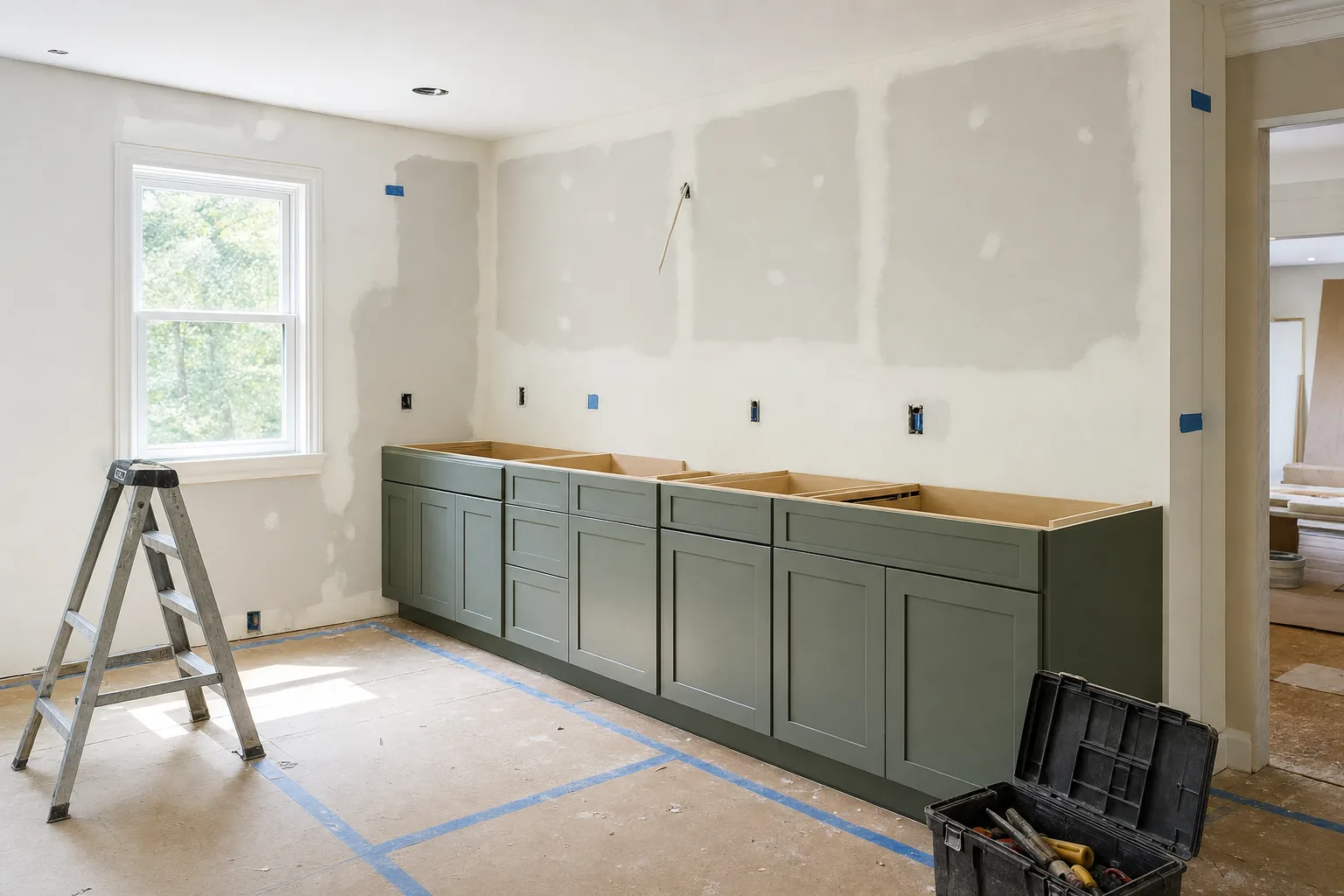
When two bids for "the same kitchen" land far apart, look for the gap in these places first:
- Allowances. "Countertop allowance: $3,000" is not a countertop price — it's a placeholder that can become a change order if the material you pick costs more. A low allowance can make a bid look lower than the kitchen you will actually choose.
- What "install" includes. Cabinet install, appliance hookup, haul-away, and patch-and-paint each may or may not be inside.
- Electrical scope. One bid may assume the panel is fine while another prices an upgrade. Ask each bidder what they checked.
- Who manages the project. A general contractor's fee pays for sequencing trades, scheduling inspections, and a single point of responsibility. Managing the project yourself saves that fee but puts that coordination on you.
- Contingency. Many budgets include a contingency for conditions found once walls are open. A bid with zero contingency hasn't eliminated that risk — ask how hidden conditions would be priced.
How to sanity-check a quote
- Sort every line into the buckets above. Anything unsortable, ask about.
- Circle every allowance and re-price it against something you'd actually choose.
- Confirm which tier the scope describes, and compare it only against quotes in the same tier.
- Ask what happens to the price if the layout stays fixed — the answer reveals how much of the budget is mechanical relocation.
- Check the cabinet line carefully: in Bob Vila's national breakdown it is the largest share of the budget.
Our part of a remodel is the cabinetry and storage. Excelle is a cabinet and storage design studio: we plan the space, design the cabinetry, and guide product selection, using premade manufacturer lines for most kitchens and the Excelle custom line for odd-sized or non-standard spaces. For trades we do not provide, we connect you with partners we work with regularly; our kitchen remodel design page sets out which parts of a remodel we handle and which your contractor does. If you are planning the cabinet side of a remodel, see how we approach kitchen design or book a design consultation and bring measurements, a floor plan, or photos.
FAQ: East Bay kitchen remodel costs
Is a $70,000 quote for a kitchen remodel in Walnut Creek normal?
It can be. A full remodel with permitted electrical and plumbing work, semi-custom cabinets, and new counters would fall in Bob Vila's national large-scale range ($65,000–$130,000, using Angi and HomeAdvisor data), just above the mid-scale range ($20,000–$65,000). National bands can't tell you whether a specific Walnut Creek bid is fair: size, exclusions, existing conditions and specifications all move it. The useful test is to compare itemized local bids for the same scope.
What's the cheapest way to cut a remodel budget?
Two levers to discuss with your contractor: keeping the layout fixed, which can avoid relocating plumbing, gas and ventilation, and choosing simpler appliances, where the national ranges above run from basic packages around $1,200 to high-end packages of $13,000 or more. Neither has to touch storage design or counter workspace.
Do I need permits to remodel a kitchen in the East Bay?
A full remodel that involves electrical, plumbing, or structural work will generally need permits, but the rules are set by each city. Check your building department's current requirements before replacing appliances, sinks, countertops or cabinets, not only before moving walls; painting is the kind of change least likely to need one.
How long does a full kitchen remodel take?
Construction time depends on scope and on what the walls hide, and the calendar before demo matters as much: design, permits, and cabinet lead time all come first, so ask each bidder for a written schedule that includes material lead times.
Should I remodel before selling my house?
That is a question for your real-estate agent, who knows local buyers and comparable sales. From a design standpoint, a full remodel designed for someone you've never met is a bet on their taste; a smaller refresh is a smaller bet.
Why do quotes vary so much between contractors?
Often because they describe different scope and allowances. One bid may price likely hidden conditions and realistic materials; another may price best-case assumptions with placeholder allowances. Normalize the scope first, then compare what remains.
About the author
Anthony
Design Lead, Excelle Kitchen & Bath
Leads cabinetry and storage design at Excelle Kitchen & Bath, a design studio with a San Jose showroom serving the Bay Area. Ten years of kitchen and custom storage projects, specialising in space planning, semi-custom cabinetry specification, and closet systems.