


Cabinet Hardware: Pulls, Knobs & Hinges That Last
How to choose cabinet pulls, knobs, and hinges that hold up to daily use and fit your cabinet style, from finish to placement.
Why Hardware Gets Underestimated
Hardware is often one of the last decisions in a kitchen project. After weeks spent choosing cabinet lines, door styles, and finishes, pulls and knobs can feel like a five-minute afterthought picked off a sample board at the counter. It deserves more time than that, because hardware is the part of a cabinet you touch every single day. A door style you love but rarely put your hand on matters less to daily comfort than a pull that feels solid, sits at a comfortable angle, and stays firmly attached.
Hardware also does more visual work than most homeowners expect. The same shaker door reads completely differently with a slim bar pull in matte black versus a traditional bin pull in brushed brass. It's the detail that signals whether a kitchen feels modern, traditional, or transitional, and it's far cheaper to get right than a full door style change if the kitchen ends up feeling off after installation.
Beyond looks, hinges in particular affect how doors behave over time. Hinge maker Blum sizes the number of hinges on a door by the door's weight, height and width, which is a reminder that a hinge is a load-bearing part, not trim. A short sample in the hand at a showroom tells you about grip and finish; the hinge specification on the cabinet order tells you about the doors. Both deserve real consideration rather than a last-minute pick.
Pulls vs. Knobs: Where Each One Belongs
Pulls and knobs aren't interchangeable, even though they get treated that way in casual conversation. Knobs are a single point of contact, usually round or a simple shape, and work well on doors where you're opening with a light touch, like upper cabinets. Pulls give you a full-hand grip along a bar, which matters more on drawers, especially lower drawers that carry heavier loads like pots, pans, or small appliances.
A common and durable approach: knobs on doors, pulls on drawers. This isn't a hard rule, plenty of kitchens use pulls throughout for a cleaner, more contemporary look, but the logic behind the mixed approach is simple: a bar pull gives your whole hand something to hold on a drawer you pull toward you, while a knob is easy to pinch on a door you swing open.
For drawer pulls, length is mostly a matter of proportion. A common visual rule of thumb is a pull around a third of the drawer's width, and some designers put two shorter pulls on very wide drawers instead of one long one. Treat that as optional styling guidance, not an ergonomic requirement: the practical checks are whether your fingers fit comfortably behind the bar and whether the drawer opens smoothly when you pull it, both easiest to judge by holding a sample against a real drawer front.
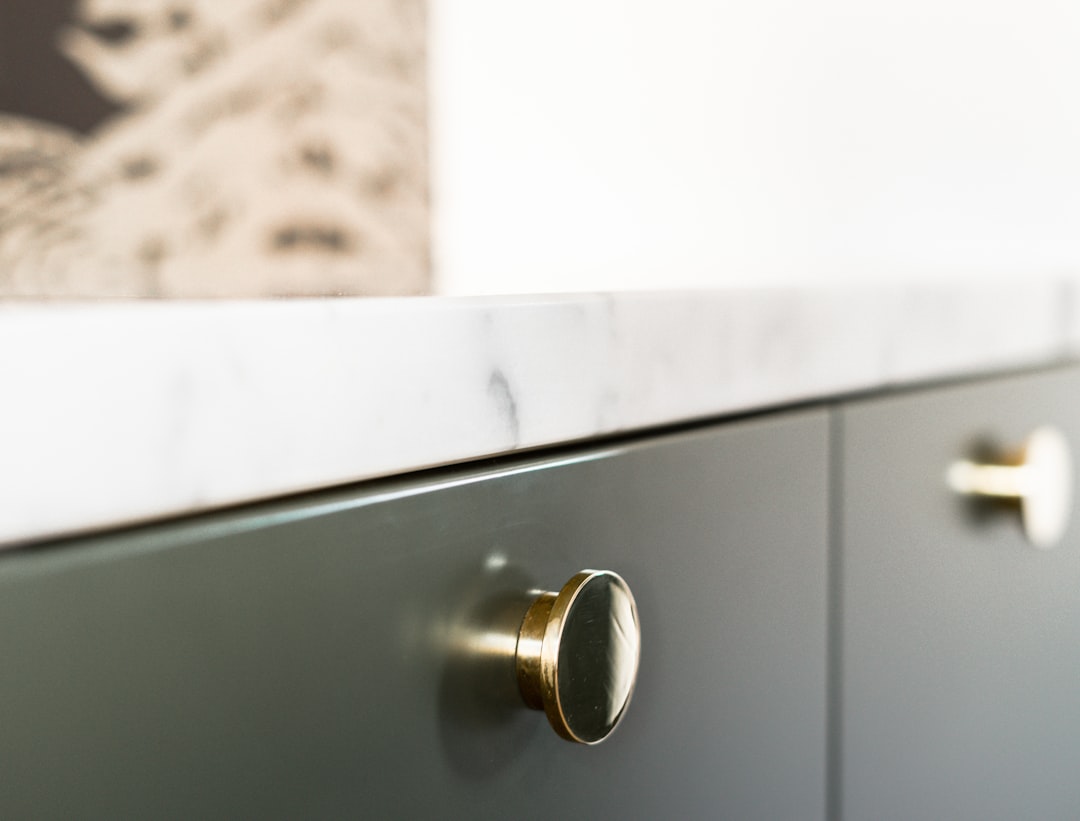
A single knob style, like this warm brass finish, can shift the whole feel of a kitchen door.
Finishes: Matching Hardware to the Rest of the Room
Hardware finish should relate to the other metal finishes already in the kitchen, faucet, cabinet hinges if visible, light fixtures, and appliance hardware, but it doesn't have to match exactly. A popular, forgiving approach is picking one dominant metal tone (matte black, brushed brass, polished nickel, or brushed stainless) for hardware and faucet, and letting light fixtures play a supporting or contrasting role.
Each finish family behaves differently in a room. Matte black stands out strongly against white and light cabinets and reads quieter against dark ones. Brushed or satin brass adds warmth and is often paired with wood tones and cream or sage cabinet colors. Brushed stainless and nickel are the neutral option, and in a kitchen with stainless appliances they sit close to the finish already in the room. How any of these handles fingerprints depends on the specific product, so handle a sample before you order.
One detail that trips people up: polished chrome and brushed nickel can look similar in photos but differ in person: polished chrome is mirror-like, while a brushed finish has a softer sheen. Always look at a physical sample under your kitchen's actual lighting before committing, since hardware finish samples viewed under warm showroom lighting can look noticeably different under daylight or LED under-cabinet lighting at home. If you're still deciding between cabinet lines and finishes together, our guide to the cabinet lines we carry compares the lines side by side.
Hinges: The Hardware You Don't See but Definitely Feel
Hinges rarely get discussed because they're hidden inside the cabinet, but they decide how every door opens and closes. A soft-close hinge has a built-in damper that slows the door in the last part of its swing; Blum describes its BLUMOTION version as being "for soft and effortless closing." Whether soft-close is included varies by cabinet line, so when you compare lines, check the specification for the one you're considering and ask whether it can be added and what that costs.
Door size and weight drive how many hinges a door needs. Blum's own guidance says "the door weight is key in determining the number of door hinges required," recommends two hinges for doors of 4–6 kg and three for 6–12 kg, notes that tall, narrow doors may be wiser with three hinges "for extra stability," and calls for an additional hinge on wider doors. If you are putting new, heavier doors on existing cabinets, check the hinge count and model against the new door's size and weight rather than assuming the old hinges carry over.
Two separate questions decide which hinge fits: how the cabinet box is built (with a face frame or frameless) and how the door sits on it (the overlay or inset). Concealed cup hinges are made for both constructions. Blum's COMPACT line, for example, is a concealed hinge for face-frame cabinets, offered in partial-overlay and full-overlay versions, while frameless cabinets mount concealed hinges directly to the cabinet side. So the hinge model follows from the construction and the door overlay together. If you're not sure which construction type your kitchen uses, our framed vs. frameless comparison explains the difference and why it affects more than just hardware.
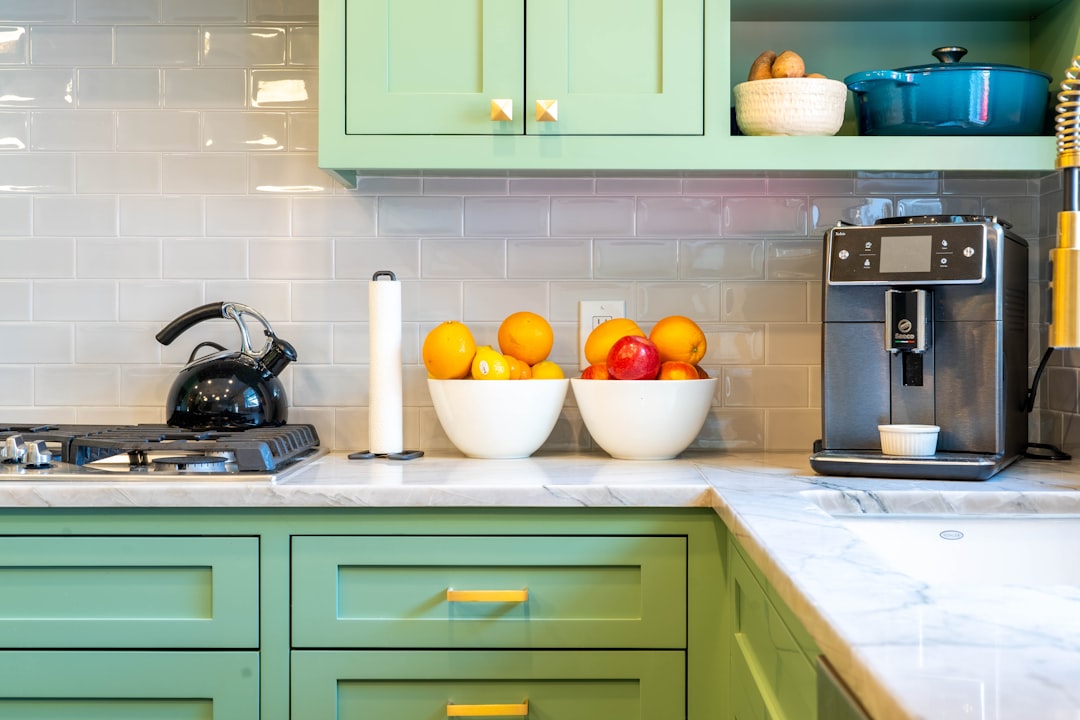
Bar pulls in a warm metal tone against a saturated cabinet color create clean visual contrast.
Placement and Sizing: Getting the Details Right
Hardware placement follows a few conventions worth knowing before you finalize an order, even if you eventually deviate from them for style reasons. On doors, knobs are typically placed at the corner closest to where the door opens, roughly 2 to 3 inches in from each edge. On drawers, a single knob is usually centered horizontally on the drawer front, while pulls are mounted horizontally and centered as well, unless the drawer is tall enough to warrant vertical orientation.
Tall cabinets and pantry doors sometimes use vertical pulls instead of horizontal ones, mounted along the leading edge of the door for a full-length grip. This works particularly well on pantry cabinets covered in our pantry design guide, where a full-height pull makes the door easier to grab when your hands are full of groceries.
Consistency across the kitchen matters more than most homeowners initially plan for. Mixing hardware sizes and mounting heights from cabinet to cabinet, even by fractions of an inch, creates a visually uneven look that's hard to unsee once you notice it. Installers should template hardware placement across the full cabinet run before drilling, rather than measuring each door individually by eye.
Budgeting for Hardware Without Blowing the Plan
Hardware cost varies enormously by material and brand, from basic builder-grade options to solid brass designer pieces, and it's easy to underestimate the total because each individual pull or knob looks inexpensive on its own. A kitchen with 30 to 40 cabinet doors and drawers adds up fast once you multiply a per-piece price across the whole project, so it's worth pricing the full hardware count early rather than after the cabinet order is placed.
If budget is tight, prioritize spending on the pieces you touch most, main drawer pulls and the pulls on your most-used cabinets, and save on hardware for rarely opened doors like a seldom-used appliance garage or a high cabinet. Buying one consistent, mid-range line across the whole kitchen usually looks more consistent than mixing a few expensive statement pieces with a lot of the cheapest option available, since the inconsistency in material quality tends to show.
It's also worth asking your design studio whether hardware is included in your cabinet package or priced separately, since this varies by cabinet line and can shift your overall budget more than people expect walking into the first design meeting. For a full breakdown of what actually drives kitchen project cost beyond hardware, our kitchen cabinet cost guide walks through the bigger cost drivers. You can compare the cabinet lines we carry on our brands page.
Quick Reference: Matching Hardware to Cabinet Type
Here's a fast checklist to sanity-check your hardware plan before placing an order:
- Upper cabinet doors: knobs, mounted 2-3 inches from the opening-side corner.
- Lower cabinet drawers: bar pulls centered horizontally, sized by eye (about a third of the drawer width is a common rule of thumb) and checked for finger clearance on a sample.
- Tall pantry or appliance garage doors: vertical pulls running the length of the leading edge for a full-hand grip.
- Framed cabinets: a hinge made for face-frame mounting (concealed face-frame hinges exist), matched to your door overlay.
- Frameless cabinets: a concealed hinge for frameless mounting, matched to your door overlay; confirm whether soft-close is included.
- Hinge count: checked against each door's weight, height and width.
- Finish consistency: one dominant metal tone for hardware and faucet across the whole kitchen.
- Budget priority order: main drawer pulls first, high-traffic door knobs second, rarely opened cabinets last.
Running through this list against your cabinet drawings before finalizing an order catches most placement and finish mismatches before they reach the wall.
Types of Drawer Pulls: A Quick Reference
"Drawer pull" covers more ground than most people realize when they start shopping. Knowing the basic categories before you browse a hardware wall or a supplier catalog saves a lot of back-and-forth later in the selection process.
- Bar pulls: A straight bar mounted on two posts, the most common style in modern and transitional kitchens. Available in short (3-4") lengths for narrow drawers up to long (18"+) appliance-pull styles for wide drawer fronts.
- Cup or bin pulls: A curved, half-moon shaped pull that mounts on the face of the drawer, with your fingers hooking into the underside of the cup. A familiar look in traditional and farmhouse-style kitchens.
- Edge pulls: A slim strip of hardware mounted along the top edge of a drawer front rather than on its face, giving a nearly invisible, minimalist look that suits slab-front modern kitchens.
- Finger pulls (integrated pulls): A routed channel cut directly into the door or drawer edge, requiring no applied hardware at all. Because it is part of the door or drawer itself, it has to be chosen when the cabinets are specified.
- Appliance pulls: Extra-long bar pulls, typically 12 inches or longer, sized for wide drawers, pull-out trash pullouts, or paneled refrigerator and dishwasher fronts that need a substantial grip.
If you're not sure which style fits, the hardware on display in our San Jose showroom lets you hold a pull against a door style, since photos rarely capture how a pull profile feels in the hand or reads against a specific door style. You can see the cabinet lines we carry on our brands page.
FAQ: Cabinet Hardware
Should cabinet knobs and pulls match throughout the kitchen?
They don't have to match exactly, but they should relate. A common approach is knobs on doors and pulls on drawers, all in the same finish, which reads as intentional rather than mismatched. Mixing finishes across the kitchen usually only works when done deliberately, like brass on an island and nickel elsewhere.
What's the standard size for cabinet drawer pulls?
There's no single fixed standard. A common visual rule of thumb is a pull about a third of the drawer's width, but it is a styling guide, not a requirement. Narrower drawers often use pulls around 4 to 6 inches, while wider drawers can use pulls of 8 inches or more, or two shorter pulls spaced apart.
Do soft-close hinges cost much more than standard hinges?
It depends on the cabinet line. Some lines include soft-close hinges and others price them as an option, so the useful comparison is the line-item on your own quote. What you pay for is a damper that slows the door as it closes, so doors shut quietly instead of banging.
Can I replace cabinet hardware without replacing the cabinets?
Yes. Swapping pulls and knobs leaves the cabinets in place, so it is a far smaller job than new cabinetry. The easiest swap is new hardware with the same hole spacing (center-to-center distance) as the old, so it uses the existing holes. If the spacing differs, the old holes need filling and the finish around them touching up, and that repair may still show, especially on stained wood. For hinges, check that replacements are made for your cabinet construction and door overlay.
How do I know if my hinges are the right weight rating for my doors?
Check the hinge maker's sizing guidance against each door's weight, height and width. Blum, for example, recommends two hinges for doors of 4–6 kg and three for 6–12 kg, with an extra hinge on tall, narrow or wider doors. If a door is out of line, have the hinge adjustment and mounting checked first; misalignment has more than one possible cause.
What are the different types of cabinet hardware?
Cabinet hardware falls into a handful of clear categories, and knowing the names helps when you're comparing quotes or browsing a hardware wall. Knobs are single-point fasteners, usually round, square, or an oval "football" shape, mounted with one screw and best suited to doors and light-use drawers. Bar pulls are the straight, horizontal handles most common on drawers and modern slab or shaker doors; they come in lengths from 3 inches up to 24-plus inches for wide drawer fronts. Cup pulls (sometimes called bin pulls) are half-moon pulls that mount on the drawer face, with your fingers hooking under the cup, a look borrowed from traditional dresser hardware. Edge pulls mount along the top edge of a slab door and stay almost invisible from the front. Appliance pulls are the extra-long bar pulls, typically 12 inches or longer, used on panel-ready refrigerators, dishwashers, and tall pantry doors that need a full-hand grip. Beyond the visible pieces, hinges (concealed hinges exist for both frameless and face-frame cabinets, each matched to the door overlay) and touch-latch or push-to-open mechanisms, which let a handleless door pop open with a light press, round out the category. Most kitchens mix two or three of these: knobs on doors, bar pulls on drawers, and concealed hinges throughout, unless the design calls for a fully handleless look with edge pulls and push-to-open hardware instead.
How much should I budget for cabinet hardware?
Hardware is a small line item relative to the cabinets themselves, but it adds up across a full kitchen. A full kitchen can easily need a few dozen pulls and knobs, and per-piece prices vary widely between builder-grade pieces and solid brass from a named hardware line, so price the whole count early rather than one piece at a time. If soft-close hinges are an option rather than included on your cabinet line, confirm that cost directly against your specific cabinet quote.
Can I mix hardware finishes in one kitchen?
Yes, within reason. The safest version of mixing is one dominant finish for cabinet hardware and faucet, with a second finish reserved for light fixtures or a single accent, like a range hood. Mixing three or more finishes across a small kitchen tends to look unplanned rather than intentional.
About the author
Anthony
Design Lead, Excelle Kitchen & Bath
Leads cabinetry and storage design at Excelle Kitchen & Bath, a design studio with a San Jose showroom serving the Bay Area. Ten years of kitchen and custom storage projects, specialising in space planning, semi-custom cabinetry specification, and closet systems.