


What Built-In Bookshelves Cost (and What Drives It)
Market ranges from IKEA hacks to cabinetry-grade built-ins, the cost drivers, and when DIY genuinely holds up.
Five things move the price of a built-in, in roughly this order: who builds it (trade carpenter or cabinet shop), whether it's paint-grade or stain-grade, the depth and span of the shelves, whether base cabinets sit underneath, and whether lighting or electrical is integrated. Change any one and the quote can change substantially — which is why a weekend shelf hack and a full library wall can both be honestly priced.
Those five variables also explain the confusing part of shopping for built-ins: "built-in" isn't one product. It names at least three kinds of construction, built by different trades, to different standards, and quoted against different assumptions about what the finished thing should be.
The three tiers, and their real price ranges
1. The IKEA-hack and modular tier. Billy or Pax carcasses trimmed with filler strips, baseboard, and crown, then painted to read as built-in. Bob Vila's cost guide, which draws on Angi, HomeAdvisor and Fixr data, reports DIY built-ins costing anywhere from $100 to $3,500, plus your own labor, which depends on the size of the wall, your tools and your experience. Done patiently, it photographs remarkably well. Its limits are structural: shallow fixed depths, visible shelf pins, particleboard spans that sag under real book loads, and trim that reveals itself at close range.
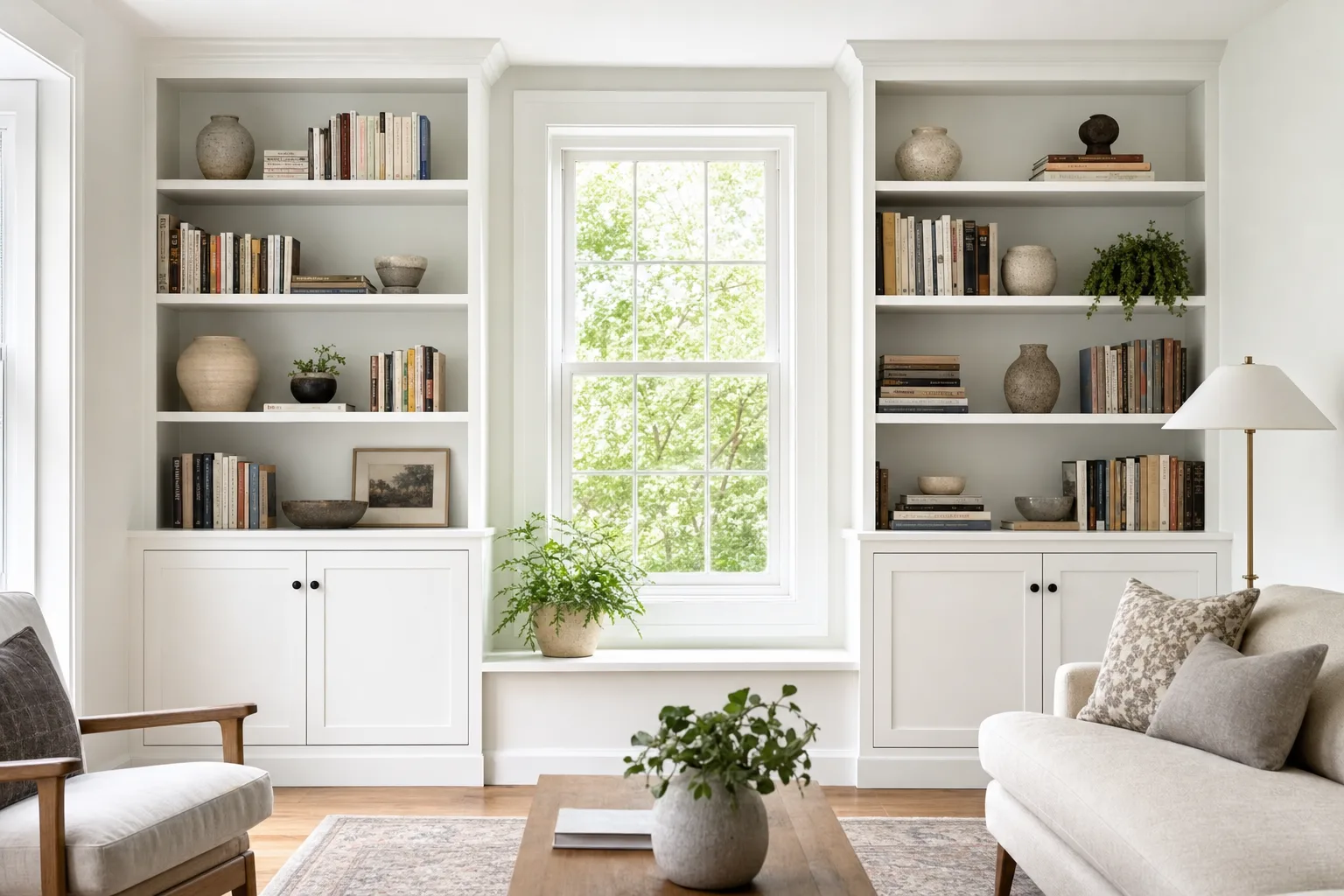
2. Carpenter-built paint-grade. A finish carpenter builds the unit in place or in sections from plywood and poplar face frames, caulked and painted. The same guide puts plywood built-ins at $150–$500 per linear foot installed — roughly $1,800–$6,000 for a 12-foot wall — and those are national figures, so local labor rates move them; get quotes where you live. This is the workhorse tier: real spans, real depth options, integrated baseboards, solid under load.
3. Cabinetry-grade. Shop-built cases with cabinet construction — adjustable interiors on system holes, doors and drawers below, stain-grade veneers or catalyzed painted finishes, integrated lighting. Bob Vila's guide lists hardwood at $500–$1,000 per linear foot installed and custom built-ins generally at $150 to $1,200 or more per linear foot; a library wall with base cabinets and a rolling ladder sits at the top of those ranges. What you're buying is furniture that happens to be attached to the house.
What actually drives the number
Two quotes for "the same wall" can differ substantially when they assume different answers to these questions. These are the levers that move them:
- Depth and what lives below. Open 11–12” shelving is the cheap part. Add 18–24” base cabinets with doors and drawers — the classic window-seat-and-media-wall move — and you've added kitchen-cabinet economics to the bottom third. It's usually worth it: closed storage below is what keeps the open shelves above from becoming clutter display.
- Paint-grade versus stain-grade. Paint forgives joints, filler, and poplar. Stain-grade demands matched veneers, clean hardwood, and grain-conscious assembly, and it costs more than paint-grade.
- Span and sag. There is no single safe shelf length: how far a shelf bends depends on the material, its thickness and depth, the load, how the load is spread, how the ends are held and whether it has an edge strip. The free Sagulator calculator models exactly those inputs, and notes that a fully loaded bookshelf weighs 20–40 pounds per running foot and that wood shelves keep sagging over time beyond their initial deflection. When a proposed span fails that kind of check, the fixes are partitions, thicker or edged shelves, or metal reinforcement — and each adds cost, which is one reason quotes differ.
- Lighting and power. Integrated LED channels, puck lights, and outlets inside the unit pull an electrician into the project, so they belong in the drawings from the start.
- Scribing to the room. Older plaster walls can bow and ceilings can run out of level across a room. Fitting a rigid unit to a room that isn't square takes skilled hours, which is why in-place carpentry and shop-built cases both bill real fitting time here.
Built-ins as architecture, not furniture
The projects that justify the upper tiers share a trait: the built-in is doing an architectural job. A window seat with drawers that turns a bay into a destination. A media wall that swallows the equipment and the cable chaos. Bookcases flanking a fireplace that make a bland living room read as designed. A hallway that becomes a library. In these, the shelving is load-bearing for the room's whole identity — and the difference between tier two and tier three is visible from the doorway every day.
This is also where storage design discipline pays: the same inventory-first thinking we apply to closet design applies to book walls. Measure the collection — the tallest and deepest books you actually own, since formats vary widely — and let the real objects set shelf depth and spacing, instead of defaulting to even rows that fit nothing well.
The DIY honesty section
If your wall is straight, your books are normal-sized, and your standard is "looks great from four feet," the modular-hack tier is legitimately good, and we'd rather say so than sell you a wall. Spend your upgrade money on two things first: anchoring to the wall (the CPSC's Anchor It campaign says "anchoring all furniture with drawers, doors, and shelves to the wall prevents tip-over injuries and deaths") and running each long shelf through a sag calculator, then adding support wherever it says the span won't hold your books. The tier-one projects that disappoint fail on sag and wobble, not on style.
Where DIY hits its ceiling: base cabinets with working drawers, stain-grade finishes, spans, lighting, and rooms where nothing is square. Those are the points where a DIY project grows much larger than planned, and where the per-foot math of hiring the work out starts winning.
Who should build yours
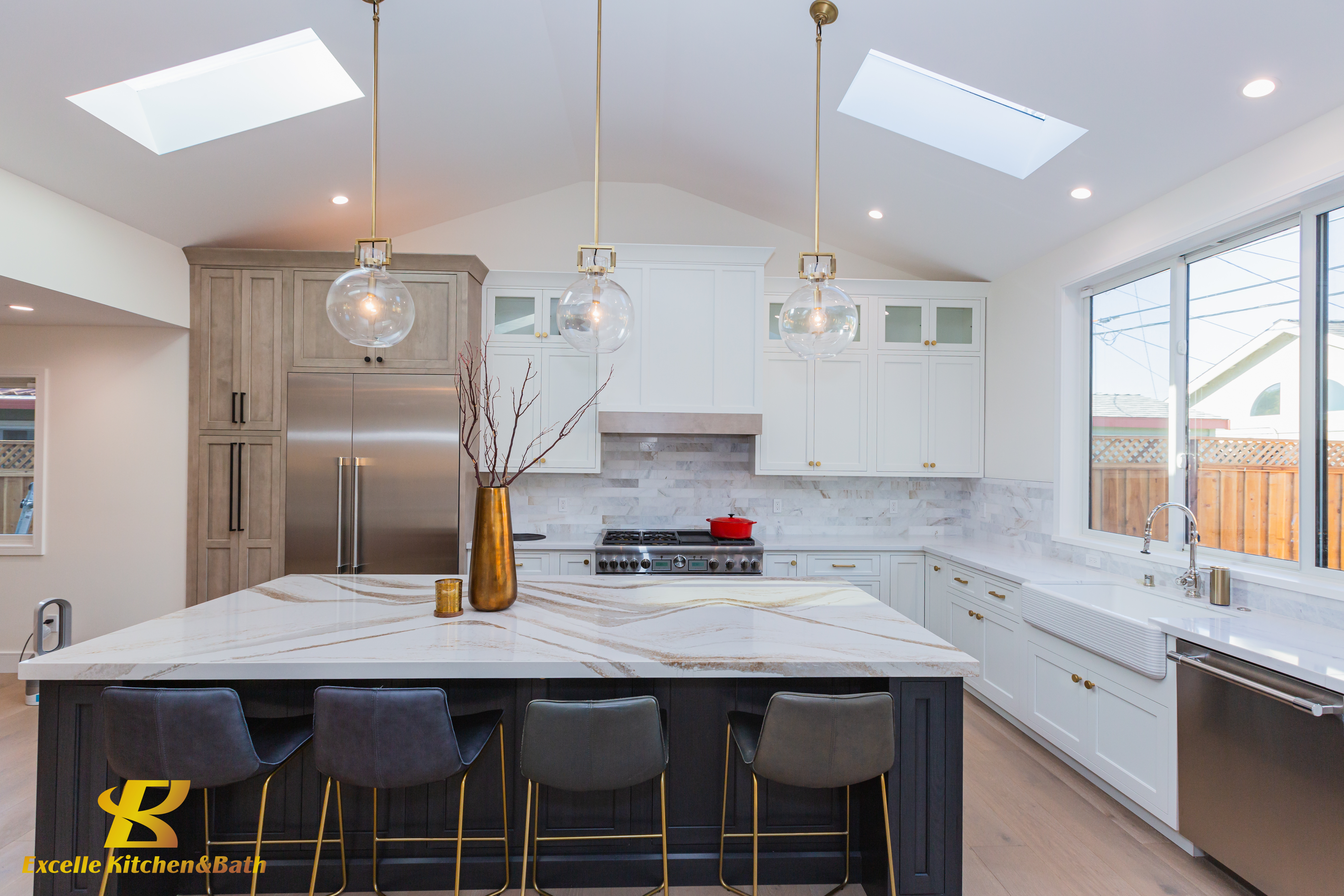
Tier two belongs to a good finish carpenter — it's their home turf. Tier three is cabinetry: shop-built cases mean better joinery, sprayed factory-quality finishes, adjustable interiors, and drawer hardware from the kitchen world. It's the same construction logic as our kitchen work pointed at a different wall, which is why cabinetry studios quote library walls, media walls, and window seats alongside kitchens — and why the drawer slides in a good built-in feel suspiciously like the ones in a good kitchen. If you're weighing a wall, bring us the room dimensions and a photo; we'll tell you honestly which tier the project wants, including when the answer is a carpenter or an IKEA hack.
FAQ: Built-in bookshelf costs
How much do built-in bookshelves cost per linear foot?
Bob Vila's cost guide, drawing on Angi, HomeAdvisor and Fixr data, reports custom built-ins at $150 to $1,200 or more per linear foot, with plywood at $150–$500 and hardwood at $500–$1,000 per linear foot installed. It puts the national average project at $2,853, within a typical $1,290–$4,420 range, and DIY builds anywhere from $100 to $3,500. These are national figures; local labor moves them.
Are built-in bookshelves worth it for resale?
Nobody can promise a resale return on them: built-ins are taste-specific and permanent, and a buyer who doesn't share the taste sees work to undo. Buy them for the years you'll use them, not for the appraisal.
What depth should bookshelves be?
Deep enough for the deepest books you plan to keep on that shelf — measure your own collection rather than trusting a rule of thumb, because book formats vary widely. Base cabinets below are a separate decision about closed storage. Deeper open shelving than the objects it holds just collects a second row of clutter in front of the first.
How do I keep long shelves from sagging?
Check the actual shelf — material, thickness, depth, span and expected book load — with a calculator such as the Sagulator, which suggests targeting 0.02 inch of sag per foot or less. If a span fails, add vertical partitions, move to thicker or edged shelves, or spec metal reinforcement.
Can built-ins go over baseboard heating or vents?
Treat heaters and duct vents as two different questions. A baseboard heater comes with its manufacturer's installation instructions, including required clearances to nearby objects; those instructions decide what may be built near it, and where they don't allow a case the run stops short or the heater is relocated by a qualified professional. For a floor or wall duct register, whether it can be extended through the base or moved is a question for an HVAC professional before the design is final. Either way, it has to be settled in the drawings, not discovered on install day.
Painted or stained — which should I choose?
Painted (usually white or a wall-matched color) reads architectural and hides joinery. Stain-grade reads as furniture and costs more than paint-grade. A common compromise: painted cases with a stained cap or bench seat where hands and eyes land.
How long does a built-in bookshelf project take?
It depends on the size of the wall, the tier and, for DIY, your tools and experience, so ask every builder for a written schedule. Carpenter-built work happens mostly on site. Shop-built cabinetry-grade cases are fitted in the shop, so on-site work is shorter than an in-place carpenter build; ask for a written lead time.
About the author
Anthony
Design Lead, Excelle Kitchen & Bath
Leads cabinetry and storage design at Excelle Kitchen & Bath, a design studio with a San Jose showroom serving the Bay Area. Ten years of kitchen and custom storage projects, specialising in space planning, semi-custom cabinetry specification, and closet systems.