


Laundry Room Storage That Contains the Chaos
A San Jose design studio's guide to laundry room cabinetry, folding counters, and storage that keeps the mess contained.
Short answer: Containing laundry room chaos comes down to three zones: a sorting spot for dirty clothes, a folding surface at a comfortable height, and closed cabinetry sized for detergent and bulk supplies, built from materials chosen with moisture in mind. See our custom storage services, including laundry, for how a laundry zone gets planned around your actual routine.
Why Laundry Rooms Turn Into Dumping Grounds
Many laundry rooms were never really designed. They're leftover space, a closet or a strip of wall near the garage that got a washer and dryer and nothing else. No counter to fold on, no cabinet to hide detergent, no hamper zone to sort dirty clothes before they hit the machine. So the room fills in with whatever's nearby: a pile of clean towels on top of the dryer, a bottle of stain remover balanced on the windowsill, a laundry basket that never quite makes it back to the bedroom.
The chaos is usually less a discipline problem than a design problem. A laundry room with no dedicated storage for detergent, no surface for folding, and no place to hang a shirt straight out of the dryer is hard to keep tidy. The room is fighting your routine instead of supporting it.
The fix is the same one that applies to any working space in the house: give every task a home. Sorting needs a spot. Folding needs a surface. Supplies need a cabinet with a door. With those three in place, there's a spot for each thing that used to land on the dryer, which makes the room much easier to keep in order. In many homes this isn't a large renovation; it can be a run of upper and lower cabinets plus a counter, sized to whatever wall the laundry room already has.
The Three Zones Every Laundry Room Needs
Break the room into sorting, working, and storing, and the layout starts to fall into place. The sorting zone is where dirty clothes land before they go into the machine. A tilt-out hamper cabinet or a run of pull-out bins labeled by load type (darks, lights, delicates) keeps laundry off the floor and organized before you start a cycle.
The working zone is a folding surface. It can be a separate counter beside the machines, or, with front-loaders, a counter over the machines — two different things with two different height questions. A separate folding counter can be set at whatever height suits the person who does most of the folding; trying a kitchen counter first is a quick way to test what feels comfortable. A counter over front-loading machines is different: its height is set by the machines themselves, plus any pedestals and the clearance the manufacturer's installation instructions call for, so it may end up higher than a comfortable folding height. If space allows, a hanging rod underneath or beside the counter lets shirts and dresses go straight from dryer to hanger.
The storing zone is cabinetry, plain and simple. Upper cabinets keep detergent, dryer sheets, and stain treatments up high and out of easy reach. Lower cabinets or drawers hold bulk items like extra detergent jugs, ironing boards, and cleaning supplies that don't need to be visible.
- Sorting: tilt-out hamper or labeled pull-out bins
- Working: a folding surface at a height that suits you, with a hanging rod nearby
- Storing: upper cabinets for daily-use items, lower for bulk supplies
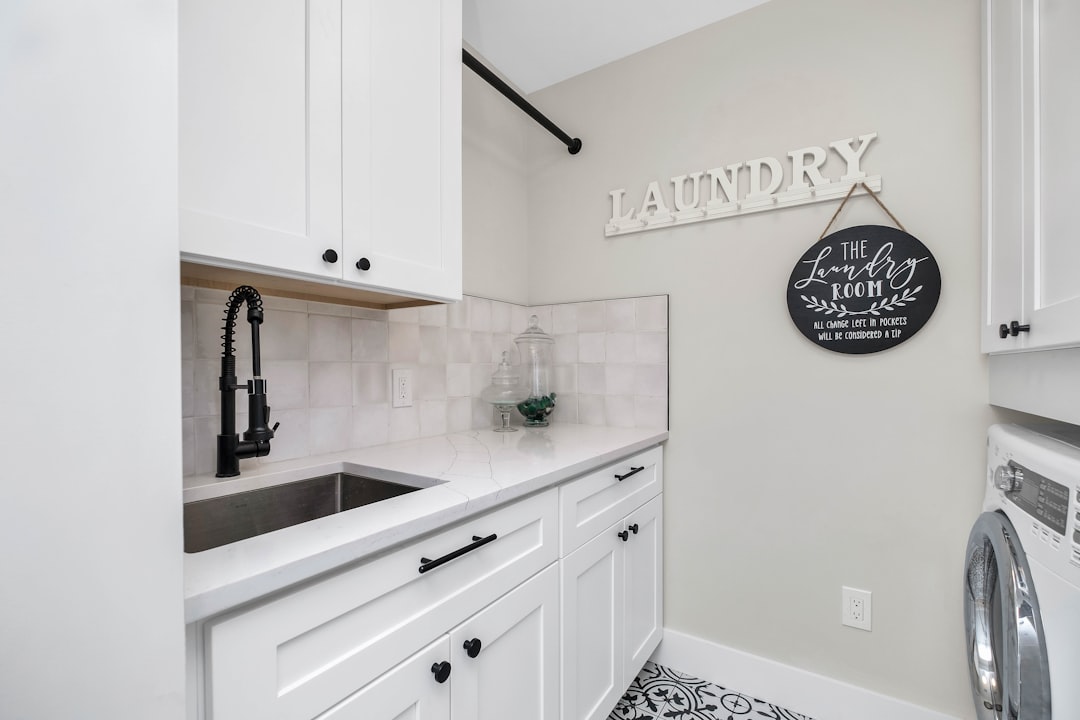
A counter with a sink, closed cabinets and a hanging rod gives a laundry nook a place for each task. Photo: Zac Gudakov / Unsplash.
Small Laundry Rooms and Closets: What Still Fits
Not every home has a dedicated laundry room; in some, the washer and dryer are stacked in a hallway closet. Before planning storage there, check the installation instructions for your specific machines: they give the closet width, depth and clearances the appliances need, along with venting and connection requirements, and those come first. Whatever space is left over is what storage can use. Above a stacked pair, a slim cabinet is often the natural spot for detergent and supplies, as long as it doesn't block access to the machines' controls, connections or vent.
Door storage is an often-overlooked option in tight laundry closets. A narrow door-mounted rack or an over-the-door hanging organizer uses vertical space that would otherwise sit empty. If the closet has a swing door rather than a bifold, even a few inches of depth on the door itself can hold spray bottles, lint rollers, and stain sticks within arm's reach of the machines — check that the door still closes with the rack loaded.
For rooms too small for a full counter, a fold-down shelf mounted to the wall gives you a working surface when you need it and folds away when you don't. It's the same idea as working with a tight kitchen footprint, covered in our guide on planning a kitchen layout: work with the space you have rather than forcing a full-size solution into a space that can't support it. For the cabinetry itself, ask your designer which cabinet sizes and lines fit the space; our guide to the cabinet lines we carry explains how the lines differ.
Materials That Hold Up to Moisture and Heat
A laundry room sees warmth from the machines, water from washer connections and wet clothes, and sometimes humidity. A vented dryer is meant to send its moist air outside: ENERGY STAR describes heat pump dryers, by contrast, as not releasing air through a home's exterior and needing no dryer vent, because they pass the humid drum air through a condenser and drain or collect the water. If a room with a vented dryer feels steamy while it runs, have the exhaust duct and its connections checked rather than designing cabinetry around the leak. If you have a ventless model, follow its instructions for installation and drainage.
Humidity still matters for everything stored in the room. The EPA notes that high room humidity can cause mold to grow on many items indoors, including clothing, and advises keeping indoor humidity below 60%, ideally between 30% and 50%, and drying wet items within 24 to 48 hours. How a cabinet box, finish or countertop copes with moisture depends on the specific product, how its edges and seams are sealed, and how much water actually reaches it, so ask for the manufacturer's specifications and care guidance for the materials you're comparing — plywood versus particleboard, and one countertop material versus another — rather than relying on a general ranking.
Hardware matters too. Hinges and drawer slides differ in materials and finishes, so ask what the hardware is rated for and how it's finished if the room runs humid. If you're weighing finish options for a laundry room build, our breakdown of cabinet finishes is written with kitchens in mind, but the same questions about finish and wear apply here.
Planning Your Laundry Room Build
Start by measuring the full wall, not just the space around the machines. Homeowners sometimes plan storage only for the empty gaps and end up with a mismatched cabinet here and a shelf there instead of one cohesive run. Measuring wall to wall, floor to ceiling, gives your designer the full picture and can reveal usable space you hadn't counted, such as the wall above the machines.
Next, decide what actually needs a home in this room. Not every household needs an ironing station or a pet-washing basin, but a folding surface and closed storage for supplies are useful in most laundry rooms. Walk through your actual laundry routine, from hamper to folded stack, and let that sequence dictate the layout rather than copying a photo that doesn't match how your family does laundry.
Budget-wise, a laundry room cabinet run usually covers fewer linear feet than a kitchen, but the same construction quality questions apply: framed vs frameless, plywood vs particleboard, soft-close vs standard hardware. If you want a full breakdown of what drives cabinet pricing before you start planning, our guide on what kitchen cabinets actually cost explains the cost drivers, and the same framed-vs-frameless, material and hardware questions apply to a short run as to a long one.
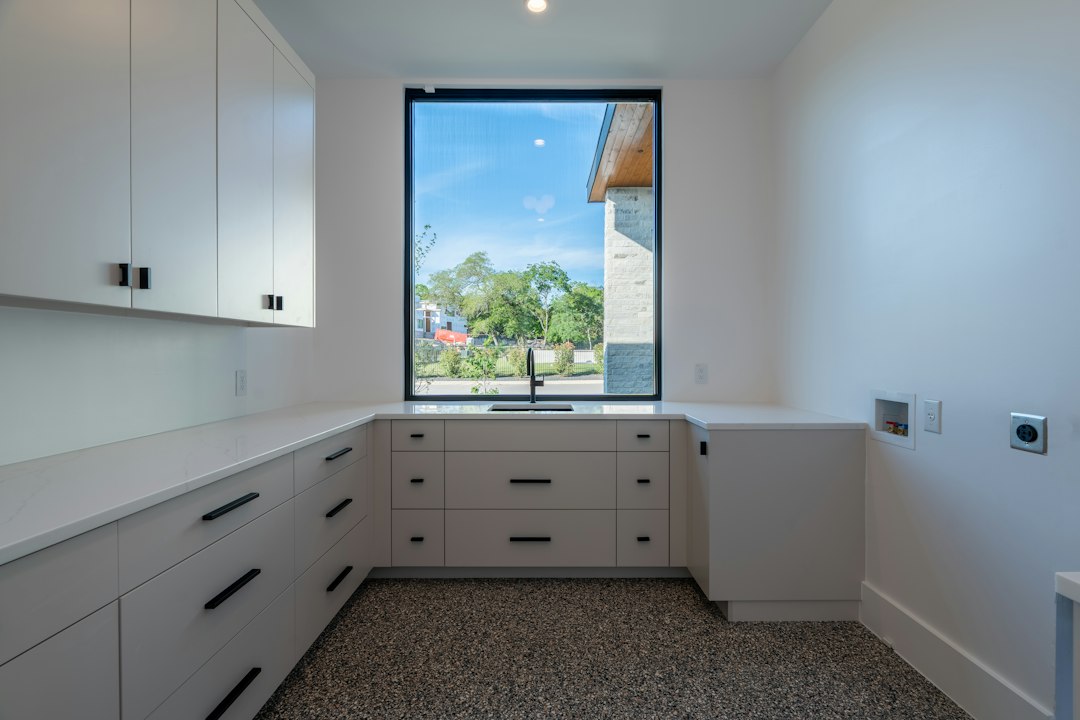
A long counter and matching cabinetry give a laundry room room to fold and room to store.
Getting the Layout Right for Front-Load vs Top-Load Machines
The machine style you own changes the cabinet plan. Front-load washers and dryers leave the top surface free, so a continuous counter can run above them, and some households raise the machines on pedestals to bring the doors to a more comfortable loading height. If you do either, take the counter height and clearances from the machines' and pedestals' installation instructions, and plan access to the hookups and vent behind them. Top-load machines need room above for the lid to open, so the working surface usually moves to an adjacent wall or a rolling cart that tucks in beside the machines.
If you're building around front-loaders and want extra landing space for baskets and folded stacks, plan it as additional counter beside the machines, supported by cabinetry, rather than as an unsupported projection. If you're keeping top-loaders, plan the folding counter as a separate run, and consider a narrow rolling cart as a flexible surface that can be pushed out of the way when the room does double duty as a mudroom or pantry extension.
Either way, check the space the doors or lids need to open fully in the machines' instructions, and leave room to stand and set a basket down without blocking the walkway. In a room where side-by-side machines leave little floor space, a stackable configuration, if your models allow it, can free up wall space for storage.
FAQ: Laundry room storage
What is the ideal counter height for a laundry room folding station?
There's no single right number. A separate folding counter can be set to suit the person who does most of the folding — try folding at a kitchen counter to see whether that height works for you. A counter over front-loading machines is a different case: its height comes from the machines, any pedestals, and the clearance in the installation instructions.
How much does a laundry room cabinet remodel typically cost?
It depends on scope and materials. A laundry room cabinet run usually covers fewer linear feet than a kitchen, but the same cost drivers apply: framed vs frameless construction, plywood vs particleboard boxes, and soft-close vs standard hardware. Our guide on what kitchen cabinets actually cost explains those drivers in more detail.
Can I add a sink to a small laundry room?
Possibly. A sink needs a water supply, a drain and venting, and any permits your jurisdiction requires, so have a licensed plumber assess the room before you plan around one. Excelle designs the cabinetry and can connect you with partners for trades we don't provide. A small utility sink is useful for hand-washing delicates, soaking stained items, or rinsing brushes and tools, and in a tight room a narrow single-basin sink takes up less counter space than a double basin.
What's the best flooring for a laundry room?
Look for flooring rated for wet areas and check the manufacturer's guidance on water exposure, since a leaking supply line or an overflowing basin is the risk here. Porcelain tile, water-resistant vinyl plank and sealed concrete are common candidates to compare; ask about slip resistance too, since the floor can get wet.
Do I need a vent fan or extra ventilation in a laundry room build?
First make sure a vented dryer exhausts outdoors as its installation instructions specify; a ventless or heat pump dryer follows its own instructions. Beyond that, an exhaust fan or a window that opens can help clear warmth and humidity, and a dehumidifier is an option if the room stays humid — the EPA recommends keeping indoor humidity below 60%. That protects stored linens and supplies as well as the cabinetry.
About the author
Anthony
Design Lead, Excelle Kitchen & Bath
Leads cabinetry and storage design at Excelle Kitchen & Bath, a design studio with a San Jose showroom serving the Bay Area. Ten years of kitchen and custom storage projects, specialising in space planning, semi-custom cabinetry specification, and closet systems.