


Framed vs Frameless Cabinets: Which Fits Your Kitchen?
A San Jose design studio breaks down framed vs frameless cabinet construction so you can pick the right fit for your kitchen.
The Real Difference Between Framed and Frameless Construction
Every kitchen cabinet box is built one of two ways, framed or frameless, and that choice is separate from the door style you eventually pick. It's about the box underneath, and it shapes storage, door options and how the kitchen reads.
Framed cabinets have a solid wood face frame attached to the front edge of the cabinet box. It is the traditional American construction, and it's what gives many traditional kitchens their slightly recessed, layered look at the cabinet fronts: the frame shows around and between the doors unless a full overlay door covers it. J&K's current specification book, for example, describes its framed boxes with solid wood doors and frames and gives cabinet depths measured "to the face frame."
Frameless cabinets, sometimes called full-access or European-style cabinets, skip the front frame entirely. The door hinges mount directly to the side panels of the box. Without a frame narrowing the opening, the interior is easier to reach edge to edge. Bellmont, a frameless manufacturer, puts it this way: "With no frame to obstruct access, frameless cabinets offer greater accessibility and more usable space within the same box size."
Neither construction type is objectively better. The right choice depends on the look you want, how you use your storage, and the specific product lines you're comparing. A useful way to start is to treat it as a function decision first and a style decision second: decide what has to fit where, then pick the look.
Where Framed Cabinets Win
Framed construction still makes sense for a large share of kitchens, and it's not just about tradition. The face frame gives the front of the box a hardwood edge. What it does not do is decide on its own whether a countertop overhang or an unsupported span is adequately supported. That depends on the countertop manufacturer's support requirements (brackets, corbels, or a support panel) and on the cabinet line's own specifications, so ask for both rather than choosing a construction type to solve it.
Style-wise, framed cabinets pair naturally with partial overlay or inset doors, both of which show a bit of the frame between doors and drawers. That creates a rhythm of lines across the kitchen that reads as traditional, transitional, or farmhouse, depending on the door profile and hardware you choose. If your home has a classic architectural style, whether that's a craftsman bungalow or a traditional two-story, framed cabinetry is a natural match for it.
For homeowners who want a traditional look without inset doors, framed construction with full or partial overlay doors is a common middle ground. Excelle's premade lines include framed options, including Shiloh and J&K, which you can ask to see at our San Jose cabinetry studio.
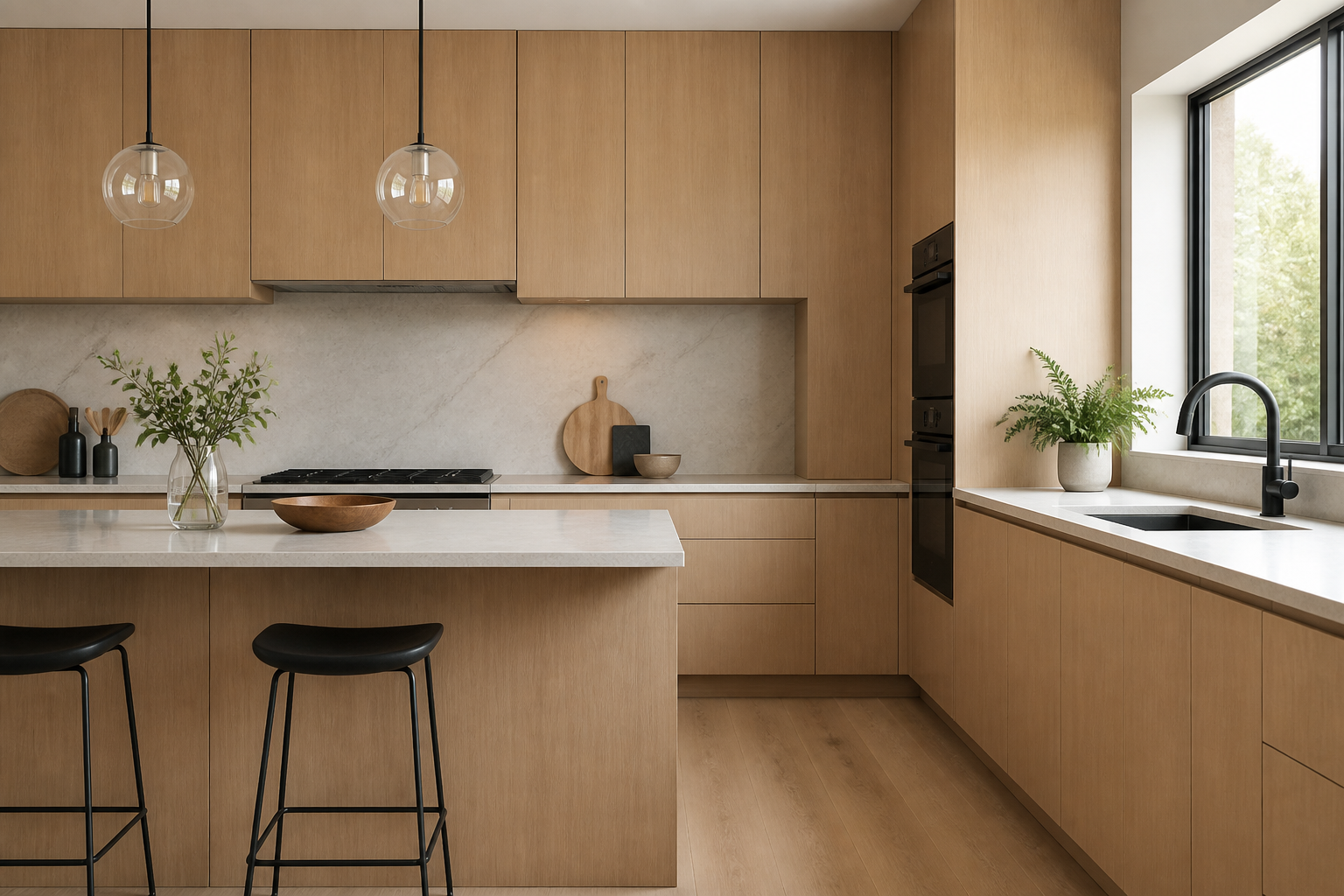
Frameless construction with full overlay doors gives a clean, uninterrupted look.
Where Frameless Cabinets Win
Frameless construction earns its popularity in kitchens where storage access and a clean visual line matter most. Without a face frame narrowing the opening, drawer boxes can use more of the box width, which is most noticeable in base cabinets where deep drawers replace old-style shelves. Bellmont says of its own frameless drawers that they "provide more space and clearance within the box to allow you to fit more items." How much more depends on the specific products being compared, so compare the actual interior drawer dimensions of the two lines you're considering rather than relying on a rule of thumb.
Visually, most frameless kitchens use full overlay doors, which cover the box edge to edge. That produces the flat, uninterrupted look associated with modern and contemporary kitchens. If your kitchen leans toward a European or minimalist aesthetic, frameless is a natural starting point.
Price is a product-line question, not a construction-type rule. When comparing lines like Eclipse, Bellmont, or Boxy, all frameless lines Excelle carries, against framed options, ask for the same cabinet layout priced in each line. For a kitchen island or a wall of pantry cabinets where interior access matters most, frameless is often the first construction people look at.
How This Decision Connects to Door Style
Construction type and door style get chosen together in practice, even though they're technically separate decisions. Framed boxes are commonly offered with full overlay, partial overlay, or inset doors. Frameless boxes are most often built with full overlay doors, but frameless is not limited to them: hinge maker Blum's specification for its CLIP hinge program states that "all three of the common frameless applications, (full overlay, half overlay and inset)" can be achieved with its hinges and mounting plates.
So the physical question and the catalog question are different. The traditional American inset look, with the door sitting inside a visible face frame, is a framed configuration. A frameless inset door, sitting inside the box sides with no frame, is hardware-possible but reads differently and is only an option if the line you choose offers it. That is why it helps to work through both decisions together, with actual samples in hand, so what you picture matches what you end up ordering.
Cost also factors in here. Inset doors have to fit precisely within their openings, and door style is one of the bigger levers in a cabinet budget, so ask how the line you're considering prices inset versus overlay. The design consultation at our San Jose cabinetry studio is the place to compare those trade-offs with real samples before committing.
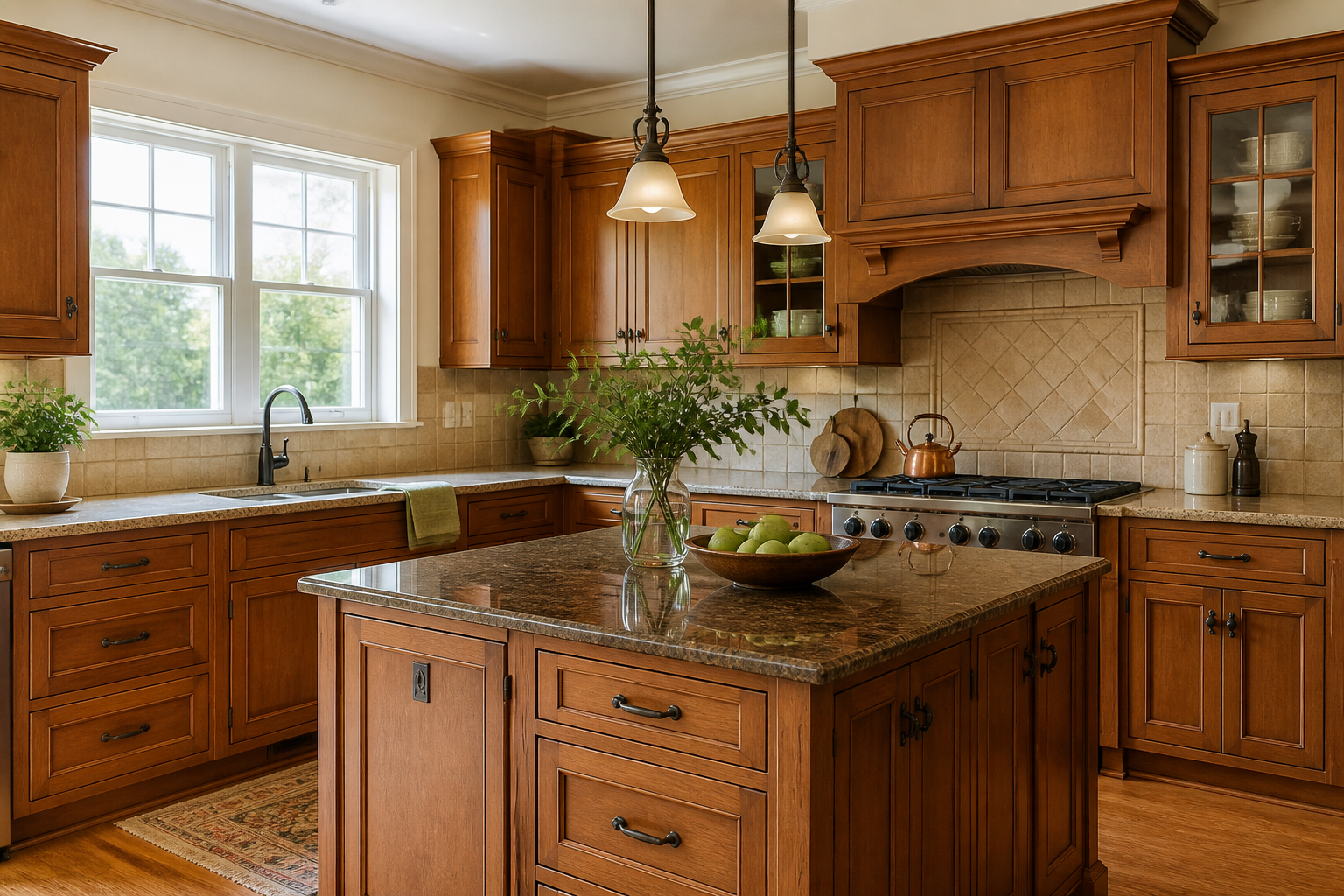
Framed cabinets with inset doors give a furniture-style, traditional look.
Quick Comparison: Framed vs Frameless
- Front of the box: Framed boxes have a hardwood face frame; frameless boxes rely on the box panels themselves. Check the line's own specifications (panel thickness, back, top) rather than assuming either is stronger.
- Storage access: Frameless interiors are open edge to edge with no frame narrowing the opening; how much extra drawer width that buys depends on the products compared.
- Door styles: Framed is commonly offered with full overlay, partial overlay, or inset doors. Frameless is most often full overlay; half overlay and inset are hardware-possible but depend on the line.
- Visual style: Framed reads traditional to transitional; frameless reads modern to European-minimalist.
- Typical use: Frameless often appears in modern kitchens, islands and pantry walls; framed often appears in traditional and transitional whole-kitchen designs.
- Price difference: Depends on the manufacturer; neither construction is reliably cheaper.
Seeing both constructions in person, with the same door style on each, is the quickest way to judge the trade-offs. If you'd like to see both side by side, our showroom at 1350 Ridder Park Dr Suite B in San Jose is open Monday through Saturday, 9 to 5, and walk-ins are welcome. Booking a design consultation through our contact page reserves a designer for your project.
The storage math: where the space goes
The face frame is the storage story. In a framed cabinet the door opening is defined by the frame, not by the inside of the box, so anything that slides in or out has to clear the frame:
- Drawers: in a framed cabinet, the drawer box must clear the frame opening; in a frameless cabinet it only has to clear the box sides and the drawer runners. To see the difference for your kitchen, ask for the interior drawer width of the same base cabinet size in each line.
- Roll-outs and pull-outs: the same logic applies, and the frame becomes a threshold that interior fittings must be sized around.
- Access: if a framed double-door cabinet has a center stile, the vertical bar splits the opening, so a large stockpot has to go in at an angle. A frameless double-door cabinet opens to one clear space.
In a large kitchen the difference is a convenience. In a compact kitchen, the interior width of a few base cabinets can decide whether a stand mixer or a stack of sheet pans lives in a drawer or on the counter, which is why it's worth measuring what you own before choosing, the same per-inch thinking behind space planning generally.
Durability, hinges, and the install day
Rigidity: the face frame stiffens the front of a framed box. Frameless boxes get their stiffness from the box itself, so how a frameless line performs depends on how it is built. Bellmont, for instance, describes its frameless boxes as having "rigid box construction and solid full-top" that offer "added support for solid surface countertops." Compare construction specifications line by line rather than assuming one type is stronger.
Hinges: both constructions commonly use concealed cup hinges today, attached through mounting plates that differ between frameless and face-frame boxes. Blum describes its CLIP top hinges as working "in almost any hinge application because of the wide variety of mounting plates available, meaning these hinges can be used in frameless and face frame cabinets." If a hinge ever needs replacing, the brand, model, cup and mounting plate all matter, so keep the hardware details from your cabinet order.
Installation: any layout with small, even gaps between doors — full-overlay or inset, on framed or frameless boxes — needs the boxes set level, plumb and in plane so the reveals stay consistent. In older homes with uneven walls and floors, that makes shimming and scribing important whichever construction you choose. Follow the tolerances in the chosen manufacturer's installation instructions, and ask your installer how they handle out-of-square walls before the cabinets arrive.
Cost: compare lines, not construction types
Which construction costs more flips by manufacturer: framed lines spend on hardwood face frames, frameless lines on the box panels and edge finishing. Door style and finish often move the price more than the box. The practical summary: choose on function and look, then price the same layout in two or three lines. (For what cabinets cost overall in this market, see our Bay Area cabinet cost guide.)
FAQ: Framed vs frameless cabinets
Is frameless cabinetry more expensive than framed?
Sometimes, but not reliably. Which costs more depends on the manufacturer and the product line. Door style and finish are often bigger cost drivers than the box construction itself. Ask your designer to price the same layout in a framed and a frameless line for an apples-to-apples number.
Can I mix framed and frameless cabinets in the same kitchen?
It's possible, but it takes careful planning, since the two constructions have different reveal lines and hinge mounting. Many kitchens keep one construction type for visual consistency, and if you do mix, plan where the runs meet, such as at a corner or an island.
Which construction type offers more storage?
Frameless generally gives easier access because there's no frame narrowing the cabinet opening, so drawers can use more of the box width. The actual gain depends on the two product lines compared, so compare interior drawer dimensions for the same cabinet size.
Can frameless cabinets have inset doors?
Hardware makes it possible: Blum's CLIP hinge specification lists full overlay, half overlay and inset as the three common frameless applications. Whether you can order it depends on the cabinet line. The traditional inset look, with a door set inside a visible face frame, is a framed configuration.
Do frameless cabinets look less traditional?
They lean modern by default because they're usually paired with full overlay doors and flat or simple door profiles. Door style changes a lot: a Shaker-style door on a frameless box reads more transitional than a slab door does, though it won't replicate the look of inset doors in a face frame.
How do I decide between framed and frameless for my kitchen?
Start with your door style preference and your storage priorities. If you want the traditional inset look, start with framed lines. If drawer access matters most, look at frameless lines first. Bringing photos of kitchens you like to your first design appointment at our San Jose showroom helps narrow the choice.
Are frameless cabinets less durable than framed?
Not inherently; it depends on how each line is built. A face frame stiffens the front of a framed box, while a frameless box relies on its panels, back and top. Compare the construction specifications of the specific lines, such as panel thickness, back construction and drawer load ratings, rather than the construction type alone.
Do frameless cabinets work in old houses with crooked walls?
Yes. Tight door reveals, whether full-overlay or inset and whether the boxes are framed or frameless, need the cabinets set precisely level and aligned, so out-of-square older homes call for careful shimming and scribing. Follow the manufacturer's installation tolerances and discuss uneven walls with your installer in advance.
About the author
Anthony
Design Lead, Excelle Kitchen & Bath
Leads cabinetry and storage design at Excelle Kitchen & Bath, a design studio with a San Jose showroom serving the Bay Area. Ten years of kitchen and custom storage projects, specialising in space planning, semi-custom cabinetry specification, and closet systems.