


Handle-less Kitchens: Pros, Cons & Design Tips
A San Jose cabinet design studio on handle-less kitchens: how the opening systems work, what affects cost, and whether the look fits your space.
What "Handle-less" Actually Means
A handle-less kitchen has no visible knobs or pulls on the cabinet fronts. Doors and drawers open another way instead: through a handgrip built into the door or drawer front itself, through a recessed profile or rail fitted into the cabinet run, or through push-to-open hardware that releases the door when you press it. Some kitchens combine more than one, for example built-in grips on drawers and push-to-open on tall pantry doors.
The appeal is mainly visual. Without hardware breaking up the cabinet fronts, a run of cabinetry can read as one continuous surface, which is why the look is associated with modern, European-style kitchens. It doesn't compete with a bold countertop or backsplash, and with less visual clutter a small kitchen can feel calmer.
"No hardware" doesn't mean "no decisions," though. Each way of opening a handle-less door has its own construction, its own feel in the hand and its own maintenance, and those are worth understanding before you commit to the style.
The Main Ways to Open a Handle-less Cabinet
Manufacturers use different names for these systems, so ask which one a quote actually includes. Broadly, there are three families:
- Integrated handgrip in the front (J-pull and routed finger pulls): the grip is shaped into the door or drawer front itself, usually along its top or bottom edge, so you hook your fingers into the front to open it. Howdens describes its J-pull units as having "a built-in handgrip that reduces visual clutter for a clean look" (Howdens). Because the grip is part of the front, it has no moving parts. A grip on the top edge of a tall or high door can be harder to reach, so think about where each one sits.
- Recessed profile or rail system: a separate channel, often metal, is fitted into the cabinet run, typically just below the countertop or between stacked drawers, leaving a continuous horizontal recess you reach into. Howdens calls these "handleless profiles" and sells them in several finishes. This is a different construction from a grip built into the door, and it has to be planned with the cabinet boxes, so confirm the cabinet line you choose supports it.
- Push-to-open hardware: a mechanism inside the cabinet pushes the door or drawer open when you press the front, so there is no grip or channel at all. Blum describes its TIP-ON system this way: "Handleless doors open with a light push with TIP-ON, the mechanical opening system from Blum. To close, simply press the door shut." Blum's unit includes a tool-free gap adjustment (Blum). Like any moving hardware, it may need adjusting or, eventually, replacing; check the rating and load limits of the specific model you're offered.
Which system suits which cabinet is a personal call. Some homeowners like a grip they can see and feel on the drawers they open most, and keep push-to-open for doors where a visible grip would spoil the line, such as a tall pantry or an appliance garage. Others want the same system everywhere. It's worth opening each type in person before choosing.
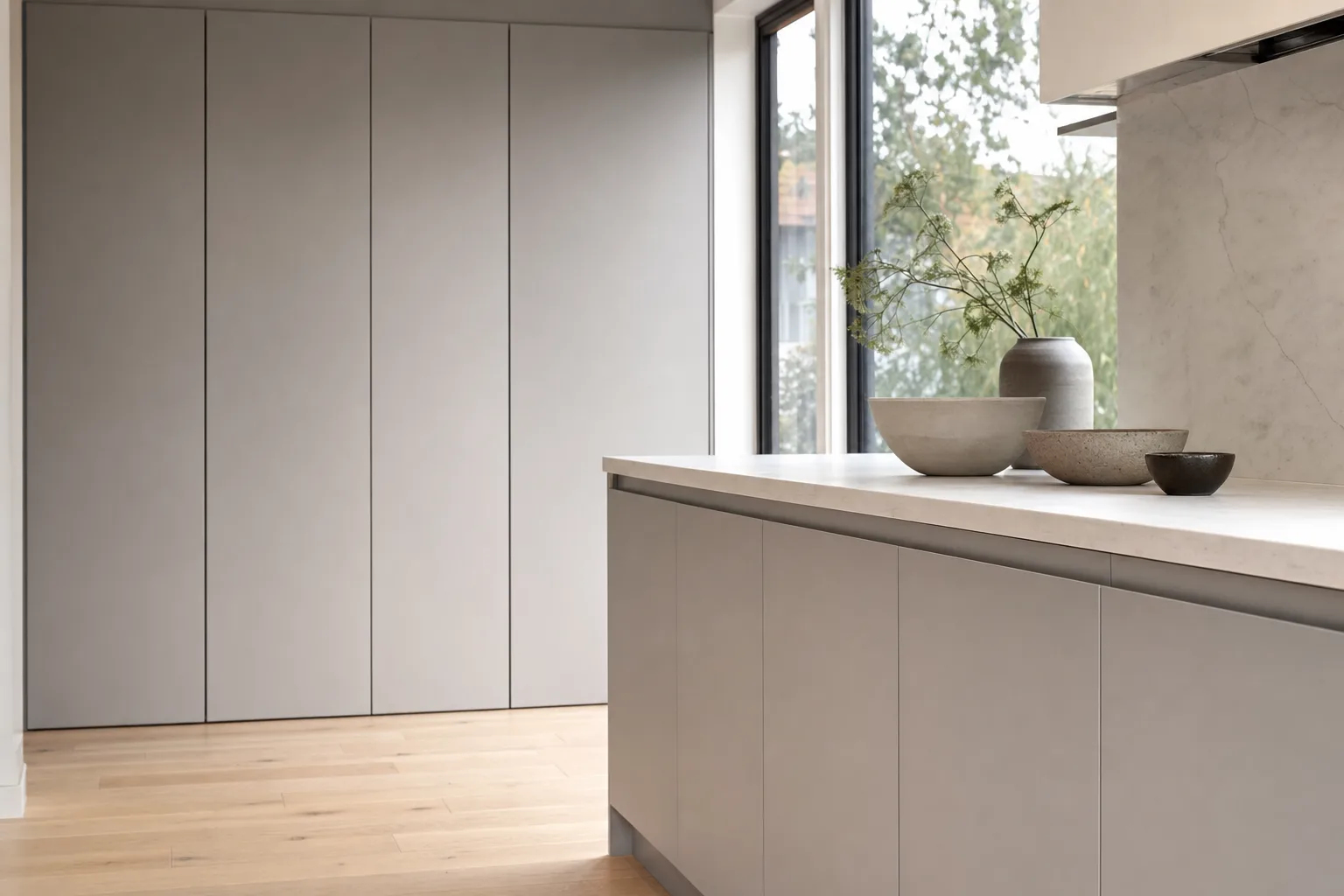
Illustration: without knobs or pulls, a run of flat cabinet fronts reads as one surface.
The Pros of a Handle-less Kitchen
Beyond the look, a few practical points come up once you live with the style. With no hardware sticking out, there is nothing on the cabinet fronts to catch a hip, a sleeve or a bag strap as you move through the room, which some people notice most in a narrow galley layout.
Cleaning can also be simpler. Knobs and pulls collect grease at the spot your hands touch, and you have to wipe around them. A flat front with no hardware can be wiped in one pass, though the grip channels or profiles themselves still need cleaning out now and then.
There is also no knob to work loose over the years or pull to get bent. That doesn't make a handle-less kitchen maintenance-free, since push-to-open hardware has its own moving parts, but it removes one kind of small hardware repair.
The Cons to Weigh Before You Commit
A handle-less kitchen has trade-offs, and a good design conversation covers them rather than only showing the finished look.
First, cost. Grips shaped into the fronts, separate profile systems and push-to-open mechanisms each change what goes into a door or drawer compared with a plain front and a knob, and how that affects the total depends on the cabinet line and the system. Ask for it to be priced during your design consultation rather than assuming it's a minor difference.
Second, fingerprints. To open a handle-less door you touch the front or the grip rather than a knob, so marks land on the cabinet surface itself. How visible they are depends on the finish and color; high-gloss surfaces reflect light, so smudges can be easier to see. Look at real samples of the finish you're considering, and touch them, before deciding.
Third, moving parts. Push-to-open mechanisms are mechanical hardware that sees use every time a door opens. Blum builds adjustment into its TIP-ON unit, and a mechanism that stops working properly is a hardware adjustment or replacement, not a new cabinet. It's still a maintenance item a plain knob doesn't have.
Finally, accessibility. For anyone with limited hand strength or dexterity, a shallow grip or a press-to-open front may be harder to use than a handle they can wrap their hand around. If the kitchen is meant to work as you age, try each option with the people who will use it.
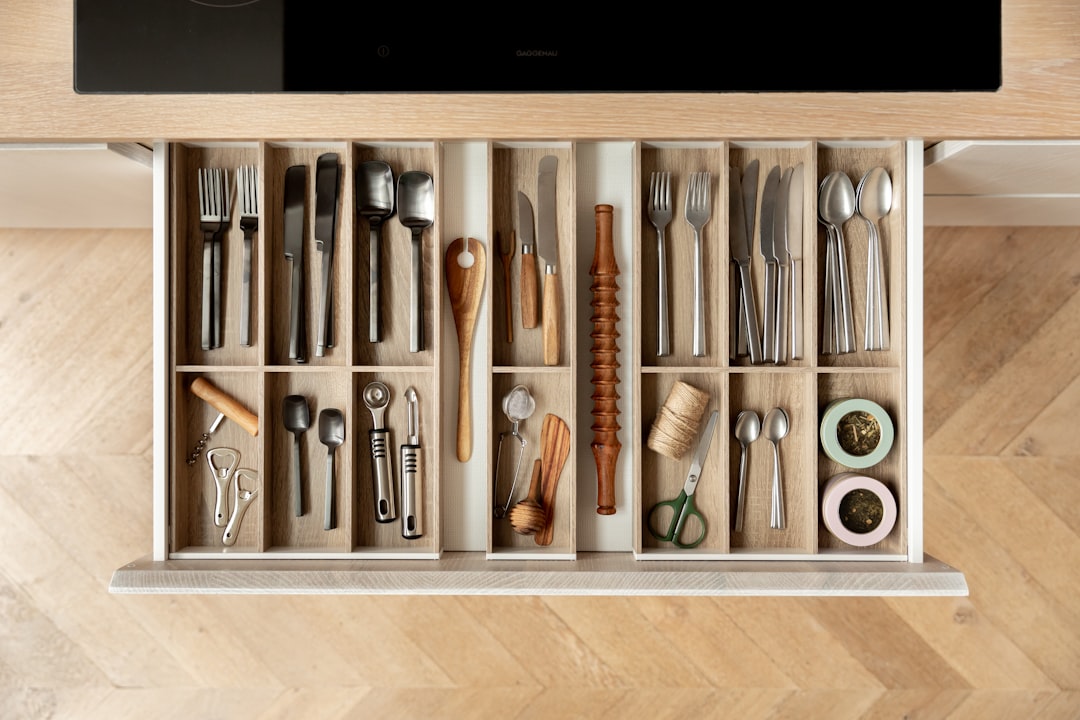
An open utensil drawer with fitted dividers. Photo: Orgalux / Unsplash.
Design Tips If You're Going Handle-less
If a handle-less kitchen is the direction you want, a few decisions make a difference in how it looks and works day to day.
Choose the finish with your hands, not just your eyes. Since you touch the fronts to open them, pick the finish after handling samples. A lower-sheen surface reflects less light, which some people prefer on the doors they touch most; others like gloss and accept wiping it more often.
Decide the opening system cabinet by cabinet. You don't have to use one system across the whole kitchen. Think about which drawers you open most, whether you'd rather feel a grip there, and where a completely plain front matters most to the look.
Plan the layout for handle-less from the start. Without a knob or pull to mark where one cabinet ends and the next begins, spacing, panel proportions and the direction of any wood grain carry more of the visual weight. Profile systems in particular have to be planned with the cabinet boxes, so settle the system before the cabinets are ordered.
Match the look to the cabinet line. Excelle's own description of modern kitchens pairs flat-panel and handle-less doors with frameless construction. Among the lines Excelle Kitchen & Bath carries, Eclipse, Shiloh's frameless line, is described as full-access frameless cabinetry with clean European lines, suited to contemporary, handle-less kitchens.
Budget for the opening system, not just the door. When you get a quote for a handle-less kitchen, whether at our San Jose showroom or elsewhere, ask for the grip, profile or hardware costs to be shown separately from the door price.
Door style and opening method are separate choices. Shaker is a door style, and handle-less opening can be combined with it; Howdens, for example, sells Shaker handleless kitchens. If you're still choosing a door style, our shaker cabinets guide is worth reading alongside this one.
FAQ: Handle-less kitchens
Do handle-less cabinets cost more than standard cabinets with knobs?
It depends on the system and the cabinet line. A grip shaped into the front, a separate profile system and push-to-open hardware each change what goes into a cabinet compared with a plain front and a knob. Ask for an itemized quote that separates the door price from the cost of the opening system.
Are push-to-open cabinets reliable long-term?
They're mechanical hardware, so they may need adjustment and, eventually, replacement. Blum's TIP-ON unit, for example, has a tool-free gap adjustment built in. Check the rating and load limits of the specific model you're offered, and ask how it is adjusted or replaced.
Do handle-less kitchens show fingerprints more than kitchens with hardware?
You touch the cabinet front or grip to open a handle-less door, so marks land on the surface rather than on a knob. How much they show depends on the finish and color; glossy surfaces reflect more light. Handle real samples of the finish before choosing.
Is a handle-less kitchen a good fit for a small kitchen?
It can be. Without hardware on the fronts, a small kitchen can look less visually busy, and there is nothing sticking out to catch clothing or bags in a tight galley. Whether it suits you also depends on the opening system and how easy you find it to use.
Can I mix handle-less cabinets with cabinets that have regular hardware?
Yes. Some kitchens use handle-less lower cabinets for a clean run below the counter and keep pulls on upper cabinets or a pantry. Talking through the layout with a designer helps decide where each approach works for your kitchen.
About the author
Anthony
Design Lead, Excelle Kitchen & Bath
Leads cabinetry and storage design at Excelle Kitchen & Bath, a design studio with a San Jose showroom serving the Bay Area. Ten years of kitchen and custom storage projects, specialising in space planning, semi-custom cabinetry specification, and closet systems.