


IKEA Pax vs. Custom Closet: How to Decide
What Pax does well, where its fixed sizes stop, and a measure-first way to decide which your closet needs.
Three measurements settle most of this before anyone's opinion enters the room. Measure your wall width and see how it divides by 19⅝”, 29½”, and 39⅜” — the Pax frame widths on IKEA's US site. Measure your ceiling height against the minimum ceiling height IKEA gives for assembling the frame and doors you'd choose — for the tall frame it is 93¼” (94½” with sliding doors). Hold a straightedge to the wall and look for bow. If the widths divide cleanly, the ceiling meets that minimum, and the wall is flat, Pax is not the budget compromise — it may be the right answer, and fitted work would be spending money on freedom you don't need.
When those numbers don't cooperate, many of the Pax limitations you'll read about come back to the same thing: it is a fixed-dimension product, and rooms are not. That explains why two people can furnish bedrooms with Pax and come away with opposite verdicts.
What Pax does well
- A low entry price. IKEA's US site lists a pair of Pax frames at $320–$400 depending on height and depth (September 2026), with doors and interior fittings sold separately — price your whole wall in IKEA's planner before comparing.
- A broad interior range. The Komplement range includes pull-out trays, trouser hangers, shallow drawers and shoe fittings, sold at flat-pack prices and chosen to suit what you own.
- It can be quick. Stocked components can be faster to get than a made-to-order closet, subject to local stock and to delivery and assembly availability — check availability for your store on IKEA's site. For a rental, a first home, or a kid's room that will change in a few years, quick and modular can be exactly right.
Where the product hits its edges
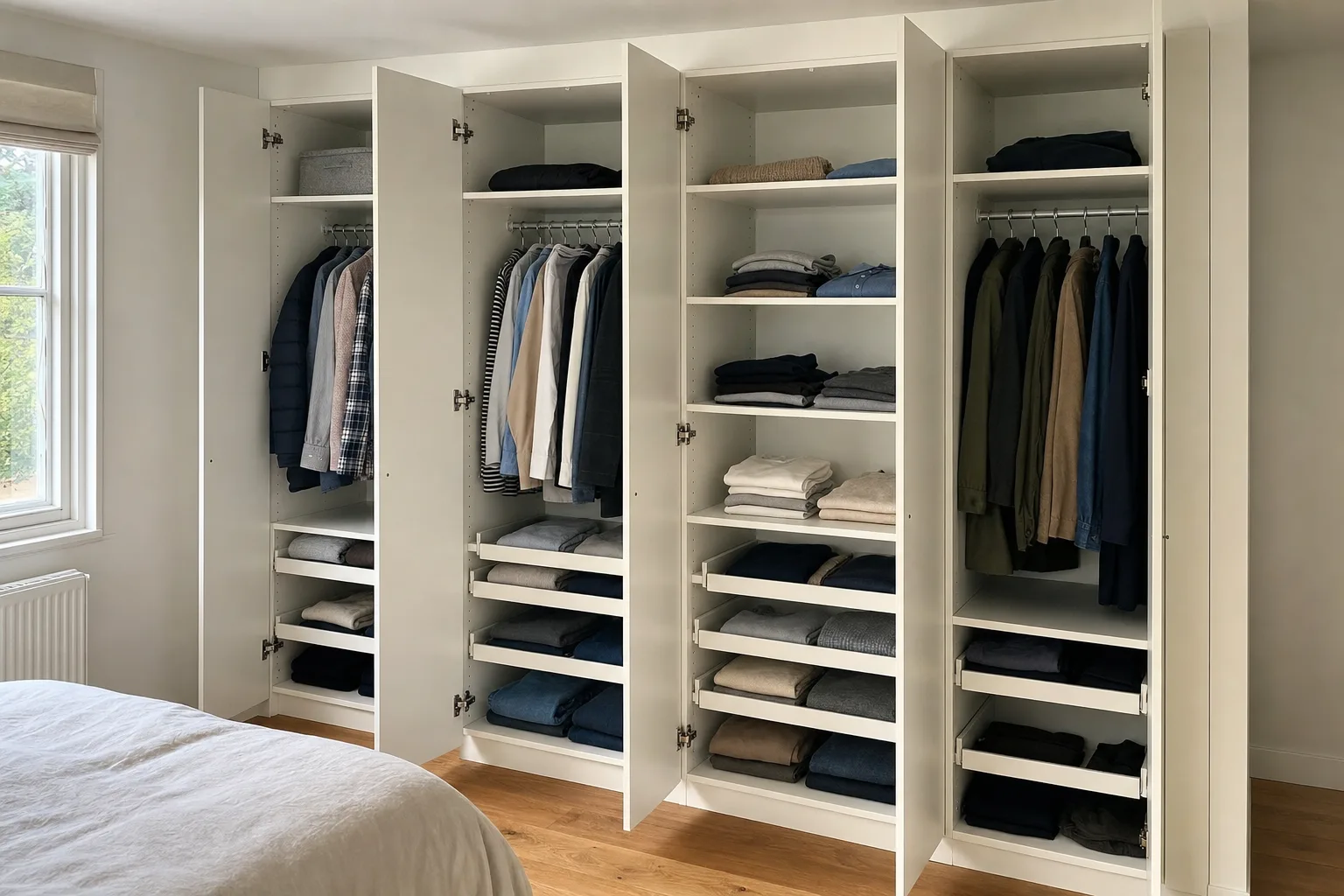
- The sizes are the sizes. Frames come in two heights (79¼” and 93⅛”), two depths (13¾” and 22⅞”), and three widths. If your wall is 117” wide, the best Pax combination covers about 108” and leaves a gap of almost 9” to fill with a panel. If your ceiling is 96”, the tall frame stops about three inches short and leaves a strip above it.
- The shallow-depth compromise. The 22⅞” frame is the deeper one; the 13¾” frame fits narrow rooms but gives up a lot of depth, so check that it works for how you hang clothes before committing. Fitted work can be built to any depth the room allows.
- Know the materials. IKEA lists the Pax frames as fiberboard, particleboard and paper foil. When you compare with fitted work, ask the other company what its carcass and shelves are made of, so you are comparing like with like.
- Anchoring is mandatory. IKEA's instructions say the frame must be mounted to the wall with the included rail, using fasteners suited to your wall material. If you move, plan on taking the frames down, reassembling them and anchoring them again in the new room.
- Parts can change over time. Interior fittings and door styles can be revised or replaced over time. If you plan to extend or repair the wall years later, note the article numbers of what you buy and check that compatible parts are still sold.
What fitted work actually buys
A fitted closet's advantage isn't a nicer finish. It's that the design starts from your room and your wardrobe instead of from a catalog of frames. Cabinetry built to the room's dimensions can run wall to wall and floor to ceiling, with any fillers and scribes planned into the design for walls that are out of square or out of plumb. Rod heights get set by your actual long-hang count, drawer banks by what you fold, shoe shelving by boot height rather than by what the catalog offers, which is the inventory-first method applied without fixed frame sizes.
Then there's the face of it. Painted Shaker fronts, veneer, integrated lighting, and hardware matching the rest of the house make a fitted wall read as architecture; Pax reads as very tidy furniture. Whether that difference is worth paying for depends on whether the closet is behind a door nobody opens or is the wall your bedroom is organized around.
Get a written quote for fitted work and put it next to your full Pax total — how franchise and local studio approaches compare is laid out in our closet alternatives guide.
What the Pax route costs you in effort
The price comparison is only fair if the labour is counted. A full wall is several frames, and IKEA says two people are needed to assemble each one. IKEA gives a minimum ceiling height for assembling the tall frame upright — 93¼” (94½” if you add sliding doors). If your room is lower than the minimum listed for the frame and doors you've chosen, choose the shorter frame or check with IKEA before buying. Interior fittings and door adjustment come afterwards.
Then come the parts first-timers can underestimate. Each frame must be secured to the wall with the included rail, using fasteners suited to your wall — IKEA notes that different wall materials require different types of fasteners. Doors need adjusting so they sit evenly; follow the instructions for the doors you choose. And if you intend the wall to read as built-in rather than as furniture, budget a separate carpentry session for filler panels, scribed trim to the wall, and crown to close the gap at the ceiling.
None of this is exotic work, but plan real time for it. If you would pay someone to assemble, anchor and trim the wall, add those costs to the Pax total before deciding on cost grounds alone.
The decision, wall by wall
Choose Pax when: you rent (with your landlord's permission for wall anchoring); the wall is straight and the ceiling clears the frame; frame widths divide your space cleanly; the budget has a hard ceiling; or the need itself is temporary — kids' rooms, guest rooms, first apartments.
Choose fitted when: the room has slopes, alcoves, bulkheads, or dimensions Pax cannot divide; you want floor-to-ceiling capacity with no gap; the closet doubles as the bedroom's main visual wall; you're staying for the long term; or your wardrobe needs a layout no modular interior quite delivers.
And consider the hybrid. One way to split a budget is to run Pax inside a reach-in nobody sees and spend the fitted budget on the walk-in or the wardrobe wall guests actually look at. Storage budgets, like kitchens, are best spent where hands and eyes land daily — the logic behind our closet and storage work in one sentence.
Your next step
Run the three measurements from the top of this page and write the numbers down: wall width, ceiling height, and the largest gap under a straightedge. Those three numbers tell you more about this decision than a review thread can, and they are useful to bring to any closet designer. If you'd like a second opinion, book a design consultation and bring your measurements, a floor plan, or photos — we won't recommend fitted work you don't need, and if that wall is a Pax wall, we'll say so.
FAQ: IKEA Pax vs. fitted closets
Is IKEA Pax good enough for a primary bedroom closet?
It can be — if the wall and ceiling cooperate with Pax's fixed sizes and you're comfortable with a furniture look rather than a built-in one. Where rooms are irregular or the closet is the room's showpiece wall, fitted work is worth pricing.
How much cheaper is Pax than a fitted closet, really?
IKEA's US site lists a pair of Pax frames at $320–$400 (September 2026), before doors and interior fittings; its planner prices a full wall. For fitted work, only a written quote for your wall gives a real number. Add any paid assembly, filler and trim carpentry, and lighting to the Pax side before comparing — those are the items that make Pax read as built-in.
Can Pax be made to look built-in?
Filler panels, scribed trim, and crown can close the gaps between the frames and the room. Budget real carpentry time for it: that fitting work is the part of a custom closet that doesn't come flat-packed.
Does Pax hold up long-term?
It depends on use, load and the room. IKEA lists the frame materials as fiberboard, particleboard and paper foil; follow the load and assembly guidance in the instructions, and before planning future changes, check that parts for the exact frames you bought are still available. For a fitted closet, ask what the carcass and shelves are made of and what the warranty covers.
Can I fit Pax to a sloped or low ceiling?
Only with compromises. The frames come in two fixed heights, so a slope or a bulkhead means stopping the run at the lower height or leaving part of the wall unused, and a room lower than IKEA's listed minimum ceiling height for the tall frame (93¼”, or 94½” with sliding doors) calls for the shorter frame or a check with IKEA first. Sloped ceilings are a clear case where fitted work, which can follow the slope, is worth pricing.
Can I mix Pax and fitted work in one home?
Yes, and it can be a sensible way to split a budget: modular systems in secondary and hidden closets, fitted work on the walls that carry the room. No rule says every closet deserves the same spend — inventory and visibility should decide.
About the author
Anthony
Design Lead, Excelle Kitchen & Bath
Leads cabinetry and storage design at Excelle Kitchen & Bath, a design studio with a San Jose showroom serving the Bay Area. Ten years of kitchen and custom storage projects, specialising in space planning, semi-custom cabinetry specification, and closet systems.