


Inset vs Overlay Cabinet Doors: How to Choose
A San Jose design studio's guide to inset and overlay cabinet doors, how cost and upkeep differ, and how to pick the right one.
What Inset and Overlay Actually Mean
Inset doors sit inside the cabinet opening, flush with the front; overlay doors sit on the front of the cabinet and cover part or nearly all of it. Choose inset for a furniture-like, traditional face and expect to pay more for it; choose full or partial overlay for a simpler, usually less costly door that is more tolerant of small variations. The rest of this guide explains why.
When you're picking cabinet doors, how the door sits relative to the cabinet is one of the first technical decisions you'll face. It sounds like a small detail, but it changes the look of a kitchen, and it affects cost and how much fine adjustment the doors may need over time.
In a traditional American kitchen, inset doors sit inside a face frame, so the door front lines up evenly with the frame around it, similar to a drawer in a fine piece of furniture. That face-frame version is the one this guide mostly discusses, because it is what the framed lines we carry offer. Inset is not strictly limited to framed boxes, though: Blum, the hinge maker, lists inset alongside full overlay and half overlay as one of "the common frameless applications" for its hinges. Whether a particular frameless line offers an inset door is a question for that line's catalog.
Overlay doors sit on top of the cabinet frame or box, covering it partially or fully depending on the style. Full overlay doors cover almost the entire face of the cabinet, leaving only a small gap between doors. Partial overlay doors cover less, leaving more of the frame visible between doors and drawers.
We walk clients through both options with real door samples at our San Jose showroom, since photos rarely capture how different the gap lines look in person.
The Case for Inset Doors
Inset doors have a furniture-like look that many homeowners are drawn to once they see it in person. The flush fit creates even gap lines around every door and drawer, and it reads as more traditional than an overlay style. If your home is a period property, a craftsman or a traditional colonial, inset doors may suit the architecture better than a modern overlay look; that is a design judgment, and your own taste decides it.
The trade-off is precision. With the door sitting inside the opening, there is no overlap to hide an uneven gap, so every gap around the door has to be even and has to stay even. That asks more of whoever builds and installs the cabinets, and our own site describes inset as the precise, premium option. On any line that offers both, ask for the inset and overlay prices side by side rather than assuming a fixed premium.
Inset doors can also be more sensitive to movement. Wood expands and contracts as humidity changes, and with tight gaps a door can rub or bind if it moves or drops out of alignment. Adjustable concealed hinges let a door be realigned; how often that is needed depends on the materials, the climate in your house, the hinge and the line, so follow the cabinet and hinge maker's instructions. It's worth discussing with your designer if your home sees big seasonal humidity swings. We offer inset through Shiloh, which lists flush and beaded inset doors, and through our Excelle custom line, which we show in person at our San Jose cabinetry studio.
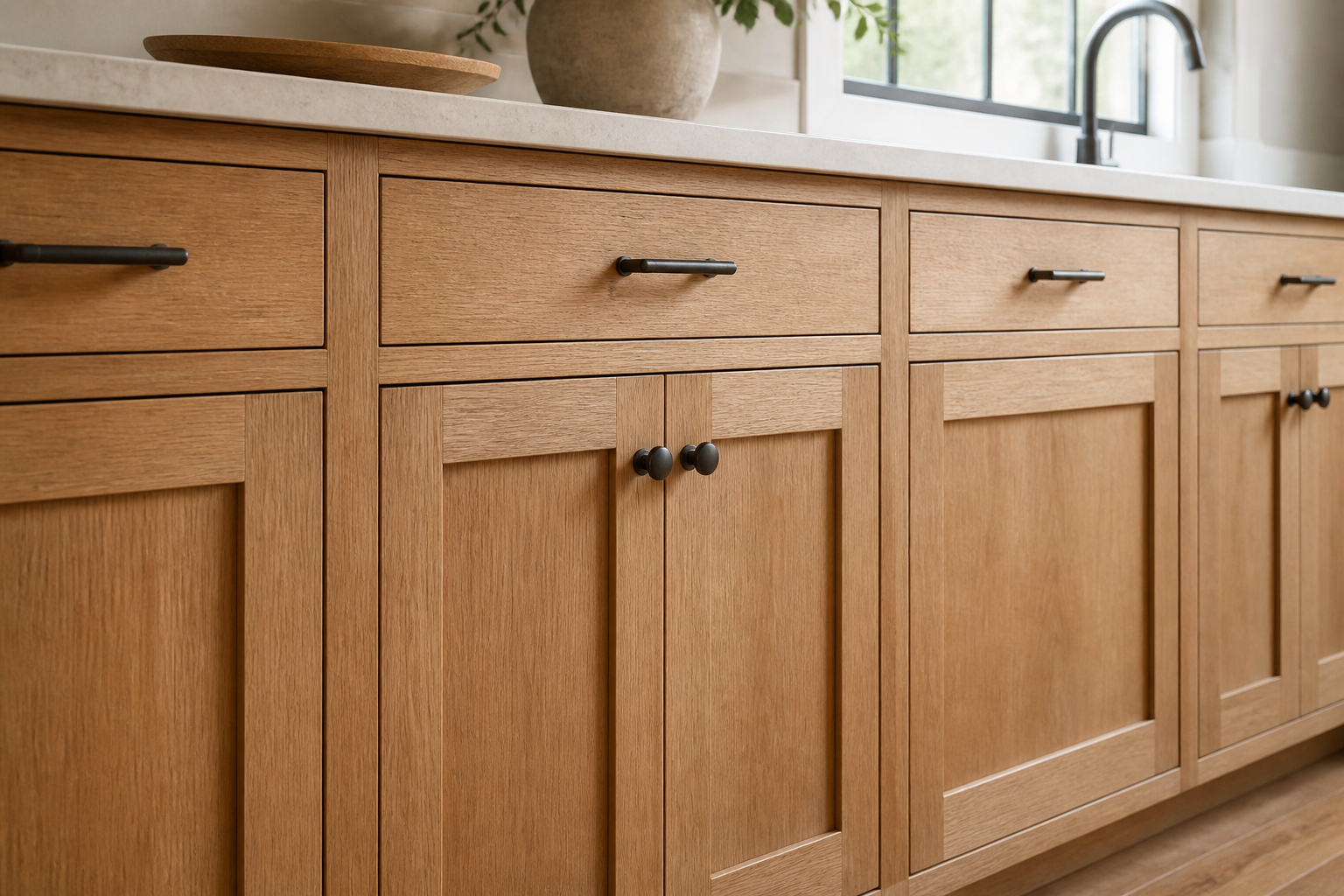
Inset doors sit flush inside the face frame, creating even gap lines on every side.
The Case for Full and Partial Overlay Doors
Full overlay gives a clean, nearly uninterrupted face with only a small gap between doors and drawers. It works on both framed and frameless boxes, which gives you more cabinet lines to choose from. The exact gap depends on the line, the face frame or panel thickness and the hinge, so compare the actual doors rather than a generic number.
Partial overlay sits between full overlay and inset visually. The doors cover part of the frame and leave a visible margin of face frame around each door. Our own site describes it as the traditional American look and a budget-friendly route to framed construction, because that margin absorbs small variations. If you're renovating an older home and want a traditional look on a tighter budget, partial overlay is worth considering.
Overlay doors, in either style, can be more tolerant of small movement, because a slight shift is less visible when the door covers the edge of the opening than when it sits inside it. That does not make them maintenance-free: any hinged door may need an occasional adjustment, and the maker's care instructions still apply. We carry the frameless Eclipse, Bellmont and Boxy lines and framed lines with full or partial overlay, all available to see in person at our San Jose showroom.
Cost, Maintenance, and Longevity Compared
Price is usually the first question homeowners ask, and it's a fair one. Our own site describes inset as the premium option and partial overlay as the budget-friendly one; for the actual difference on your kitchen, ask for both prices on the same line, because it varies with the line, the door style and the number of doors.
Maintenance can differ too. Doors of any style can drift out of alignment as a house goes through seasonal humidity changes, and concealed hinges are adjustable so a door can be brought back into line. With inset doors, a small shift is easier to see and may need attention sooner; with overlay doors, the same shift is often less noticeable. How often any kitchen needs adjusting is not something we can promise, so follow the hinge and cabinet maker's instructions.
Longevity depends mostly on the quality of the cabinet line and the installation rather than on the door style. The practical difference is visibility: on an inset door, a slightly loose hinge or a change in the gap shows sooner because the door sits inside the opening. If you would rather not notice small shifts, overlay is often the more forgiving choice.
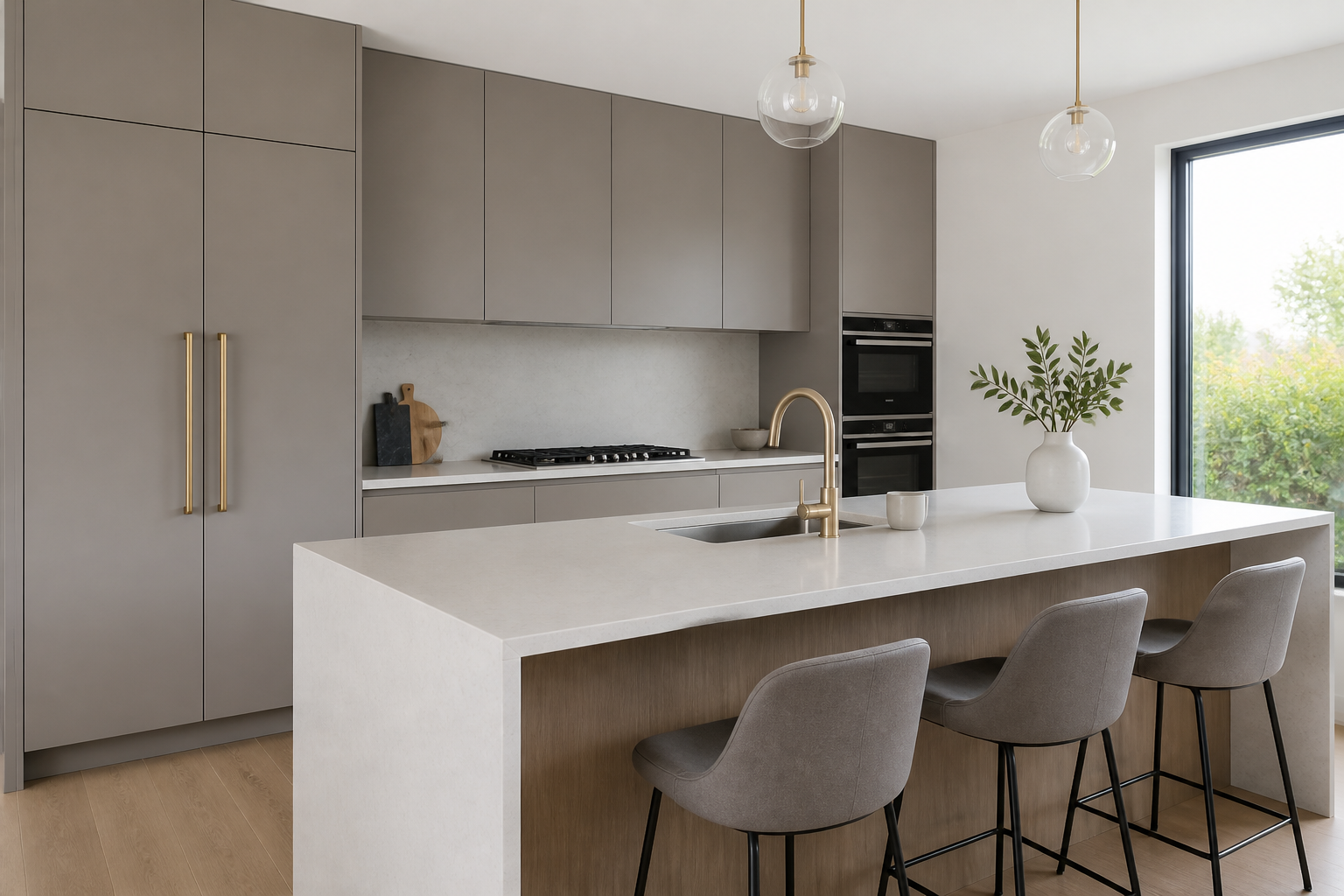
Full overlay doors cover nearly the entire cabinet face for a clean look.
Quick Comparison: Inset vs Full Overlay vs Partial Overlay
- Look: Inset is flush and furniture-like; full overlay is clean and modern; partial overlay shows a visible frame margin and reads traditional.
- Box type: Full overlay works with framed or frameless boxes. Partial overlay shows a face frame, so it belongs to framed construction. Inset is most familiar on framed boxes; frameless inset hardware exists, but check whether the line you like offers it.
- Gap between doors: depends on the line, frame and hinge; compare real doors or the maker's drawings.
- Price: inset is the premium option and partial overlay the budget-friendly one on our site; ask for both prices on the same line.
- Adjustment: all hinged doors can need realigning; small shifts tend to show sooner on inset.
- Style fit: inset and partial overlay lean traditional; full overlay leans modern and transitional. Your taste decides.
Seeing samples side by side under real kitchen lighting can make the choice easier, whether you're in San Jose or planning custom cabinets in Cupertino. A door style that looks great in a magazine photo can read differently on your actual cabinet boxes with your actual hardware.
If you're still deciding on construction, our guide to framed versus frameless cabinets is a good next read, since it covers the structural side of this decision in more depth.
How to Decide for Your Kitchen
Start with your home's architecture rather than a trend. Many people pair a traditional or period home with inset or partial overlay doors and a modern or transitional home with full overlay, but that is a starting point, not a rule.
Next, think honestly about tolerance for upkeep. If you want the door style where small shifts are least likely to show, full overlay is the more forgiving choice. If you love the furniture-like look of inset and don't mind the occasional hinge adjustment, it can be a worthwhile trade for the look.
Budget matters too, and it's fine to let it guide the decision. If inset is out of range but you love the traditional look, partial overlay on a framed box keeps a visible frame at a lower price point. Bring photos of kitchens you like to your first appointment; a designer can compare them with real samples and talk through which door style and construction type gets you closest within your budget. You can start that conversation through our contact page or by visiting the showroom directly.
FAQ: Inset vs overlay cabinet doors
Can I mix inset and overlay doors in the same kitchen?
It's possible. Our preference is to keep one door application within a room and get variety from panel style, wood species or finish color instead, because mixed gap lines can look unintentional. If you do want to mix, a designer can help make it look deliberate, for example by changing application only on an island or a separate furniture-style piece.
Do inset cabinets cost more to maintain long-term?
They can need a little more attention, because small shifts in alignment are easier to see on a door that sits inside its opening. Concealed hinges are adjustable for this. How often any door needs adjusting depends on the materials, your home's humidity and the hardware, so follow the cabinet and hinge maker's instructions rather than a fixed schedule.
Which door style works with frameless cabinets?
Full overlay is the usual frameless application, and it is what frameless lines are best known for. Blum lists full overlay, half overlay and inset as the common frameless hinge applications, so frameless inset exists. Whether a given frameless line offers it is up to that line, so check its catalog. Partial overlay in the traditional sense shows a face frame, so it is a framed look.
Is full overlay the same as "flush" cabinets?
No, though people sometimes use the terms loosely. Flush usually refers to inset doors, which sit even with the frame. Full overlay doors sit on top of the box or frame with a small gap between them, so they can look nearly flush but are built differently.
How do I see these door styles in person before deciding?
Look at real door samples side by side under different lighting. Our showroom at 1350 Ridder Park Dr Suite B in San Jose is open Monday through Saturday, 9 to 5, and our designers can walk you through samples from Shiloh, Eclipse, Bellmont, J&K, Boxy and our own Excelle custom line.
Why Full Overlay Is So Common
Full overlay is a common choice for three practical reasons: it works on both framed and frameless boxes, it gives the clean, nearly continuous face that modern and transitional kitchens tend to favor, and small shifts in alignment are less visible than on inset.
Inset asks more of the build, because each door has to sit evenly inside its opening with a consistent gap on every side. That extra precision is why our site places inset at the premium end.
None of this means inset is a worse choice. The two styles serve different priorities: inset rewards homeowners who value a specific traditional look enough to pay for the precision behind it, while overlay suits homeowners who want a simpler door and a more forgiving face. Knowing which priority matters more to you is most of the decision.
About the author
Anthony
Design Lead, Excelle Kitchen & Bath
Leads cabinetry and storage design at Excelle Kitchen & Bath, a design studio with a San Jose showroom serving the Bay Area. Ten years of kitchen and custom storage projects, specialising in space planning, semi-custom cabinetry specification, and closet systems.