


Shaker Cabinets: Why They Endure & When to Choose Them
A look at what makes shaker-style cabinet doors a lasting choice, and how to know if they're right for your kitchen.
What Actually Makes a Door "Shaker"
"Shaker" is often used loosely, for almost any cabinet door with a flat surface and clean lines. The look itself is specific: a recessed, flat center panel inside flat, square-edged rails and stiles, with no carved details, no raised panel and no ornamental molding. Traditionally that look is built as a five-piece frame-and-panel door (four frame pieces around one panel); how a particular manufacturer produces the profile can vary, so if construction matters to you, ask how a specific door is made. Wikipedia's entry on Shaker furniture describes Shaker doors as "flat paneled with rail frames." The style traces back to the American Shaker religious communities of the 18th and 19th centuries, who built furniture around a belief that plainness was itself a form of honesty and craftsmanship.
That plain-but-precise construction is exactly why the look has outlasted dozens of design trends since. A shaker door photographs well in a farmhouse kitchen with warm wood tones and it photographs just as well in a stark white modern kitchen with brass hardware. The recessed panel adds just enough visual depth to avoid looking flat, but the flat rails keep it from ever feeling fussy or dated. If you are unsure what style you want, shaker is a reasonable place to start comparing, because its plain profile is not tied to one decorative trend — and you can see door styles side by side at our San Jose showroom.
Why Designers Keep Coming Back to This Style
One reason shaker has stayed popular for so long is how forgiving the style is across different finish and hardware choices. A shaker door in a warm walnut stain reads traditional. The same door profile painted a deep navy with brass pulls reads transitional-to-modern. Paint it matte white with slim black bar pulls and it slides fully into contemporary territory. Very few door styles can pull off that range without looking like they're trying too hard.
There's also a practical reason: shaker is widely offered, from premade manufacturer lines to fully custom work. Boxy, one of the manufacturer lines we carry, lists both regular and slim shaker doors, and our fully custom Excelle line can build the profile to any size. You're not locked into a single price point to get the look. That combination of visual flexibility and availability is part of the appeal.
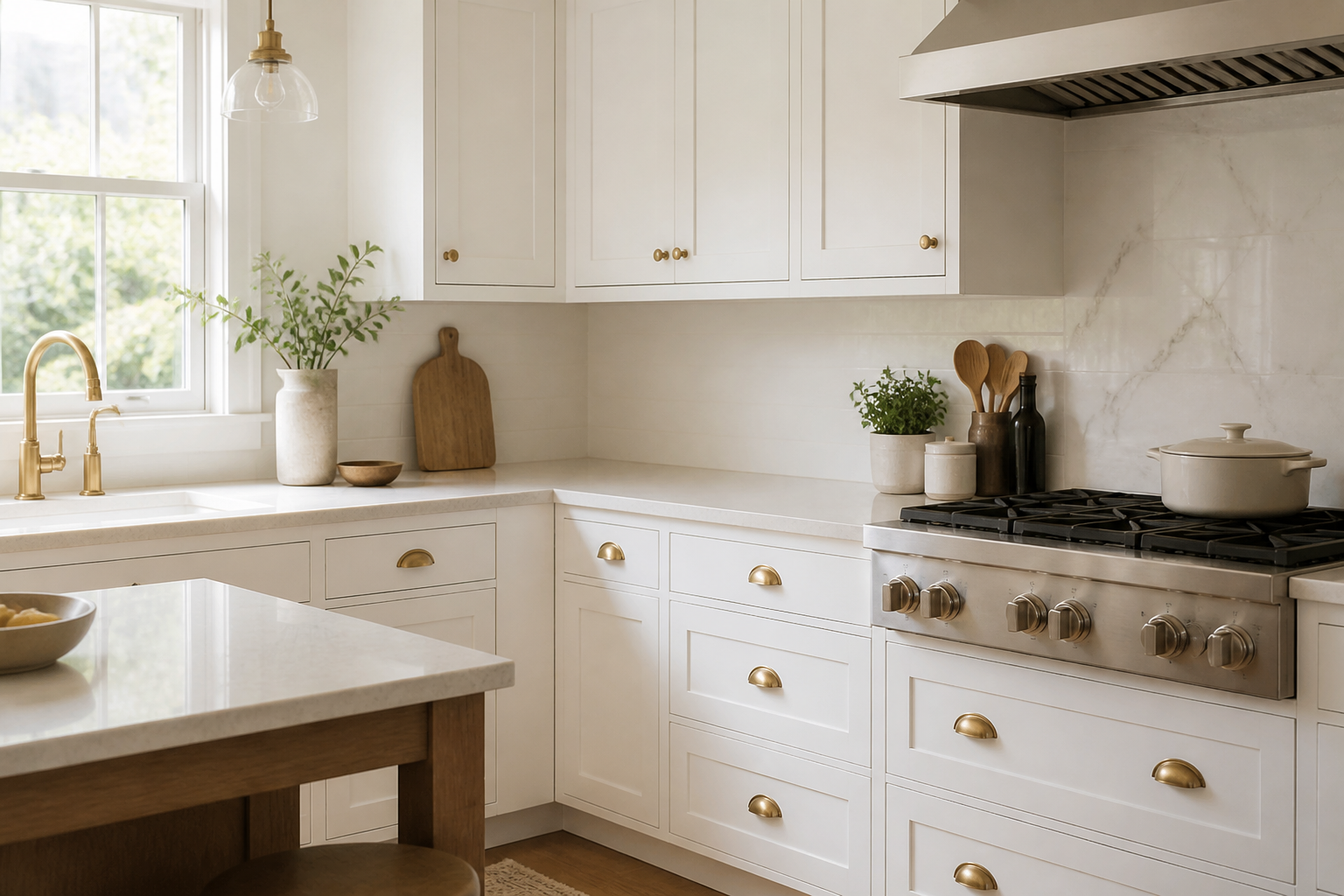
A white shaker kitchen with brass hardware: traditional bones, contemporary finish.
Shaker in a Traditional Kitchen
In a traditional kitchen, shaker doors do a lot of quiet work. They give you the classic, furniture-like look homeowners associate with a "real" kitchen without tipping into the heavier ornamentation of raised-panel or cathedral-arch doors, which some homeowners find harder to keep feeling current. Pair a shaker door with a warm wood stain, oil-rubbed bronze or antique brass hardware, and a furniture-style island leg detail, and you land squarely in classic traditional territory.
Framed construction (face-frame boxes rather than frameless) tends to pair especially well with shaker doors in this context, since the visible face frame reinforces the furniture-like, built-not-assembled feeling traditional kitchens go for. We cover the framed-versus-frameless decision in more depth in our framed vs frameless comparison, but the short version for a traditional kitchen is: framed shaker doors give you a slightly more substantial, classic silhouette, while shaker doors on frameless (full-access) cabinet boxes open up a bit more usable interior space per cabinet. Neither is wrong. It depends on whether you're optimizing for look or for storage capacity, and a design consultation is the fastest way to figure out which matters more for your specific kitchen.
Shaker in a Modern or Transitional Kitchen
The reason shaker survived the shift toward minimalist, handle-less kitchens is that it splits the difference between plain and detailed better than almost any other door style. A fully flat slab door (a single flat face, no frame or recessed panel) can feel cold or sterile to homeowners who still want some visual texture in their cabinetry. Shaker gives you that texture, the shadow line where the recessed panel meets the frame, without any of the ornamentation that reads as old-fashioned.
For a transitional kitchen, one option to consider is a narrower rail width (the flat frame around the recessed panel). Boxy, for example, lists a slim shaker door alongside its regular one; to many eyes a slim rail reads cleaner and more current than a wider one, though that is a matter of taste. Pair that narrower profile with a matte painted finish, either a soft warm white or a mid-tone like sage or greige, and slim integrated or bar-style pulls, and you get a kitchen that feels current without leaning on a short-lived trend. Keep three decisions separate while you plan: the door profile (shaker, slab and so on), how the door sits on the cabinet box (inset, set inside the face frame, or overlay, covering it — a shaker door can be either), and whether you use handles at all. How inset and overlay compare is covered in our inset vs overlay guide.
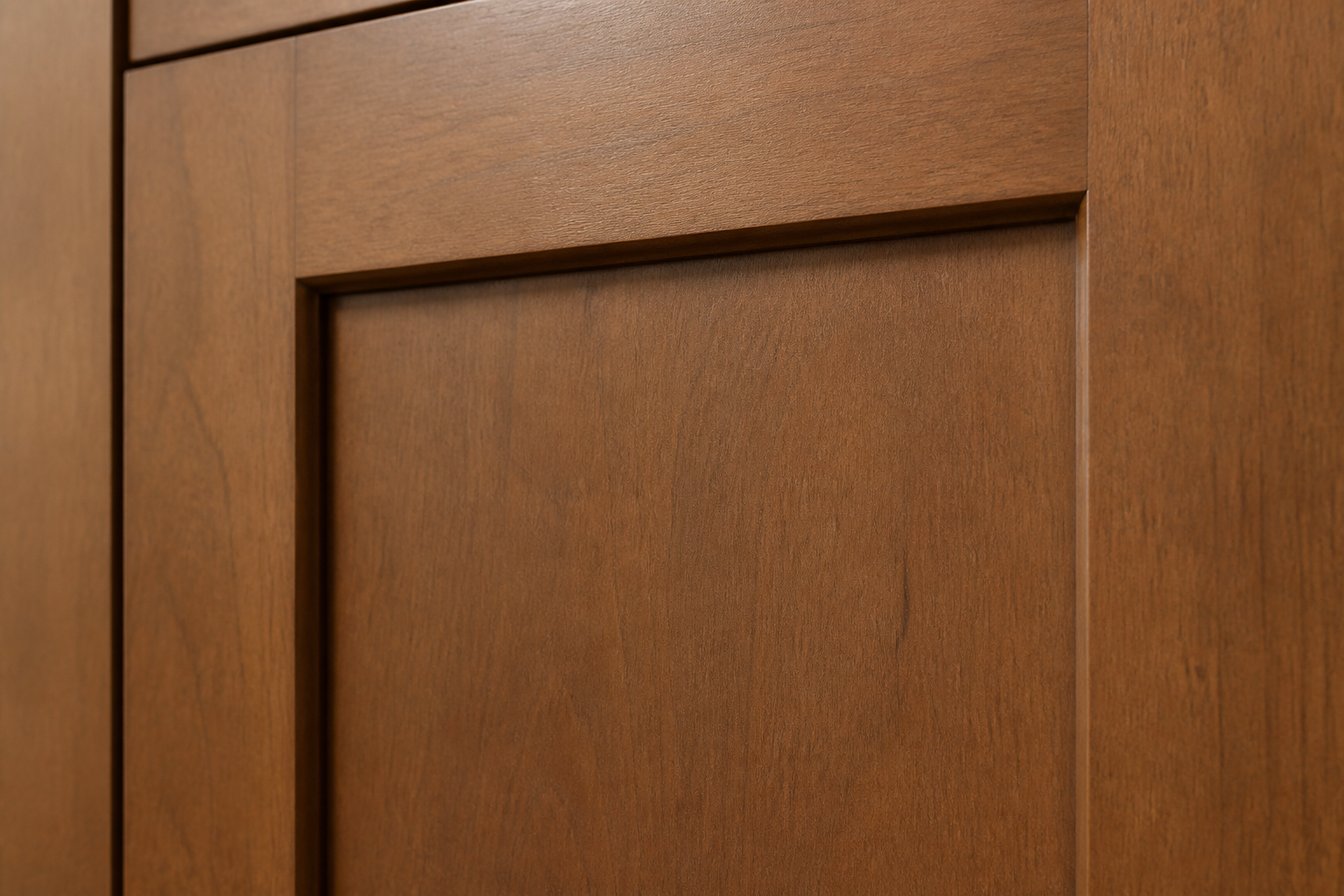
The recessed panel and flat rail: the detail that defines the shaker look.
Finish and Hardware Pairings That Work
Because a shaker door has so little ornamentation of its own, the finish and hardware you choose carry most of the visual weight. Here's how the common pairings tend to read:
- Warm wood stain + oil-rubbed bronze or antique brass pulls: classic, traditional, ages well in kitchens with natural stone counters and warm-toned floors.
- Matte white paint + polished or brushed brass pulls: reads bright and current without feeling trendy.
- Matte navy, forest, or charcoal paint on lower cabinets + white or light stone uppers: a two-tone approach that keeps a shaker kitchen from feeling monotone, especially useful in smaller kitchens where an all-dark palette can feel closed-in.
- Warm wood tone + matte black hardware: a transitional pairing that adds contrast without going fully modern.
- Painted greige or sage + brushed nickel: a quiet, understated combination that tends to suit older homes with more traditional architecture.
One thing worth knowing before you fall in love with a finish photo online: stain and paint colors read differently depending on your kitchen's actual lighting, cabinet orientation, and the undertones in your countertop and floor. A finish that looks perfect in a south-facing kitchen with warm oak floors can look flat or muddy in a north-facing kitchen with cool gray tile. Holding finishes up against your own counter and flooring samples, for example with the finishes on display at our San Jose showroom catches this kind of mismatch before it becomes an expensive surprise.
When Shaker Isn't the Right Call
Shaker's popularity doesn't mean it's automatically the right choice for every kitchen, and it is worth asking whether a different door style would serve you better. If you're going for a strictly ultra-modern, European-inspired look, a flat slab door with handle-less, push-to-open hardware will read more authentically minimal than shaker ever will. Shaker's recessed panel and visible frame add a small amount of visual texture, which works against a truly unbroken, monolithic look.
On the other end, if your home has strong period architecture, a Spanish colonial, a craftsman bungalow, or an ornate Victorian, a door style with more period-appropriate detailing (like a raised panel or a beadboard-style door) may fit the house's existing character better than shaker's relatively neutral profile. Shaker works almost everywhere, but "almost everywhere" isn't quite the same as "everywhere." And if budget is the deciding factor rather than style, it's worth knowing that shaker doors aren't necessarily the cheapest option across every manufacturer line. A basic slab door can be less expensive than a shaker door in the same line, so if cost is your primary driver, it's worth comparing actual line-item quotes rather than assuming shaker is the budget default. Our honest cost guide walks through the factors that move the number either way.
Seeing Shaker Doors in Person
Photos and renderings can get you most of the way to a decision, but the rest, how a finish actually catches light in your kitchen, how a rail width feels next to your existing trim, how a hardware finish looks against your specific counter, really does require seeing the physical door. Our showroom at 1350 Ridder Park Dr, Suite B in San Jose has door styles, finishes and hardware on display, so you can compare door profiles, finish tones and hardware pairings in person rather than guessing from a screen. The brands we represent are Shiloh, Eclipse, Bellmont, J&K and Boxy, plus our fully custom Excelle line; if you want to see a particular line or door, call ahead and ask what is on display.
We're open Monday through Saturday, 9 to 5; walk-ins are welcome, and booking a design consultation reserves a designer for your project. Bring measurements, a floor plan or photos, and a flooring or counter sample if you have one, so you can check things like rail width and how a stain reads against your own materials. If you're weighing shaker against other door and construction options for new kitchen cabinetry, our custom kitchen cabinets page is a good starting point, and our kitchen cabinetry page compares door styles, construction types, and finishes.
FAQ: Shaker Cabinets
What's the difference between shaker and slab cabinet doors?
A shaker door shows a flat frame of rails and stiles around a recessed center panel, giving it a visible shadow line and a small amount of texture; traditionally it is built as a five-piece frame-and-panel door. A slab door presents a single flat face with no frame or recess. Shaker reads as slightly more traditional and textured; slab reads as sleeker and more minimal.
Are shaker cabinets more expensive than other door styles?
Not necessarily. Shaker is widely offered across price tiers, from premade manufacturer lines to custom work. In some lines a basic slab door costs less than a shaker door, so cost comparisons should be based on actual quotes rather than assumptions about which style is "the budget option."
Does shaker style work in a small kitchen?
Yes. Shaker's clean lines and lack of heavy ornamentation make it well suited to small kitchens, especially in lighter paint finishes that keep the space feeling open. A two-tone approach, darker lowers with lighter uppers, can also help a small shaker kitchen avoid feeling flat or monotone.
What hardware pairs best with shaker cabinets?
It depends on the finish. Warm wood stains pair well with oil-rubbed bronze or antique brass. Matte white paint pairs well with brushed or polished brass. Matte black hardware works well with both warm wood tones and painted finishes for a more transitional look. Seeing samples in person against your actual counters and flooring is the most reliable way to choose.
How long do shaker cabinets typically last?
Lifespan depends far more on box construction, finish quality, and care than on door style. What shaker adds is style longevity: because it isn't tied to one design trend, homeowners can refresh a shaker kitchen with new hardware or a new paint color instead of replacing the doors.
About the author
Anthony
Design Lead, Excelle Kitchen & Bath
Leads cabinetry and storage design at Excelle Kitchen & Bath, a design studio with a San Jose showroom serving the Bay Area. Ten years of kitchen and custom storage projects, specialising in space planning, semi-custom cabinetry specification, and closet systems.