


Custom vs. Semi-Custom vs. IKEA Cabinets in the Bay Area
How the three cabinet tiers differ, sourced price ranges and warranties, when each one fits, and how mixing tiers can put the budget where the room needs it.
Pick your tier by measuring your walls, not your ambition. If standard box sizes fit your runs with little filler, your layout is simple and you are comfortable assembling or hiring assembly, flat-pack (IKEA and other ready-to-assemble lines) is a legitimate choice. If the room needs sizes, depths, finishes or interior fittings a flat-pack system does not make, semi-custom is often the better value. Reserve full custom for geometry and details no catalog can produce.
That is the decision in brief. The rest of this guide is about telling which description fits your kitchen, because the argument about whether custom cabinets are "worth it" usually pits someone who loved their custom kitchen against someone whose flat-pack kitchen still looks good years later. Both can be right about different rooms.
The three tiers in plain terms
Stock and flat-pack. Factory boxes in fixed sizes. You fit your layout to the boxes and close gaps with filler panels. Stock cabinets are a matter of sizing: many arrive already assembled. Flat-pack, or ready-to-assemble (RTA), cabinets such as IKEA's ship in pieces, so you assemble them or pay for assembly. This is usually the least expensive tier. HomeAdvisor's June 2026 cost guide puts stock cabinets at $100 to $300 per linear foot installed.
Semi-custom. Factory-built to order from a structured catalog of sizes, door styles, finishes and interior fittings, with modifications such as changed depths or heights. HomeAdvisor puts semi-custom at $150 to $650 per linear foot installed.
Full custom. Built to the dimensions and details your room and storage demand, with the widest choice of sizes, species and finishes a given maker offers. HomeAdvisor puts custom at $500 to $1,200 per linear foot installed, the highest of the three ranges.
For the full cost picture, including what moves a price inside each tier and how to read a quote, see our Bay Area cabinet cost guide. This post is about which tier your room is asking for.
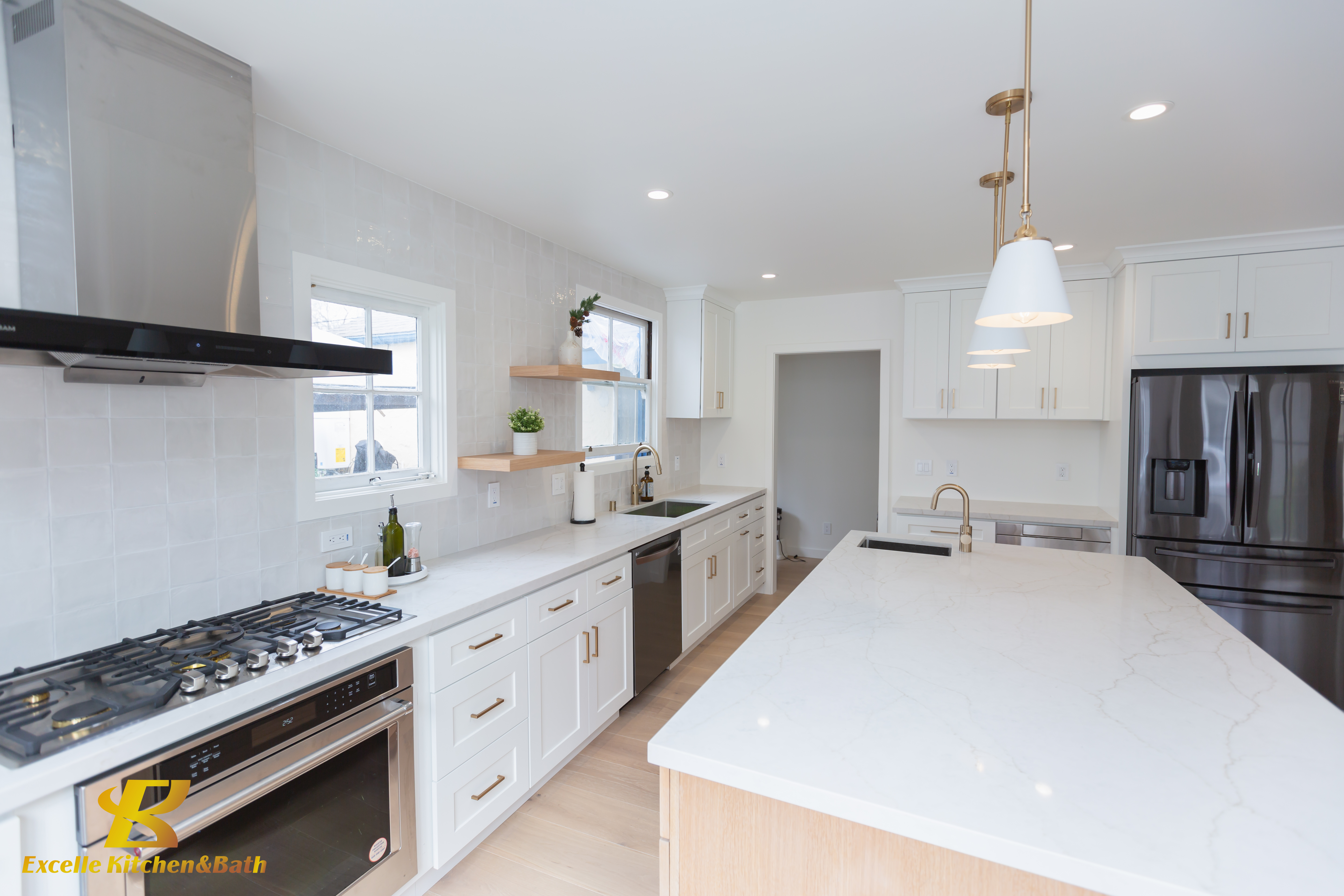
The tiers differ less than their labels suggest
A common assumption in tier arguments is that price tracks quality in a straight line. Published specifications show it does not. Features often associated with the premium end appear as standard in semi-custom and even value lines:
- Plywood boxes: J&K, a value line, specifies 1/2" to 5/8" plywood boxes as standard; Boxy's 3000 Series catalog specifies 3/4" eucalyptus plywood boxes; Shiloh uses plywood sides, tops and bottoms.
- Dovetail drawers and soft-close hardware: J&K's spec book lists dovetail drawers, soft-close hinges and soft-close drawer glides; Shiloh lists a hardwood dovetail drawer box and Blum soft-close guides and hinges as standard; Boxy's 3000 Series catalog lists solid birch dovetail drawer boxes, soft-close hinges and soft-close drawer slides. There are exceptions: Shiloh notes its 3/8" partial-inset doors use a knife hinge that does not soft-close, and Boxy's catalog marks at least one lazy-Susan corner cabinet "soft close not available." Check the specific cabinets on your plan.
- Long warranties outside custom shops: IKEA's SEKTION kitchen system carries a 25-year limited warranty; Shiloh and Eclipse 10 years; Bellmont a limited lifetime warranty on three of its four series.
What still separates the tiers is dimensional freedom: how closely the cabinetry can follow your particular walls, ceiling and storage list. That is a property of your room, not of your taste, which is why measuring comes first.
When flat-pack is the right call
- Rentals and flips, where the next owner or tenant will judge the kitchen on looks and function rather than the box.
- Standard layouts: straight walls, a simple L or galley, and box sizes that fit with minimal filler.
- Tight budgets with time to assemble. Money saved can go to counters and appliances.
The caveats are specific. You work within fixed sizes, so an awkward wall means filler. Read the warranty's coverage list: IKEA's SEKTION warranty, for example, covers frames, fronts, hinges and drawers for 25 years but excludes knobs and handles, and puts some wire baskets and electrical push-openers on shorter terms. And a discontinued front can make matching a damaged door harder years later, a risk that applies to any catalog line.
When semi-custom earns its premium
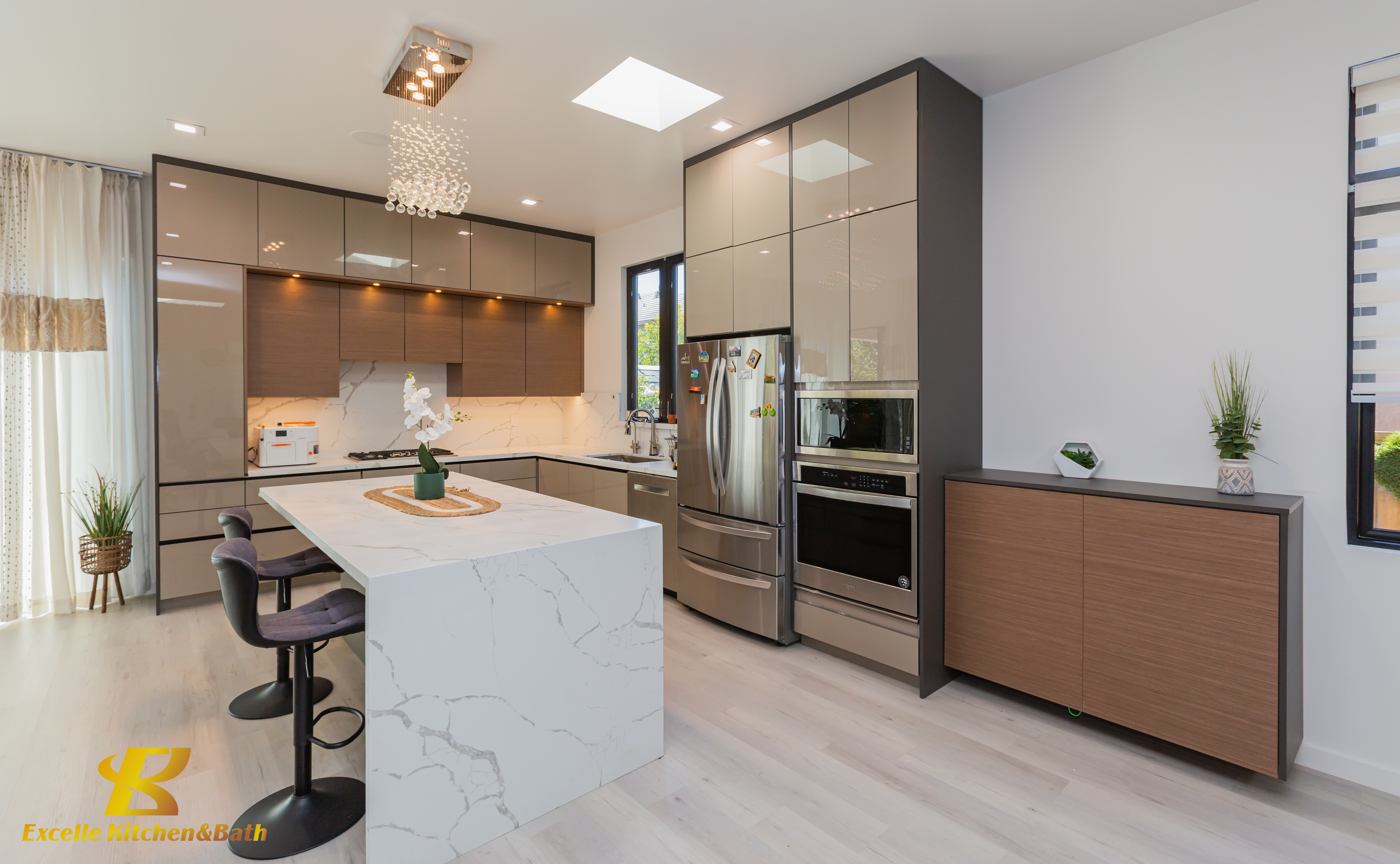
Semi-custom makes sense when the room needs something a fixed catalog does not make:
- Out-of-square or odd-sized walls, where modified widths and depths reduce filler.
- Tall ceilings, where taller wall cabinets or stacked uppers turn dead air into storage.
- A specific finish or door: Shiloh matches nearly any Sherwin-Williams color; Bellmont's 1900 Series offers any Sherwin-Williams, Benjamin Moore or Farrow & Ball color and more than 40 door styles.
- Framed construction or inset doors. IKEA's kitchen system is frameless (Main Line Kitchen Design's brand list files it as such), so a face-frame look or a framed inset door means a different line.
- A dealer-backed order, where one party measures, specifies and handles claims through the manufacturer.
A practical test: if your walls would need several inches of filler across the kitchen, or you want uppers running to a tall ceiling, you have probably left flat-pack territory. Before assuming you need full custom for a particular storage idea, such as a mixer lift, a spice pull-out or a charging drawer, check whether a semi-custom line's accessory catalog already has it.
When full custom is worth it
- Unusual spaces: angled or curved walls, a structural column mid-run, a sloped ceiling, a narrow alcove.
- Matching existing millwork in an older home.
- Specific species, grain matching or furniture-grade details a catalog cannot produce.
- Built-ins that continue beyond the kitchen, where cabinetry becomes part of the architecture.
- A finish or proportion that must run unbroken across a kitchen and adjoining rooms.
If none of those describe your project, much of a full-custom quote buys flexibility you will not use.
Mixing tiers in one kitchen
A kitchen does not have to be one tier. A common approach is a manufacturer line for the standard runs and custom pieces only where the room demands them: the angled peninsula, the tricky corner, the appliance nook, or a furniture-style island. That keeps the premium where it solves a real problem. Excelle Kitchen & Bath works this way: it represents Shiloh, Eclipse, Bellmont, J&K and Boxy for premade runs, and its own Excelle custom line is built to exact dimensions for odd-sized and non-standard spaces.
Three planning mistakes that cost more than the wrong tier
- Stopping the uppers short of the ceiling. The space above standard wall cabinets is storage you have already paid for in square footage; adding it later means matching a finish years apart.
- Doors where drawers belong. Base cabinets with doors mean kneeling and reaching to the back; drawer bases bring the contents out to you. Price both when you plan the lowers.
- Rushing the layout. A kitchen designed around a sale deadline keeps its awkward corner long after the discount is forgotten.
All three are design failures, not product failures; the tier only decides how expensive the mistake is. That is why a layout should be planned before any product is chosen; see how to plan a kitchen layout, and the same thinking applies to closets and storage.
Your next step
Take a tape measure to your longest cabinet run and write down the wall-to-wall dimension, the ceiling height, and anything in the way: windows, columns, soffits, a radiator. Note the storage you know you need. Then bring those numbers and a photo of the room to the San Jose showroom at 1350 Ridder Park Dr, Suite B (Monday to Saturday, 9:00 AM to 5:00 PM), or book a design consultation. A designer can tell you which tier each part of the room needs, and the brand comparison shows how the lines differ.
FAQ: Custom, semi-custom and IKEA cabinets
Are custom cabinets worth it for resale?
No one can promise a resale return for a particular cabinet tier. What a kitchen adds at sale depends on the whole project, its cost, the local market and the rest of the house, so cabinet tier alone doesn't predict it. Choose the tier for what the room needs and how long you plan to use it.
What warranty do IKEA kitchen cabinets have?
IKEA's SEKTION kitchen system carries a 25-year limited warranty from the date of purchase, covering frames, fronts, hinges, drawers and several other parts for residential use. Knobs and handles are not covered, and some components have shorter terms.
What does semi-custom mean?
Factory-built cabinets ordered to your specification from a structured catalog: you choose sizes, depths, door styles, finishes and interior fittings, and the factory builds your order. It sits between stock (fixed sizes) and custom (anything, built from scratch).
Can I mix tiers in one kitchen?
Yes. A common approach is manufacturer boxes for the main runs and custom pieces only where the space demands them.
Is semi-custom always better built than flat-pack?
Not automatically. Compare published specifications rather than labels: box material, drawer construction, hinges and slides, and warranty terms. Some value and flat-pack systems publish strong specs and long warranties.
How do I tell whether a supplier is really selling custom?
Ask what happens if you need a cabinet half an inch narrower than the catalog width. A custom maker should be able to build it; a semi-custom line will tell you what modification, if any, it can make; a stock line will typically offer a filler. All three answers are legitimate, but only the first matches the word "custom" on a quote.
Is custom always more expensive than premade?
For equivalent scope it is usually higher, because each piece is built to order rather than drawn from a standard system. HomeAdvisor's national ranges put custom at $500 to $1,200 per linear foot installed against $150 to $650 for semi-custom.
About the author
Anthony
Design Lead, Excelle Kitchen & Bath
Leads cabinetry and storage design at Excelle Kitchen & Bath, a design studio with a San Jose showroom serving the Bay Area. Ten years of kitchen and custom storage projects, specialising in space planning, semi-custom cabinetry specification, and closet systems.